
 África
 Asia
Asia Europa
 América do Sur
 Australia e Oceanía
 Antártida
 Océano Pacífico
 Océano Atlántico
 Océano Índico
 Océano Glacial Ártico
 Mar Mediterráneo
 Mar Vermello
 Mar Caribe
 Mar do Coral
 Mar da China Meridional
 Mar de Filipinas
 Mar de Andamán
 Mar do Norte
 Mar de Timor e de Arafura
 Golfo de Bengala
 Golfo de California
Valentin's sharpnose puffer
 Velenoso se se come
Valentin's sharpnose puffer is a small reef fish with four black stripes across its back. It lives in warm seas across the Indian Ocean, the Red Sea and parts of the Pacific. It is special because its skin holds one of the most potent natural poisons known, which keeps most predators away.1



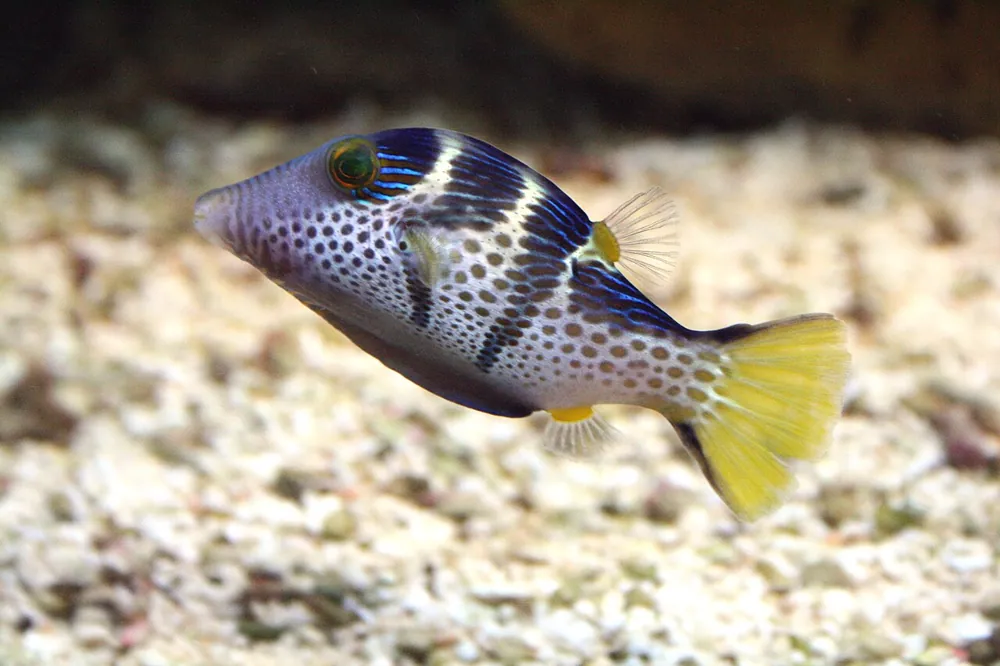

 Como recoñecelo
- Four distinct black stripes, called saddles, run across its back.1
- The head is blue-grey.1
- The main body is white, speckled with blue-grey spots.1
- The tail and fins show hints of yellow, and a rainbow streak sits behind the eyes.1
Adoita confundirse con: The filefish Paraluteres prionurus has similar colours and sometimes swims in schools with this puffer. It mimics the puffer's appearance for protection, but it is not toxic.1
Poder do veleno
Só é perigoso se algo o come.
Que fai o seu veleno?
Its skin and other tissues contain tetrodotoxin, a neurotoxin, which attacks the nerves. It is one of the most potent naturally occurring toxins and is lethal to many species of fish. This makes the fish unpalatable to predators.1
Que perigoso é para as persoas?
Perigo para as persoas: GraveSe alguén o come, hai que ir ao médico. As mortes son moi raras.It is highly poisonous to eat.1
Que fai cando ten medo?
It gulps water to puff its body up to three or four times its normal volume, and its toxic skin deters predators.1
 Se alguén o tocou ou o comeu
- Se alguén o comeu ou ten síntomas despois de comelo: chama de inmediato ao teu número de emerxencias ou ao centro de toxicoloxía.
Chama sempre primeiro ao teu número de emerxencias (112, 000, 911). Isto son consellos xerais de primeiros auxilios, non consello médico. Primeiros auxilios básicos
 Mantente a salvo
- Nunca toques, collas nin molestes un animal salvaxe, aínda que sexa pequeno e aínda que pareza durmido ou morto.
- Déixalle espazo. Se atopas un, mantén a calma, recúa amodo e déixao ir polo seu camiño.
- Se o tocaches ou o comiches: non esfregues os ollos nin a boca, lava as mans e busca axuda médica.
Non vai a por ti. O seu veleno só está aí para que ninguén o coma. Máis sobre como estar a salvo
En que lugar do mundo?
Que tamaño ten?
Canto mide?
 mide coma 3 pezas de construción de xoguete en fila
 podería nadar o longo dunha piscina grande (50 m) en 45 segundos
Que tamaño ten Valentin's sharpnose puffer comparado CONTIGO?
Só son contas no teu navegador. Non se garda nin se envía nada a ningures.
Que rápido é?
Datos
Its tetrodotoxin is one of the most potent naturally occurring toxins, and it is lethal to many fish.1
A non-toxic filefish, Paraluteres prionurus, has evolved to look like this puffer, which helps it avoid predators.1
Its eggs are unpalatable, so predatory fish rarely eat them, and any swallowed eggs are quickly passed out again. This means the parents need not guard them.1
Juveniles of the grouper Plectropomus laevis also mimic its colours.1
Its eggs, at 0.68 to 0.72 mm across, are among the smallest in the puffer family Tetraodontidae.1
Desmontamitos
Mito: Pufferfish hold their breath while they puff up.
Verdade: A 2014 study found that oxygen consumption actually increases while the fish is inflated. Oxygen intake through the gills is almost five times higher than normal.1
Para expertos en pezoñas
- Nome científico
- Canthigaster valentini
- Grupo
- Outros animais velenosos
- Familia
- Tetraodontidae2
- Orde
- Tetraodontiformes
- Continentes
- Océano Pacífico, Océano Índico, Mar Vermello, Mar do Coral, Mar de Filipinas, Mar da China Meridional, Mar de Timor e de Arafura, Os océanos
- Crías
- Females lay anywhere between fifteen and over 800 eggs at a time, every four to ten days depending on the season.1
- Perigo para as persoas
- 3 / 5: Grave3
De onde veñen os datos
- Valentin's sharpnose puffer (Wikipedia (CC BY-SA 4.0))
- Canthigaster valentini (iNaturalist): nomes e clasificación.
- Venom Wiki: o nivel de perigo, o tamaño típico e a velocidade estimada son nosos. Mira como os calculamos: Como valoramos o perigo.
Cada dato desta páxina ten un número que leva á súa fonte. Se nos equivocamos nalgo, sentímolo, somos fans dos animais, non unha revista científica. Dínolo en [email protected] e arranxarémolo.
 O escorpión ten fame! Venom Wiki é un proxecto dunha soa persoa: gratis, sen anuncios e sen rastrexadores. Unha pequena propina axuda a mantelo en liña.Dálle de comer ao escorpión
Máis do mesmo grupo: Outros animais velenosos
 Japanese pufferfishOutros animais velenososMortal
 Hawksbill sea turtleOutros animais velenososPode matar
 Greenland sharkOutros animais velenososSó doe
 Silver-cheeked toadfishOutros animais velenososMortal
 Blackspotted pufferOutros animais velenososPode matar
 White-spotted pufferOutros animais velenososPode matar
Tamén vive en: Océano Pacífico
 Australian box jellyfishMedusas e outros picadores do marMortalNon tocar
 Geography coneCaracois cono e polbosMortal
 Greater blue-ringed octopusCaracois cono e polbosMortal
 Southern blue-ringed octopusCaracois cono e polbosMortal
 Irukandji jellyfishMedusas e outros picadores do marPode matarNon tocar
 Reef stonefishPeixes pezoñentosPode matarNon tocar