
 África
 Asia
Asia Europa
 América do Sur
 Australia e Oceanía
 Antártida
 Océano Pacífico
 Océano Atlántico
 Océano Índico
 Océano Glacial Ártico
 Mar Mediterráneo
 Mar Vermello
 Mar Caribe
 Mar do Coral
 Mar da China Meridional
 Mar de Filipinas
 Mar de Andamán
 Mar do Norte
 Mar de Timor e de Arafura
 Golfo de Bengala
 Golfo de California
Venezuelan suntiger
 Morde
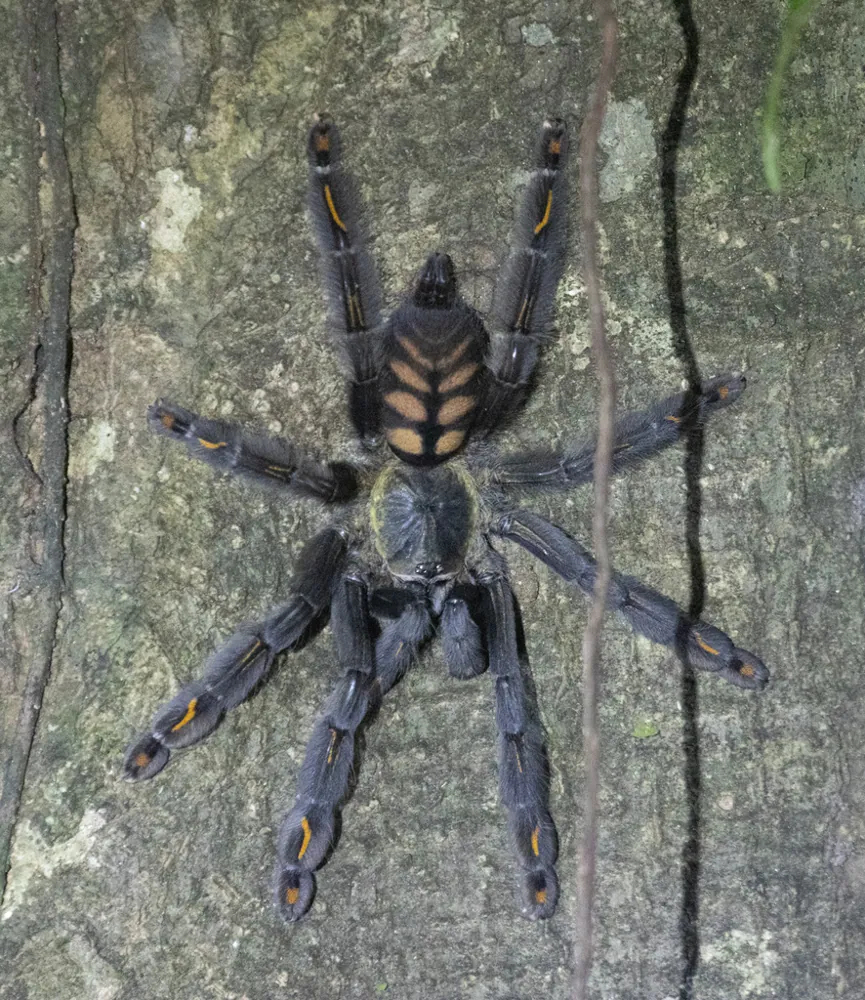
MordeThe Venezuelan suntiger is a tarantula that lives in the forests of northern South America. It spends much of its life in holes and crevices above ground, and it is a popular pet in the exotic pet trade. Its striking black and orange colours are the main reason it is so well known.1

 Como recoñecelo
- Black, with vibrant orange markings on the abdomen and legs.1
- Adults of both sexes have orange 'flame' markings on the legs, and the abdomen has a chevron pattern.1
- Once mature, the male turns entirely grey or grey-brown, keeping orange only on the tarsi (the last leg segments).1
- Mature males have much 'leggier' proportions than females.1
- Spiderlings are orange-red on the carapace (the upper body shell), with black legs and a black abdomen. They gradually gain adult colours with each moult.1
Poder da pezoña
A pezoña sae polos seus cairos ou dentes cando morde.
Que perigoso é para as persoas?
Perigo para as persoas: DolorosoPode doer moito, pero case nunca é grave.Que fai cando ten medo?
When threatened, it may flee into its retreat or raise its front legs and show its fangs in a threat posture. If it cannot escape, it bites. It does not throw urticating hairs, unlike most New World tarantulas.1
 Se morde
- Lava a mordedura e arrefríaa. Busca axuda médica se a dor é forte ou a persoa se sente mal.
Chama sempre primeiro ao teu número de emerxencias (112, 000, 911). Isto son consellos xerais de primeiros auxilios, non consello médico. Primeiros auxilios básicos
 Mantente a salvo
- Nunca toques, collas nin molestes un animal salvaxe, aínda que sexa pequeno e aínda que pareza durmido ou morto.
- Déixalle espazo. Se atopas un, mantén a calma, recúa amodo e déixao ir polo seu camiño.
- Se un te morde: mantén a calma, non te movas, chama ao teu número de emerxencias (112, 000, 911) ou vai rápido a un hospital. Lembra como era, unha foto axuda.
Non vai a por ti. Usa a súa pezoña para cazar comida ou para defenderse, e prefire con moito agocharse. Máis sobre como estar a salvo
En que lugar do mundo?
Que tamaño ten?
Canto mide?
 mide coma 4 pezas de construción de xoguete en fila
 podería percorrer 100 metros en 210 segundos (o humano máis rápido precisa 9,6)
Que tamaño ten Venezuelan suntiger comparado CONTIGO?
Só son contas no teu navegador. Non se garda nin se envía nada a ningures.
Que rápido é?


Datos
Adult males change colour dramatically after their final moult, turning from black with orange to mostly grey.1
The undersides of its tarsi and metatarsi are iridescent, and they are visible during its threat display, which probably helps the display work.1
Psalmopoeus species lack the urticating hairs that most New World tarantulas use to defend themselves.1
Mature males spin special sperm webs, onto which they deposit sperm and then store it in their palpal bulbs (copulatory organs) ready for mating.1
The species is classed as a Psalmopoeus because it has stridulatory setae, also called a lyra, on its maxillae. No other described New World species has this trait.1
De onde veñen os datos
- Psalmopoeus irminia (Wikipedia (CC BY-SA 4.0))
- Psalmopoeus irminia (iNaturalist): nomes e clasificación.
- Venom Wiki: o nivel de perigo, o tamaño típico e a velocidade estimada son nosos. Mira como os calculamos: Como valoramos o perigo.
Cada dato desta páxina ten un número que leva á súa fonte. Se nos equivocamos nalgo, sentímolo, somos fans dos animais, non unha revista científica. Dínolo en [email protected] e arranxarémolo.
 O escorpión ten fame! Venom Wiki é un proxecto dunha soa persoa: gratis, sen anuncios e sen rastrexadores. Unha pequena propina axuda a mantelo en liña.Dálle de comer ao escorpión
Máis do mesmo grupo: Tarántulas e arañas de tea en funil
 Goliath birdeaterTarántulas e arañas de tea en funilSó doe
 Brazilian salmon pink birdeaterTarántulas e arañas de tea en funilInofensivo
 Chilean rose tarantulaTarántulas e arañas de tea en funilInofensivo
 Greenbottle blue tarantulaTarántulas e arañas de tea en funilInofensivo
 Pinktoe tarantulaTarántulas e arañas de tea en funilInofensivo
 Brazilian funnel-web spiderTarántulas e arañas de tea en funilPrecisa un médico
 Golden poison frog
 Terciopelo
 Brazilian wandering spider
 Eyelash viper
 Golden lancehead
 South American bushmaster