
 Afirka
 Asiya
Asiya Turai
Turai Kudancin Amurka
 Ostareliya da Oceania
 Antatika
 Tekun Pasifik
 Tekun Atlantika
 Tekun Indiya
 Tekun Arctic
 Bahar Rum
 Bahar Maliya
 Tekun Caribbean
 Tekun Coral
 Tekun Kudancin China
 Tekun Philippines
 Tekun Andaman
 Tekun Arewa
 Tekun Timor da Arafura
 Gaɓar Tekun Bengal
 Gaɓar Tekun California
Chinese cobra
 Cizo
CizoThe Chinese cobra is a venomous snake from southern China and a few neighbouring countries and islands. It is one of the most common venomous snakes in China, and it has caused many snakebites there.1
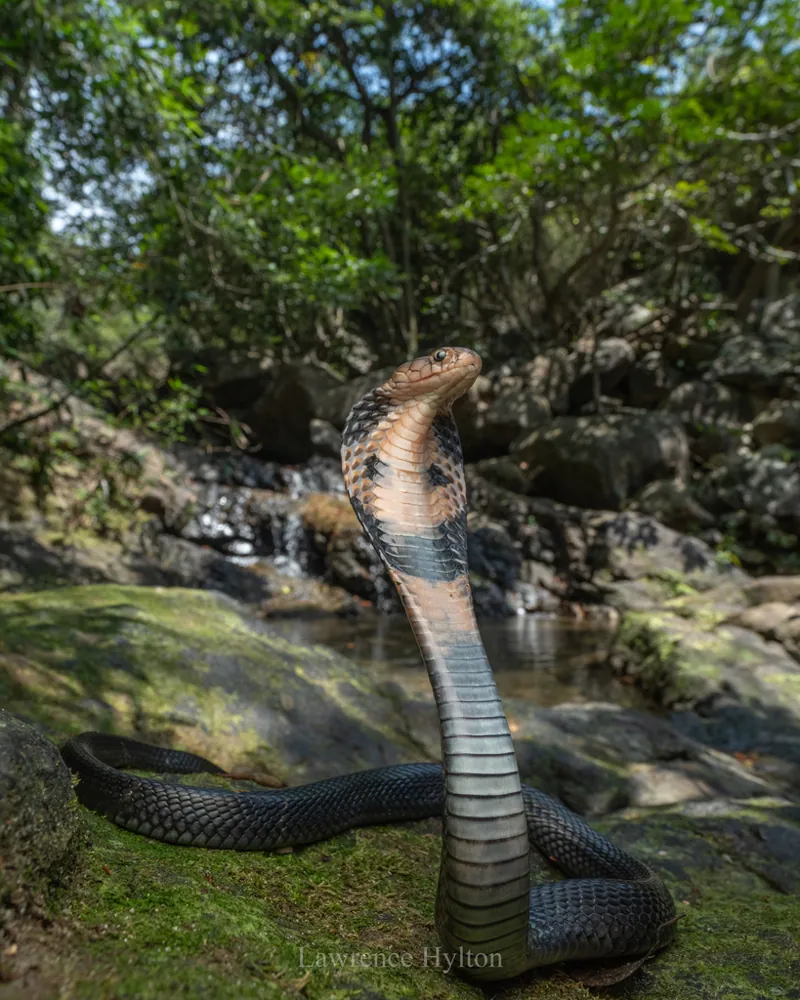
 Yadda za ka gane shi
- The hood marking varies. It can look like spectacles, a mask, a horseshoe or the letter O, and it is often linked to a pale throat area on at least one side.1
- The body is iridescent black, with widely spaced yellow double lines running across it.1
- The underside is pearl or slate-coloured. The upper colour is usually brown, grey or black, sometimes with narrow pale lines, which are especially clear in young snakes.1
- Typical adults are 1.2 to 1.5 metres long.1
Ana yawan rikita shi da: It is sometimes confused with the monocled cobra (Naja kaouthia). The Chinese cobra has lower counts of ventral and subcaudal scales, which are the belly and tail scales. Sex should be taken into account when comparing these counts.1
Ƙarfin dafi
Dafi yana fitowa ta haƙoransa na dafi ko haƙoransa idan ya ciza.
Me dafinsa yake yi?
The Chinese cobra is a highly venomous member of the true cobras. Local symptoms at the bite include darkening of the wound, redness, swelling, pain and numbness, and blisters and necrosis (death of tissue) almost always follow. Necrosis can last for years after the person has otherwise recovered. Whole-body symptoms can include chest discomfort, fever, sore throat, difficulty swallowing, loss of voice, weak limbs, unsteady walking, lockjaw and difficulty breathing.1
Yaya haɗarinsa yake ga mutane?
Haɗari ga mutane: Mai haɗari sosaiYana iya kashe mutumin da bai samu magani ba.It is one of the most common venomous snakes in China and has caused many snakebite incidents there. Deaths occasionally occur, but they are much rarer than they used to be.1
 Labari mai daɗi: likitoci suna da magani (antivenom) ko jinya don wannan.1
Me yake yi idan ya ji tsoro?
Adults can be aggressive, and young snakes are more nervous and more likely to be aggressive, but it usually escapes to avoid a confrontation.1
 Idan ya ciji
- Ka sa mutumin ya zauna ba motsi kuma ya natsu, ka cire zobba da abubuwa masu matsi, kuma ku je asibiti da sauri: maganin dafi (antivenom) shi ne magani.
- Idan an tofa dafi cikin idanu, ka wanke su da ruwa mai tsabta mai yawa nan take.
Kullum ka fara kiran lambar gaggawa (112, 000, 911). Wannan jagorar agajin gaggawa ce ta gaba ɗaya, ba shawarar likita ba. Muhimman abubuwan agajin gaggawa
 Kiyaye lafiya
- Kada ka taɓa, kada ka kama, kada ka tsokani dabbar daji, ko da ƙarama ce, kuma ko da tana kama da tana barci ko ta mutu.
- Ka ba shi sarari. Idan ka haɗu da ɗaya, ka natsu, ka koma baya a hankali kuma ka bar shi ya bi hanyarsa.
- Idan ɗaya ya ciji ka: ka natsu, ka zauna ba motsi, ka kira lambar gaggawarka (112, 000, 911) ko ka je asibiti da sauri. Ka tuna yadda yake, hoto yana taimakawa.
Ba ya neman cutar da kai. Yana amfani da dafinsa don kama abinci ko don kare kansa, kuma ya fi son ya ɓuya. Ƙarin bayani game da kiyaye lafiya
Yaya girmansa yake?
Yaya tsawonsa yake?
 tsawon kyanwoyin gida 4 daga hanci zuwa wutsiya
 tsawon ayaba 11 a jere
 zai iya gudun mita 100 cikin daƙiƙa 48 (mutum mafi sauri yana buƙatar 9,6)
Yaya girman Chinese cobra yake idan aka kwatanta da KAI?
Lissafi ne kawai a cikin burauzarka. Ba a adana komai ko a aika ko'ina.
Yaya saurinsa yake?


Bayanai
Necrosis from a bite can continue for many years after the victim has recovered in general.1
A snake kept at a snake farm gave an average venom yield of about 250.8 mg, of which about 80 mg was dry weight.1
Its fangs are always erect and sit at the front of the upper jaw, as in other elapid snakes.1
Inda bayanan suka fito
- Chinese cobra (Wikipedia (CC BY-SA 4.0))
- Naja atra (iNaturalist): sunaye da rarrabuwa.
- Venom Wiki: matakin haɗari, girman al'ada da ƙiyasin sauri namu ne. Ga yadda muke lissafa su: Yadda muke auna haɗari.
Kowane bayani a wannan shafi yana da lamba da ke nuna tushensa. Idan mun yi kuskure, ka yi haƙuri, mu masoya dabbobi ne, ba mujallar kimiyya ba. Ka gaya mana a [email protected] kuma za mu gyara.
 Kunama tana jin yunwa! Venom Wiki aikin mutum ɗaya ne: kyauta, ba talla kuma ba masu bin diddigi. Ɗan ƙaramin kyauta yana taimakawa wajen ci gaba da kasancewarsa a intanet.Ciyar da kunama
 Indian cobra
 King cobra
 Caspian cobra
 Common krait
 Malayan krait
 Many-banded krait
 Deathstalker
 Indian saw-scaled viper
 Puff adder
 Kububuwar Russell
 Asian giant hornet
 Komodo dragon