
 Afirka
 Asiya
Asiya Turai
Turai Kudancin Amurka
 Ostareliya da Oceania
 Antatika
 Tekun Pasifik
 Tekun Atlantika
 Tekun Indiya
 Tekun Arctic
 Bahar Rum
 Bahar Maliya
 Tekun Caribbean
 Tekun Coral
 Tekun Kudancin China
 Tekun Philippines
 Tekun Andaman
 Tekun Arewa
 Tekun Timor da Arafura
 Gaɓar Tekun Bengal
 Gaɓar Tekun California
Golfodulcean poison frog
 Guba a fatarsa
The Golfodulcean poison frog is a small, brightly marked frog that lives only in Costa Rica. Its skin contains a strong nerve poison, so it is one of the most toxic frogs in its genus, and it is a reminder that bright colours can be a warning. It lives in wet forests near streams.1

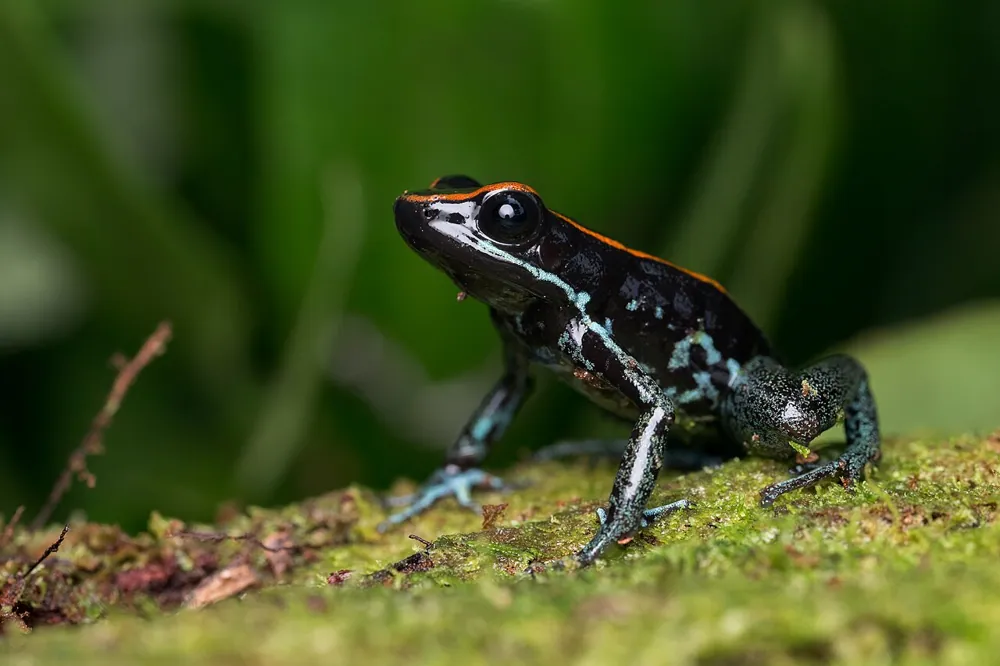
 Yadda za ka gane shi
- The body is black, but it can look glittery because of pigments in the skin.1
- Two stripes run down the back from just above the vent to the tip of the nose. They are usually fire orange, but can be golden, yellow or green.1
- The legs are mottled blue, and the sides often have a blue or green marble pattern.1
- It is a fairly large poison frog for its genus, with a smooth, sloping back. Its shoulder blades are usually hidden under the skin, so it can look a little plump.1
- Females are typically larger than males. Adults reach about 3.5 cm long.1
Ana yawan rikita shi da: The related P. bicolor and P. terribilis have visible shoulder blades under the skin, which the Golfodulcean poison frog usually lacks, so it looks smoother and rounder.1
Ƙarfin guba
Fatarsa tana da guba. Yana da haɗari a taɓa shi, a lasa shi ko a ci shi.
Me gubarsa take yi?
Its skin contains batrachotoxin, a neurotoxic alkaloid poison, which attacks the nerves. A large enough dose causes severe pain, then tonic-clonic seizures (violent convulsions) and paralysis.1
Yaya haɗarinsa yake ga mutane?
Haɗari ga mutane: Mai raɗaɗiYana iya yin ciwo sosai, amma kusan bai taɓa zama mai tsanani ba.It is highly toxic, though it is only the fourth most toxic species in the genus Phyllobates. The poison is in the skin, so the risk comes from handling the frog or getting the poison from its skin into the body.1
Me yake yi idan ya ji tsoro?
Its bright, multi-coloured body advertises its toxin as a warning to predators.1
 Idan wani ya taɓa shi ko ya ci shi
- Idan wani ya taɓa ɗaya: a wanke hannaye sosai kuma kada a taɓa idanu ko baki. Idan yaro ko dabbar gida ya lasa ko ya ci ɗaya: ka kira cibiyar guba ko lambar gaggawa.
Kullum ka fara kiran lambar gaggawa (112, 000, 911). Wannan jagorar agajin gaggawa ce ta gaba ɗaya, ba shawarar likita ba. Muhimman abubuwan agajin gaggawa
 Kiyaye lafiya
- Kada ka taɓa, kada ka kama, kada ka tsokani dabbar daji, ko da ƙarama ce, kuma ko da tana kama da tana barci ko ta mutu.
- Ka ba shi sarari. Idan ka haɗu da ɗaya, ka natsu, ka koma baya a hankali kuma ka bar shi ya bi hanyarsa.
- Idan ka taɓa shi ko ka ci shi: kada ka goge idanunka ko bakinka, ka wanke hannayenka kuma ka nemi taimakon likita.
Ba ya neman cutar da kai. Gubarsa tana nan ne kawai don kada wani abu ya cinye shi. Ƙarin bayani game da kiyaye lafiya
Yaya girmansa yake?
Yaya tsawonsa yake?
 kusan tsawon kilif ɗin takarda
 zai iya gudun mita 100 cikin daƙiƙa 100 (mutum mafi sauri yana buƙatar 9,6)
Yaya girman Golfodulcean poison frog yake idan aka kwatanta da KAI?
Lissafi ne kawai a cikin burauzarka. Ba a adana komai ko a aika ko'ina.
Yaya saurinsa yake?


Bayanai
It is one of the few frogs whose poison is named batrachotoxin, a potent nerve toxin.1
Its climbing toe pads stick to leaves in a similar way to geckos, and it can climb out of an unsealed container.1
Male frogs carry their tadpoles on their backs, often for 1 to 2 days, to puddles, pools in palm leaves, or water-filled tree holes.1
Frogs in captivity have no toxin, which shows that their poison comes from what they eat.1
Its skin holds a large amount of poison, because it is comparatively large for a poison dart frog.1
The tadpoles become frogs after about 45 days, and the young frogs become sexually mature after ten months.1
Don ƙwararru a kan dafi
- Sunan kimiyya
- Phyllobates vittatus
- Rukuni
- Kwaɗi masu guba, toad da newt
- Iyali
- Dendrobatidae2
- Tsari
- Anura
- Nahiyoyi
- Arewacin Amurka
- Jarirai
- During the breeding season, the female lays 7 to 21 eggs per clutch on leaves, about every one or two weeks, and the male guards the eggs and carries the hatched tadpoles on his back to water.1
- Haɗari ga mutane
- 2 / 5: Mai raɗaɗi3
Inda bayanan suka fito
- Golfodulcean poison frog (Wikipedia (CC BY-SA 4.0))
- Phyllobates vittatus (iNaturalist): sunaye da rarrabuwa.
- Venom Wiki: matakin haɗari, girman al'ada da ƙiyasin sauri namu ne. Ga yadda muke lissafa su: Yadda muke auna haɗari.
Kowane bayani a wannan shafi yana da lamba da ke nuna tushensa. Idan mun yi kuskure, ka yi haƙuri, mu masoya dabbobi ne, ba mujallar kimiyya ba. Ka gaya mana a [email protected] kuma za mu gyara.
 Kunama tana jin yunwa! Venom Wiki aikin mutum ɗaya ne: kyauta, ba talla kuma ba masu bin diddigi. Ɗan ƙaramin kyauta yana taimakawa wajen ci gaba da kasancewarsa a intanet.Ciyar da kunama
Ƙari daga rukuni ɗaya: Kwaɗi masu guba, toad da newt
 Cane toadKwaɗi masu guba, toad da newtYana buƙatar likitaKada ka taɓa
 Strawberry poison-dart frogKwaɗi masu guba, toad da newtCiwo kawaiKada ka taɓa
 California newtKwaɗi masu guba, toad da newtNa iya kisaKada ka taɓa
 Rough-skinned newtKwaɗi masu guba, toad da newtNa iya kisaKada ka taɓa
 Colorado River toadKwaɗi masu guba, toad da newtYana buƙatar likitaKada ka taɓa
 Panamanian golden frogKwaɗi masu guba, toad da newtYana buƙatar likitaKada ka taɓa
 Terciopelo
 Eastern coral snake
 Eastern diamondback rattlesnake
 Eyelash viper
 Timber rattlesnake
 Western diamondback rattlesnake