
 Africa
 Asia
Asia Europa
 Sud America
 Australia e Oceania
 Antartide
 Oceano Pacifico
 Oceano Atlantico
 Oceano Indiano
 Oceano Artico
 Mar Mediterraneo
 Mar Rosso
 Mar dei Caraibi
 Mar dei Coralli
 Mar Cinese Meridionale
 Mar delle Filippine
 Mare delle Andamane
 Mare del Nord
 Mar di Timor e Mar degli Arafura
 Golfo del Bengala
 Golfo di California
Eastern cicada killer
 Punture
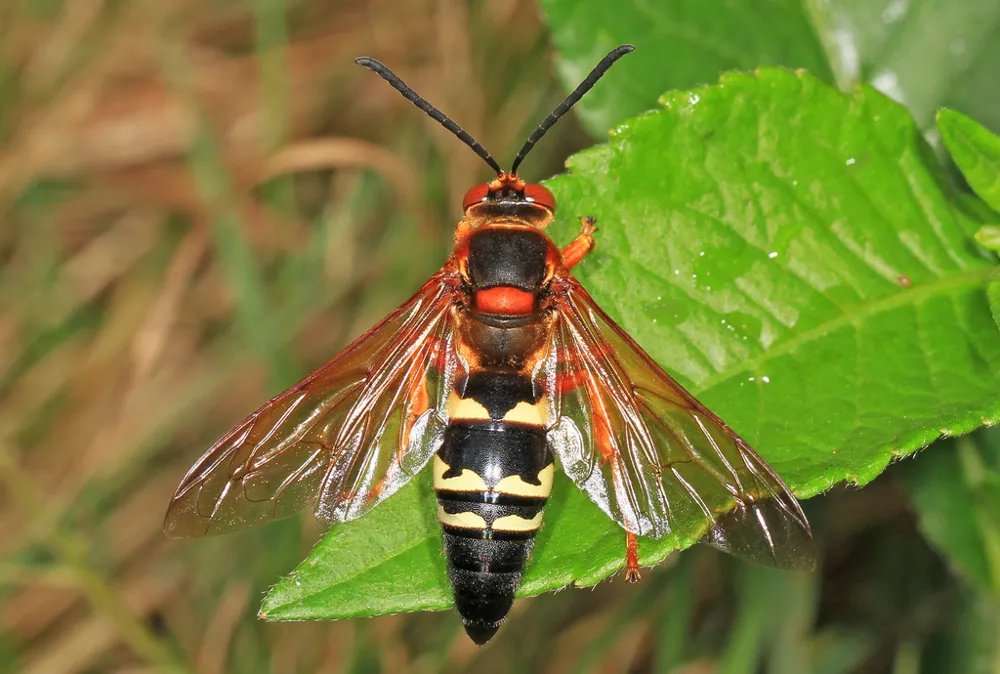
The eastern cicada killer is a large wasp that hunts cicadas, the loud insects that buzz in summer trees. It lives in the Eastern and Midwest United States and further south into Mexico and Central America. Females are not aggressive and rarely sting, so the sight of them flying over lawns is usually harmless.1


 Come riconoscerlo
- Large, at 1.5 to 5.0 cm long1
- Hairy thorax with reddish and black areas1
- Black to reddish brown abdomen marked with light yellow stripes1
- Brownish wings1
- Females are somewhat larger than males1
Spesso confuso con: Its colours resemble some yellowjacket and hornet species, and European hornets are often mistaken for it. European hornets are about 3.5 cm long, so they are smaller than the largest cicada killers.1
Potere del veleno
Il veleno esce da un pungiglione.
Cosa fa il suo veleno?
The female's sting paralyses cicadas so that they can be stored as food for the young.1
Quanto è pericoloso per le persone?
Pericolo per le persone: LieveCome una puntura d'ape o meno. In pratica innocuo per le persone.Females are not aggressive and rarely sting unless they are grasped roughly, stepped on with bare feet, or caught in clothing. One author who was stung said the sting felt like not much more than a pinprick. Males cannot sting.1
Cosa fa quando ha paura?
Females sting only if handled roughly. Males may jab with a sharp spine on the tip of the abdomen if handled roughly, but they usually fly away when swatted at.1
 Se punge
- Raschia via il pungiglione d'ape e raffredda la zona.
- Se la persona fa fatica a respirare, ha il viso o la gola gonfi, o si sente svenire, è un'emergenza allergica: chiama il numero di emergenza e usa il suo autoiniettore di adrenalina, se ne ha uno.
Chiama sempre prima il numero di emergenza (112, 000, 911). Queste sono indicazioni generali di primo soccorso, non consigli medici. Primo soccorso di base
 Stai al sicuro
- Non toccare, catturare o stuzzicare mai un animale selvatico, anche se è piccolo e anche se sembra addormentato o morto.
- Lasciagli spazio. Se ne incontri uno, resta calmo, indietreggia piano e lascialo andare per la sua strada.
- Se uno ti punge: resta calmo, stai fermo, chiama il numero di emergenza (112, 000, 911) o vai subito in ospedale. Ricorda com'era, una foto aiuta.
Non ce l'ha con te. Usa il veleno per procurarsi il cibo o per difendersi, e preferisce di gran lunga nascondersi. Altro su come stare al sicuro
Dove nel mondo?
Quanto è grande?
Quanto è lungo?
 più corto del tuo dito mignolo
 potrebbe attraversare in volo un intero campo da calcio in 9,7 secondi
Quanto è grande Eastern cicada killer rispetto a TE?
Solo calcoli nel tuo browser. Niente viene salvato o inviato da nessuna parte.
Quanto è veloce?


Informazioni
A female often carries a cicada up into a tree before flying to her burrow, because the cicada can weigh more than twice as much as she does.1
Males are seen in groups and may lock together in midair combat until one breaks away.1
Cicada killers may help trees by reducing the number of cicadas that feed on them.1
The parasitic velvet ant wasp, also called the cow-killer wasp, often lays its egg in cicada killer nest cells.1
A single burrow may eventually have 10 or more nest cells.1
Sfatiamo i miti
Mito: Male cicada killers are dangerous and will sting people.
Verità: Males only grapple with other insects and cannot sting. They investigate things that move near them because they are looking for females.1
Per gli esperti di veleni
- Nome scientifico
- Sphecius speciosus
- Gruppo
- Api, vespe e calabroni
- Famiglia
- Crabronidae2
- Ordine
- Hymenoptera
- Continenti
- Nord America
- Cuccioli
- Each female lays one egg on a cicada inside a nest cell, and the egg hatches in one or two days. Males receive one cicada per egg and females receive two or sometimes three.1
- Pericolo per le persone
- 1 / 5: Lieve3
Da dove vengono le informazioni
- Sphecius speciosus (Wikipedia (CC BY-SA 4.0))
- Sphecius speciosus (iNaturalist): nomi e classificazione.
- Venom Wiki: il livello di pericolo, la taglia tipica e la stima della velocità sono nostri. Guarda come li calcoliamo: Come valutiamo il pericolo.
Ogni informazione in questa pagina ha un numero che rimanda alla sua fonte. Se abbiamo sbagliato qualcosa, scusa, siamo appassionati di animali, non una rivista scientifica. Scrivici a [email protected] e lo correggeremo.
 Lo scorpione ha fame! Venom Wiki è un progetto di una sola persona: gratis, senza pubblicità e senza tracker. Una piccola mancia aiuta a tenerlo online.Dai da mangiare allo scorpione
Altri dello stesso gruppo: Api, vespe e calabroni
 Tarantula hawkApi, vespe e calabroniFa solo male
 Executioner waspApi, vespe e calabroniServe un medico
 Warrior waspApi, vespe e calabroniServe un medico
 Bald-faced hornetApi, vespe e calabroniFa solo male
 Cow killer velvet antApi, vespe e calabroniFa solo male
 Aerial yellowjacketApi, vespe e calabroniFa solo male
 Terciopelo
 Eastern coral snake
 Eastern diamondback rattlesnake
 Eyelash viper
 Timber rattlesnake
 Western diamondback rattlesnake