
 Africa
 Asia
Asia Europa
 Sud America
 Australia e Oceania
 Antartide
 Oceano Pacifico
 Oceano Atlantico
 Oceano Indiano
 Oceano Artico
 Mar Mediterraneo
 Mar Rosso
 Mar dei Caraibi
 Mar dei Coralli
 Mar Cinese Meridionale
 Mar delle Filippine
 Mare delle Andamane
 Mare del Nord
 Mar di Timor e Mar degli Arafura
 Golfo del Bengala
 Golfo di California
Golfodulcean poison frog
 Tossine nella pelle
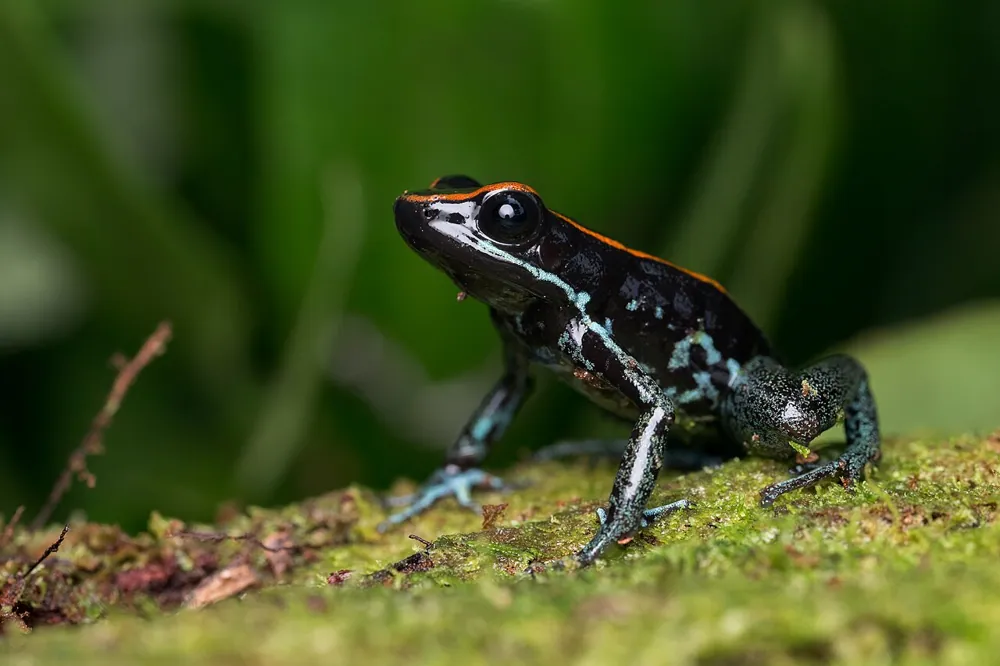
The Golfodulcean poison frog is a small, brightly marked frog that lives only in Costa Rica. Its skin contains a strong nerve poison, so it is one of the most toxic frogs in its genus, and it is a reminder that bright colours can be a warning. It lives in wet forests near streams.1

 Come riconoscerlo
- The body is black, but it can look glittery because of pigments in the skin.1
- Two stripes run down the back from just above the vent to the tip of the nose. They are usually fire orange, but can be golden, yellow or green.1
- The legs are mottled blue, and the sides often have a blue or green marble pattern.1
- It is a fairly large poison frog for its genus, with a smooth, sloping back. Its shoulder blades are usually hidden under the skin, so it can look a little plump.1
- Females are typically larger than males. Adults reach about 3.5 cm long.1
Spesso confuso con: The related P. bicolor and P. terribilis have visible shoulder blades under the skin, which the Golfodulcean poison frog usually lacks, so it looks smoother and rounder.1
Potere tossico
La sua pelle è tossica. È pericoloso toccarlo, leccarlo o mangiarlo.
Cosa fanno le sue tossine?
Its skin contains batrachotoxin, a neurotoxic alkaloid poison, which attacks the nerves. A large enough dose causes severe pain, then tonic-clonic seizures (violent convulsions) and paralysis.1
Quanto è pericoloso per le persone?
Pericolo per le persone: DolorosoPuò fare davvero male, ma non è quasi mai grave.It is highly toxic, though it is only the fourth most toxic species in the genus Phyllobates. The poison is in the skin, so the risk comes from handling the frog or getting the poison from its skin into the body.1
Cosa fa quando ha paura?
Its bright, multi-coloured body advertises its toxin as a warning to predators.1
 Se qualcuno l'ha toccato o mangiato
- Se qualcuno ne ha toccato uno: lava bene le mani e non toccare occhi o bocca. Se un bambino o un animale domestico ne ha leccato o mangiato uno: chiama il centro antiveleni o il numero di emergenza.
Chiama sempre prima il numero di emergenza (112, 000, 911). Queste sono indicazioni generali di primo soccorso, non consigli medici. Primo soccorso di base
 Stai al sicuro
- Non toccare, catturare o stuzzicare mai un animale selvatico, anche se è piccolo e anche se sembra addormentato o morto.
- Lasciagli spazio. Se ne incontri uno, resta calmo, indietreggia piano e lascialo andare per la sua strada.
- Se l'hai toccato o mangiato: non strofinarti gli occhi o la bocca, lavati le mani e cerca aiuto medico.
Non ce l'ha con te. Le sue tossine servono solo perché nessuno lo mangi. Altro su come stare al sicuro
Dove nel mondo?
Quanto è grande?
Quanto è lungo?
 lungo più o meno come una graffetta
 potrebbe percorrere 100 metri in 100 secondi (l'uomo più veloce ci mette 9,6)
Quanto è grande Golfodulcean poison frog rispetto a TE?
Solo calcoli nel tuo browser. Niente viene salvato o inviato da nessuna parte.
Quanto è veloce?


Informazioni
It is one of the few frogs whose poison is named batrachotoxin, a potent nerve toxin.1
Its climbing toe pads stick to leaves in a similar way to geckos, and it can climb out of an unsealed container.1
Male frogs carry their tadpoles on their backs, often for 1 to 2 days, to puddles, pools in palm leaves, or water-filled tree holes.1
Frogs in captivity have no toxin, which shows that their poison comes from what they eat.1
Its skin holds a large amount of poison, because it is comparatively large for a poison dart frog.1
The tadpoles become frogs after about 45 days, and the young frogs become sexually mature after ten months.1
Per gli esperti di veleni
- Nome scientifico
- Phyllobates vittatus
- Gruppo
- Rane dardo, rospi e tritoni
- Famiglia
- Dendrobatidae2
- Ordine
- Anura
- Continenti
- Nord America
- Cuccioli
- During the breeding season, the female lays 7 to 21 eggs per clutch on leaves, about every one or two weeks, and the male guards the eggs and carries the hatched tadpoles on his back to water.1
- Pericolo per le persone
- 2 / 5: Doloroso3
Da dove vengono le informazioni
- Golfodulcean poison frog (Wikipedia (CC BY-SA 4.0))
- Phyllobates vittatus (iNaturalist): nomi e classificazione.
- Venom Wiki: il livello di pericolo, la taglia tipica e la stima della velocità sono nostri. Guarda come li calcoliamo: Come valutiamo il pericolo.
Ogni informazione in questa pagina ha un numero che rimanda alla sua fonte. Se abbiamo sbagliato qualcosa, scusa, siamo appassionati di animali, non una rivista scientifica. Scrivici a [email protected] e lo correggeremo.
 Lo scorpione ha fame! Venom Wiki è un progetto di una sola persona: gratis, senza pubblicità e senza tracker. Una piccola mancia aiuta a tenerlo online.Dai da mangiare allo scorpione
Altri dello stesso gruppo: Rane dardo, rospi e tritoni
 Cane toadRane dardo, rospi e tritoniServe un medicoNon toccare
 Strawberry poison-dart frogRane dardo, rospi e tritoniFa solo maleNon toccare
 California newtRane dardo, rospi e tritoniPuò uccidereNon toccare
 Rough-skinned newtRane dardo, rospi e tritoniPuò uccidereNon toccare
 Colorado River toadRane dardo, rospi e tritoniServe un medicoNon toccare
 Panamanian golden frogRane dardo, rospi e tritoniServe un medicoNon toccare
 Terciopelo
 Eastern coral snake
 Eastern diamondback rattlesnake
 Eyelash viper
 Timber rattlesnake
 Western diamondback rattlesnake