
 Africa
 Asia
Asia Europa
 Sud America
 Australia e Oceania
 Antartide
 Oceano Pacifico
 Oceano Atlantico
 Oceano Indiano
 Oceano Artico
 Mar Mediterraneo
 Mar Rosso
 Mar dei Caraibi
 Mar dei Coralli
 Mar Cinese Meridionale
 Mar delle Filippine
 Mare delle Andamane
 Mare del Nord
 Mar di Timor e Mar degli Arafura
 Golfo del Bengala
 Golfo di California
Pygmy copperhead
 Morsi
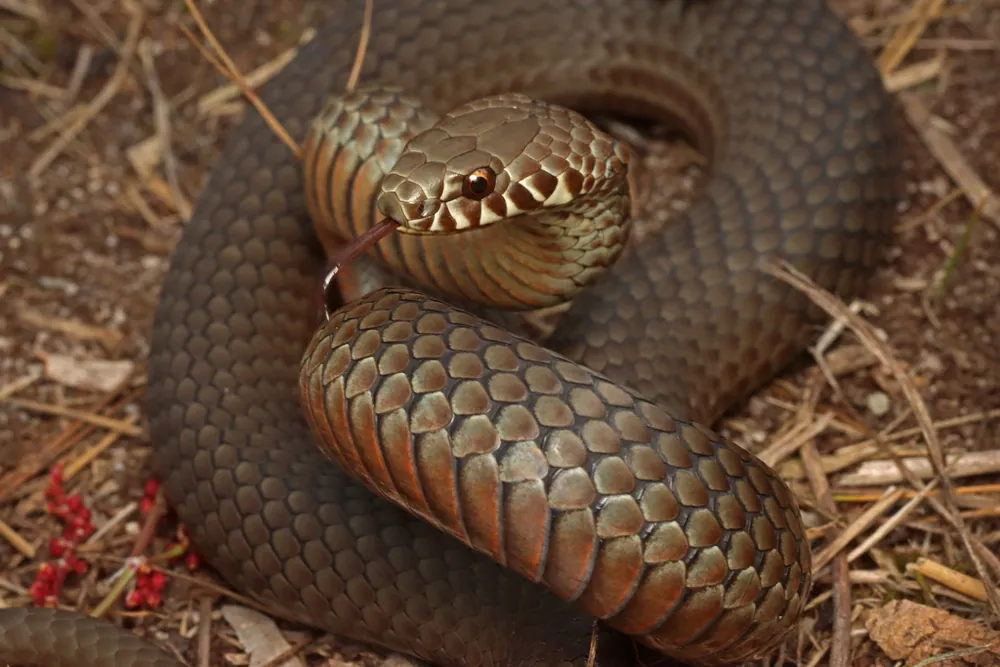
MorsiThe pygmy copperhead is a small, venomous snake found only in South Australia, mainly on Kangaroo Island and in the Fleurieu Peninsula and Mount Lofty Ranges. It is the smallest of the Australian copperheads. Its venom is dangerous, so prompt medical treatment matters.1


 Come riconoscerlo
- Dorsal scales are brown to grey, with a darker stripe along the spine.1
- The belly is cream to light grey, with red along the edges that fades to a brown-grey underside.1
- The lip scales are barred with dark colour.1
- Adults average about 80 cm long, with males usually larger than females.1
- Newborns often have paler backsides than adults.1
Spesso confuso con: The highland and lowland copperheads are larger, and the pygmy copperhead is the smallest of the Australian copperheads. It is not closely related to the American copperhead, Agkistrodon contortrix.1
Potere del veleno
Il veleno esce dalle zanne o dai denti quando morde.
Cosa fa il suo veleno?
The venom is strongly neurotoxic, which means it attacks the nerves, and its toxicity is similar to that of the Indian cobra. It is weakly coagulant and strongly anticoagulant, meaning it can both disrupt blood clotting and destroy blood and muscle. Without prompt treatment, a bite can cause possibly irreversible damage to nerve endings.1
Quanto è pericoloso per le persone?
Pericolo per le persone: GraveUn morso richiede un medico. Le morti sono molto rare.Bites are considered possibly lethal. The snake is not known for being aggressive and is unlikely to attack unless it is stepped on or purposely provoked.1
 Buone notizie: i medici hanno una medicina (il siero antiveleno) o una cura per questo.1
Cosa fa quando ha paura?
It is generally unobtrusive and usually hides under leaf litter, old iron and haystacks.1
 Se morde
- Prompt antivenom treatment is essential, because bites are considered lethal without it. Antivenom developed from tiger snake venom cannot completely neutralise the neurotoxicity of pygmy copperhead venom.1
- Bendaggio compressivo e immobilizzazione: avvolgi una benda elastica ben salda sopra il morso e poi su tutto l'arto, immobilizzalo con una stecca e tieni la persona completamente ferma finché non arrivano i soccorsi.
- Non lavare il morso: in ospedale possono analizzare il veleno rimasto sulla pelle per scegliere il siero antiveleno giusto.
Chiama sempre prima il numero di emergenza (112, 000, 911). Queste sono indicazioni generali di primo soccorso, non consigli medici. Primo soccorso di base
 Stai al sicuro
- Non toccare, catturare o stuzzicare mai un animale selvatico, anche se è piccolo e anche se sembra addormentato o morto.
- Lasciagli spazio. Se ne incontri uno, resta calmo, indietreggia piano e lascialo andare per la sua strada.
- Se uno ti morde: resta calmo, stai fermo, chiama il numero di emergenza (112, 000, 911) o vai subito in ospedale. Ricorda com'era, una foto aiuta.
Non ce l'ha con te. Usa il veleno per procurarsi il cibo o per difendersi, e preferisce di gran lunga nascondersi. Altro su come stare al sicuro
Dove nel mondo?
Quanto è grande?
Quanto è lungo?
 lungo come 2,5 gatti di casa dal naso alla coda
 lungo come 7 banane in fila
 potrebbe percorrere 100 metri in 56 secondi (l'uomo più veloce ci mette 9,6)
Quanto è grande Pygmy copperhead rispetto a TE?
Solo calcoli nel tuo browser. Niente viene salvato o inviato da nessuna parte.
Quanto è veloce?


Informazioni
Sightings on islands near Tasmania are probably the result of snakes stowing away on boats.1
It is the only snake endemic to South Australia.1
It is the smallest of the Australian copperhead snakes.1
Its litter size is about half that of the other Australian copperheads, which is linked to its smaller body size.1
In field research, only about two thirds of surveyed adult females were reproductive, which suggests females do not breed every year.1
Sfatiamo i miti
Mito: Because it is small and not aggressive, the pygmy copperhead is harmless.
Verità: Its venom is strongly neurotoxic, and its bite is considered possibly lethal without prompt antivenom treatment.1
Da dove vengono le informazioni
- Pygmy copperhead (Wikipedia (CC BY-SA 4.0))
- Austrelaps labialis (iNaturalist): nomi e classificazione.
- Venom Wiki: il livello di pericolo, la taglia tipica e la stima della velocità sono nostri. Guarda come li calcoliamo: Come valutiamo il pericolo.
Ogni informazione in questa pagina ha un numero che rimanda alla sua fonte. Se abbiamo sbagliato qualcosa, scusa, siamo appassionati di animali, non una rivista scientifica. Scrivici a [email protected] e lo correggeremo.
 Lo scorpione ha fame! Venom Wiki è un progetto di una sola persona: gratis, senza pubblicità e senza tracker. Una piccola mancia aiuta a tenerlo online.Dai da mangiare allo scorpione
Altri dello stesso gruppo: Serpenti australiani
 Coastal taipan
 Common death adder
 Eastern brown snake
 Taipan dell'interno
 Serpente tigre
 Collett's snake
Vive anche in: Australia e Oceania
 Sydney funnel-web spiderTarantole e ragni dei cunicoliMortale
 Redback spiderRagniServe un medico
 Brown tree snakeSerpenti con le zanne posterioriFa solo male
 Hooded pitohuiAltri animali tossiciFa solo maleNon toccare
 PlatypusMammiferi velenosiFa solo male
 Northern tree-dwelling funnel-web spiderTarantole e ragni dei cunicoliMortale