
 Africa
 Asia
Asia Europa
 Sud America
 Australia e Oceania
 Antartide
 Oceano Pacifico
 Oceano Atlantico
 Oceano Indiano
 Oceano Artico
 Mar Mediterraneo
 Mar Rosso
 Mar dei Caraibi
 Mar dei Coralli
 Mar Cinese Meridionale
 Mar delle Filippine
 Mare delle Andamane
 Mare del Nord
 Mar di Timor e Mar degli Arafura
 Golfo del Bengala
 Golfo di California
Red-bellied newt
 Tossine nella pelle
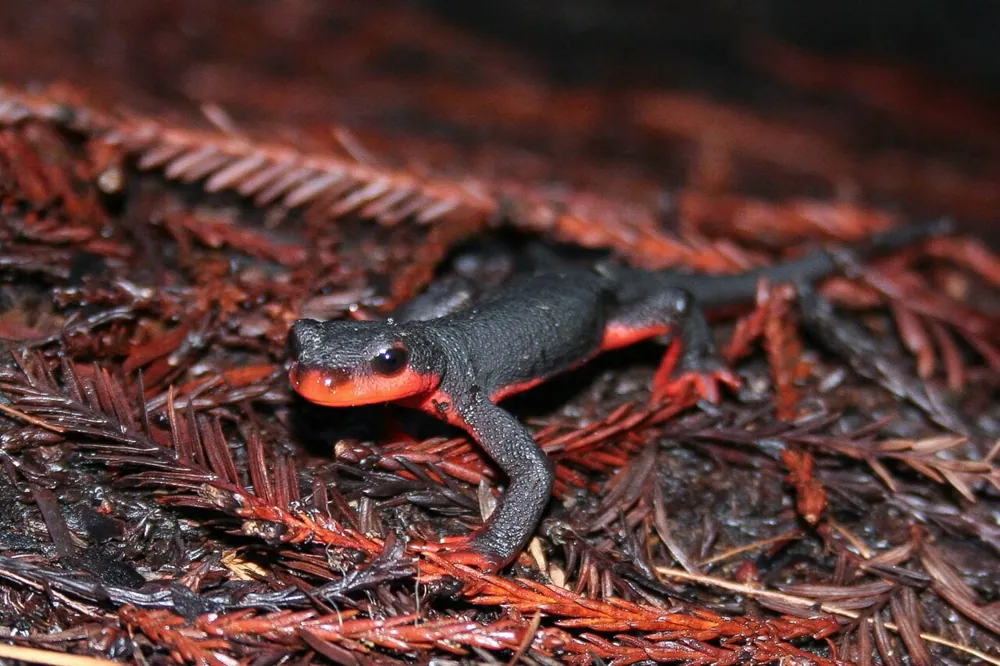
The red-bellied newt is a small amphibian with a brownish-black back and a bright red belly. It lives in coastal woodlands in northern California, mostly on land. Its skin is poisonous, so it is important to leave it alone.1
 Come riconoscerlo
- Brownish-black upper body with grainy skin1
- Tomato-red underbelly1
- Length of about 7 to 9 cm from nose to vent, and 14 to 19 cm including the tail1
- Males often have a dark, broad patch across the vent; females do not1
- Breeding males have smooth skin and a flattened tail1
Spesso confuso con: Other coastal newts are similar in shape. The red-bellied newt can be told apart by its red belly and by the lack of yellow in its eyes.1
Potere tossico
La sua pelle è tossica. È pericoloso toccarlo, leccarlo o mangiarlo.
Cosa fanno le sue tossine?
The red-bellied newt is poisonous rather than venomous, so it does not bite or sting. Its skin, eggs and embryos contain tetrodotoxin, a neurotoxin, which is a poison that attacks the nerves. There is enough of it to potentially kill an adult human.1
Quanto è pericoloso per le persone?
Pericolo per le persone: GraveSe qualcuno lo tocca o lo mangia, serve un medico. Le morti sono molto rare.The newt's skin is poisonous to touch and to eat. Its toxin is strong enough to potentially kill an adult human. It is also nearly inedible, and few animals eat it.1
Cosa fa quando ha paura?
When disturbed, it pulls its head and tail back to show its bright-red underside, which warns predators that it is poisonous.1
 Se qualcuno l'ha toccato o mangiato
- Se qualcuno ne ha toccato uno: lava bene le mani e non toccare occhi o bocca. Se un bambino o un animale domestico ne ha leccato o mangiato uno: chiama il centro antiveleni o il numero di emergenza.
Chiama sempre prima il numero di emergenza (112, 000, 911). Queste sono indicazioni generali di primo soccorso, non consigli medici. Primo soccorso di base
 Stai al sicuro
- Non toccare, catturare o stuzzicare mai un animale selvatico, anche se è piccolo e anche se sembra addormentato o morto.
- Lasciagli spazio. Se ne incontri uno, resta calmo, indietreggia piano e lascialo andare per la sua strada.
- Se l'hai toccato o mangiato: non strofinarti gli occhi o la bocca, lavati le mani e cerca aiuto medico.
Non ce l'ha con te. Le sue tossine servono solo perché nessuno lo mangi. Altro su come stare al sicuro
Dove nel mondo?
Quanto è grande?
Quanto è lungo?
 lungo come 6 mattoncini da costruzione in fila
Quanto è grande Red-bellied newt rispetto a TE?
Solo calcoli nel tuo browser. Niente viene salvato o inviato da nessuna parte.
Quanto è veloce?


Informazioni
Like other newts, they can regrow several body parts, including their limbs, eyes, hearts, intestines, jaws and damaged spinal cords.1
They can find their way back to the same spot in a stream over several miles of rugged terrain, probably by using their sense of smell.1
Red-bellied newts can live for 20 to 30 years.1
Adults leave the water and live underground until they are ready to breed, which usually happens after four to six years.1
Females do not breed every year, unlike the males.1
Per gli esperti di veleni
- Nome scientifico
- Taricha rivularis
- Gruppo
- Rane dardo, rospi e tritoni
- Famiglia
- Salamandridae2
- Ordine
- Caudata
- Continenti
- Nord America
- Cuccioli
- Newts start life as aquatic larvae, similar to tadpoles, with external gills. Females lay their eggs in about 12 clusters, with six to 16 eggs in each cluster.1
- Durata della vita
- circa 30 anni1
- Pericolo per le persone
- 3 / 5: Grave3
Da dove vengono le informazioni
- Red-bellied newt (Wikipedia (CC BY-SA 4.0))
- Taricha rivularis (iNaturalist): nomi e classificazione.
- Venom Wiki: il livello di pericolo, la taglia tipica e la stima della velocità sono nostri. Guarda come li calcoliamo: Come valutiamo il pericolo.
Ogni informazione in questa pagina ha un numero che rimanda alla sua fonte. Se abbiamo sbagliato qualcosa, scusa, siamo appassionati di animali, non una rivista scientifica. Scrivici a [email protected] e lo correggeremo.
 Lo scorpione ha fame! Venom Wiki è un progetto di una sola persona: gratis, senza pubblicità e senza tracker. Una piccola mancia aiuta a tenerlo online.Dai da mangiare allo scorpione
Altri dello stesso gruppo: Rane dardo, rospi e tritoni
 Cane toadRane dardo, rospi e tritoniServe un medicoNon toccare
 Strawberry poison-dart frogRane dardo, rospi e tritoniFa solo maleNon toccare
 California newtRane dardo, rospi e tritoniPuò uccidereNon toccare
 Rough-skinned newtRane dardo, rospi e tritoniPuò uccidereNon toccare
 Colorado River toadRane dardo, rospi e tritoniServe un medicoNon toccare
 Panamanian golden frogRane dardo, rospi e tritoniServe un medicoNon toccare
 Terciopelo
 Eastern coral snake
 Eastern diamondback rattlesnake
 Eyelash viper
 Timber rattlesnake
 Western diamondback rattlesnake
.jpg)