
 Afirika
 Asiya
Asiya Bulaaya
 Amerika ey'Obukiikaddyo
 Awusitureeliya ne Oseyaniya
 Antakitika
 Oseyani ya Pasifiki
 Oseyani ya Atlantiki
 Oseyani y'e Buyindi
 Oseyani ya Arakitiki
 Ennyanja ya Mediterenia
 Ennyanja Emmyufu
 Ennyanja ya Karibiyani
 Ennyanja ya Korali
 Ennyanja ya China ey'Obukiikaddyo
 Ennyanja ya Bufilipino
 Ennyanja ya Andaman
 Ennyanja ey'Obukiikakkono (North Sea)
 Ennyanja ya Timor ne Arafura
 Ekikono kya Bengal
 Ekikono kya Kalifoniya
Chilean six-eyed sand spider
 Kiruma
The Chilean six-eyed sand spider is a small spider that lives in the deserts of northern and central Chile. It hides under rocks and comes out at night. Its venom has effects similar to those of the Chilean recluse spider, which is why it matters to people who live nearby.1


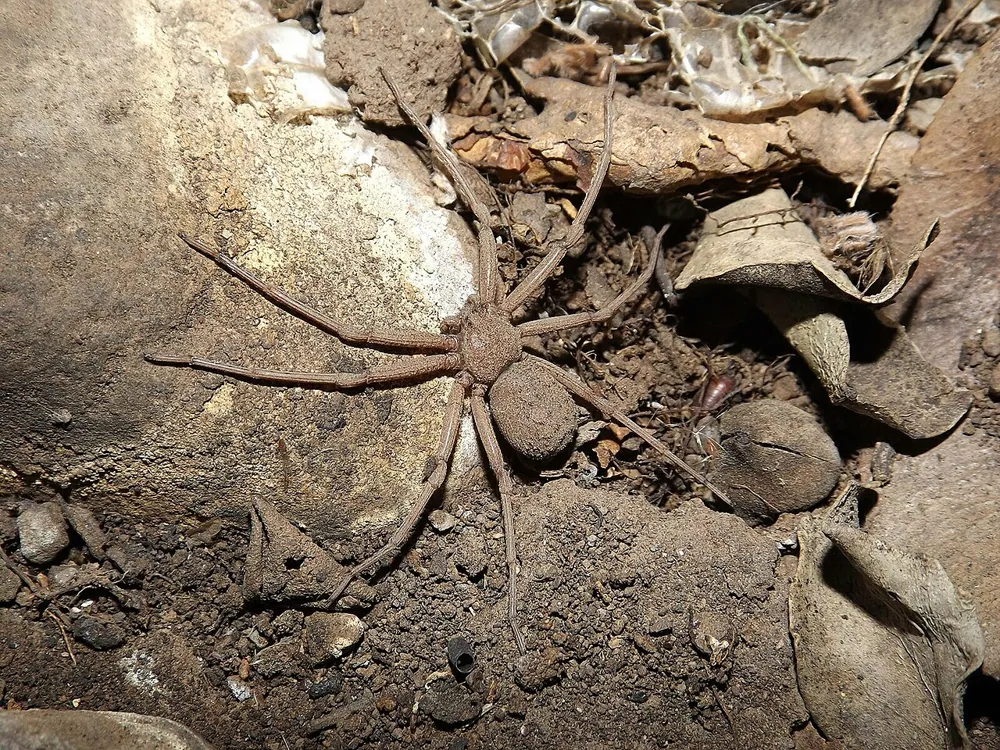
 Engeri y'okukitegeera
- Body length of 12 to 20 mm1
- Active at night, with nocturnal habits1
- Shelters under rocks on sandy ground1
- Very common in urban areas with household waste1
Kitera okutabulwa ne: Older records under the name Sicarius terrosus may actually describe other species, such as Sicarius levii. Names in older books can therefore be unreliable.1
Amaanyi g'obusagwa
Obusagwa buyita mu mannyo gaakyo amawanvu (fangs) oba mu mannyo amalala nga kiruma.
Obusagwa bwakyo bukola ki?
Its venom contains an enzyme called sphingomyelinase D, which has effects similar to those of the Chilean recluse spider. In laboratory tests the venom broke down red blood cells (haemolysis) and damaged skin cells, and 50 μg was enough to cause dermonecrosis, or the death of skin tissue. The venom also broke down fibrinogen, a protein needed for blood to clot.1
Kirina akabi kenkana wa eri abantu?
Akabi eri abantu: Kya bulumiKisobola okuluma ddala, naye kumpi tekiba kya kabi kinene.Laboratory work shows that the venom can damage human tissue. Adult spiders carry up to eight times the amount of venom tested, so bites from adults could cause more serious lesions.1
 Bwe kiruma
- Naaza ekifo ekirumiddwa era okiteekeko ayisi olw'obulumi. Funa obuyambi bw'abasawo singa obulumi bungi, busaasaana oba omuntu awulira bubi.
Bulijjo sooka kuba ennamba y'ebigwa bitalaze (112, 000, 911). Buno bulagirizi bwa bujjanjabi obusooka obwa bulijjo, si kuwabula kwa musawo. Obujjanjabi obusooka obw'omusingi
 Weekuume
- Tokwatako, tokwata wadde okusoomooza ensolo ey'omu nsiko, ne bw'eba ntono, era ne bw'eba erabika nga yeebase oba nga efudde.
- Gireke n'ebbanga. Bw'osisinkana emu, beera mukkakkamu, dda emabega mpola era gireke egende mu kkubo lyayo.
- Bw'emu ekuluma: beera mukkakkamu, totambula, kuba ennamba y'ebigwa bitalaze (112, 000, 911) oba tuuka mu ddwaliro mangu. Jjukira bwe yali efaanana, ekifaananyi kiyamba.
Tekikunoonya. Kikozesa obusagwa bwakyo okukwata emmere oba okwekuuma, era kyandisinze kwekweka. Ebirala ku kwekuuma
Wa mu nsi?
Kinene kyenkana wa?
Kiwanvu kyenkana wa?
 kiwanvu nga pepa kiripu
 kyandisobodde okudduka mita 100 mu sikonda 330 (omuntu asinga embiro yeetaaga 9,6)
Chilean six-eyed sand spider kinene kyenkana wa bw'ogeraageranya ne GGWE?
Kubala bwokka mu browser yo. Tewali kitterekebwa wadde okusindikibwa wonna.
Kidduka kyenkana wa?


Ebituufu
In 2020 a 20 mm spider was recorded preying on a 28 mm gecko, which is larger than the spider itself.1
Its venom breaks down fibrinogen, a clotting protein, faster than the venom of the Loxosceles species it was compared with.1
Scientists found that 50 μg of its venom was enough to cause dermonecrosis in laboratory tests.1
It is extremely common in Chilean cities where household waste is plentiful.1
Omumenyi w'enfumo
Enfumo: The species is known as Sicarius terrosus.
Amazima: The correct name is Sicarius thomisoides. The name terrosus was used for this species for a long time, but it was often used wrongly for other species too.1
Ebituufu we biva
- Sicarius thomisoides (Wikipedia (CC BY-SA 4.0))
- Sicarius thomisoides (iNaturalist): amannya n'ensengeka y'ebika.
- Venom Wiki: omutendera gw'akabi, obunene obwa bulijjo n'okuteebereza kw'embiro bibyaffe. Laba engeri gye tubibalamu: Engeri gye tupimamu akabi.
Buli kituufu ku lupapula luno kirina ennamba eraga we kyava. Bwe tuba tukoze ensobi, tusonyiwe, tuli bayagazi ba nsolo, so si magazini ya ssaayansi. Tubuulire ku [email protected] tujja kugitereeza.
 Enjaba erumwa enjala! Venom Wiki pulojekiti ya muntu omu: ya bwereere, tewali birango era tewali bikulondoola. Akasiimo akatono kayamba okugikuuma ku yintaneti.Liisa enjaba
Ebirala okuva mu kibinja kye kimu: Nnabbubi
 Brazilian wandering spider
 Amazon wandering spider
 Chilean recluse
 Golden silk orb-weaver
 Keyserling's wandering spider
 Argentine black widow
Era kibeera mu: Amerika ey'Obukiikaddyo
 Golden poison frogEbikere eby'obutwa, ebikere ebinene (toads) ne newtsKittaTokwatako
 TerciopeloPit vipers (emisota egiwulira ebbugumu)Kitta
 Eyelash viperPit vipers (emisota egiwulira ebbugumu)Kisobola okutta
 Golden lanceheadPit vipers (emisota egiwulira ebbugumu)Kisobola okutta
 South American bushmasterPit vipers (emisota egiwulira ebbugumu)Kisobola okutta
 Cane toadEbikere eby'obutwa, ebikere ebinene (toads) ne newtsKyetaaga omusawoTokwatako