
 Afirika
 Asiya
Asiya Bulaaya
 Amerika ey'Obukiikaddyo
 Awusitureeliya ne Oseyaniya
 Antakitika
 Oseyani ya Pasifiki
 Oseyani ya Atlantiki
 Oseyani y'e Buyindi
 Oseyani ya Arakitiki
 Ennyanja ya Mediterenia
 Ennyanja Emmyufu
 Ennyanja ya Karibiyani
 Ennyanja ya Korali
 Ennyanja ya China ey'Obukiikaddyo
 Ennyanja ya Bufilipino
 Ennyanja ya Andaman
 Ennyanja ey'Obukiikakkono (North Sea)
 Ennyanja ya Timor ne Arafura
 Ekikono kya Bengal
 Ekikono kya Kalifoniya
Eastern copperhead
 Kiruma
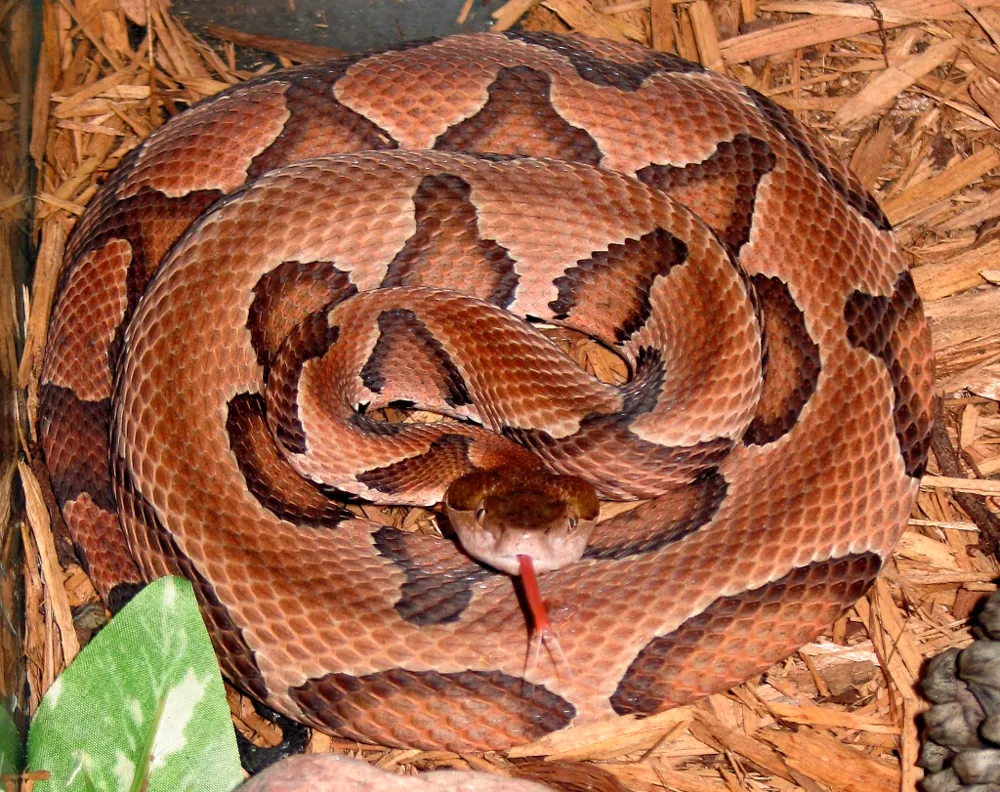
The eastern copperhead is a venomous pit viper that lives across much of the eastern United States. It has hourglass-shaped bands on a tan or reddish-brown body, which help it hide in leaves and clay. It is common, so people sometimes meet it without realising, and it makes up half of the treated snake bites in the United States.1



 Engeri y'okukitegeera
- Dark brown, hourglass-shaped crossbands on a light reddish-brown or brown background1
- A heavy, stout body rather than a slender one1
- A broad head that is distinct from the neck1
- Young have green or yellow tail tips, which darken to brown or black within a year1
- Adults are typically 50 to 95 cm long, including the tail1
Kitera okutabulwa ne: The snout slopes down and back, so it looks less blunt than the snout of the cottonmouth. The head also extends further forward than the mouth.1
Amaanyi g'obusagwa
Obusagwa buyita mu mannyo gaakyo amawanvu (fangs) oba mu mannyo amalala nga kiruma.
Kirina akabi kenkana wa eri abantu?
Akabi eri abantu: Kya maanyiOkulumwa kwetaaga omusawo. Okufa kubaawo kitono nnyo.Copperhead bites account for half of the treated snake bites in the United States. Bites usually happen when people unknowingly step on or near the snake. It is generally nonaggressive and will strike only if threatened as a last resort.1
Kikola ki nga kitidde?
It often freezes instead of fleeing, relying on its camouflage, and may vibrate its tail when closely approached.1
 Bwe kiruma
- Omuntu muleke ateetambula era ateefu, ekitundu ekirumiddwa kibeere ku buwanvu bw'omutima, ggyamu empeta n'ebintu ebinyweza, era omutwale mu ddwaliro mangu.
Bulijjo sooka kuba ennamba y'ebigwa bitalaze (112, 000, 911). Buno bulagirizi bwa bujjanjabi obusooka obwa bulijjo, si kuwabula kwa musawo. Obujjanjabi obusooka obw'omusingi
 Weekuume
- Tokwatako, tokwata wadde okusoomooza ensolo ey'omu nsiko, ne bw'eba ntono, era ne bw'eba erabika nga yeebase oba nga efudde.
- Gireke n'ebbanga. Bw'osisinkana emu, beera mukkakkamu, dda emabega mpola era gireke egende mu kkubo lyayo.
- Bw'emu ekuluma: beera mukkakkamu, totambula, kuba ennamba y'ebigwa bitalaze (112, 000, 911) oba tuuka mu ddwaliro mangu. Jjukira bwe yali efaanana, ekifaananyi kiyamba.
Tekikunoonya. Kikozesa obusagwa bwakyo okukwata emmere oba okwekuuma, era kyandisinze kwekweka. Ebirala ku kwekuuma
Wa mu nsi?
Kinene kyenkana wa?
Kiwanvu kyenkana wa?
Kizitowa kyenkana wa?
 kiwanvu nga kkapa ez'awaka 2 okuva ku nnyindo okutuuka ku mukira
 kiwanvu nga ndiizi 5 eziteekeddwa mu lunyiriri
 kyandisobodde okudduka mita 100 mu sikonda 100 (omuntu asinga embiro yeetaaga 9,6)
Eastern copperhead kinene kyenkana wa bw'ogeraageranya ne GGWE?
Kubala bwokka mu browser yo. Tewali kitterekebwa wadde okusindikibwa wonna.
Kidduka kyenkana wa?


Ebituufu
Its tail can vibrate more than 40 times per second, faster than almost any non-rattlesnake snake.1
Juveniles wave a brightly coloured tail to attract frogs and perhaps lizards, a behaviour called caudal luring.1
Its camouflage is so good that it can be almost impossible to see on dead leaves or red clay.1
In Texas, copperheads have been found in bushes, vines and trees up to 12 metres above the ground, seeking newly emerged cicadas.1
Its venom has potential medicinal value to humans.1
Historically, kingsnakes were major predators of copperheads, and recent copperhead numbers have risen where kingsnake populations have declined.1
Omumenyi w'enfumo
Enfumo: Copperheads are aggressive snakes that chase people and go looking for trouble.
Amazima: They are generally nonaggressive. They usually freeze or flee, and they strike only if threatened as a last resort. Most bites happen when people step on or near them without noticing.1
Ku bakugu mu busagwa
- Erinnya erya ssaayansi
- Agkistrodon contortrix
- Ekibinja
- Pit vipers (emisota egiwulira ebbugumu)
- Amaka
- Viperidae2
- Ensengeka
- Squamata
- Ssemazinga
- Amerika ey'Obukiikakkono
- Abaana abawere
- Newborn copperheads are born with green or yellow tail tips, which darken to brown or black within one year.1
- Kiri kitya mu nsiko
- Least Concern (IUCN Red List, v3.1, 2001); population trend stable when assessed in 20071
- Akabi eri abantu
- 3 / 5: Kya maanyi3
Ebituufu we biva
- Eastern copperhead (Wikipedia (CC BY-SA 4.0))
- Agkistrodon contortrix (iNaturalist): amannya n'ensengeka y'ebika.
- Venom Wiki: omutendera gw'akabi, obunene obwa bulijjo n'okuteebereza kw'embiro bibyaffe. Laba engeri gye tubibalamu: Engeri gye tupimamu akabi.
Buli kituufu ku lupapula luno kirina ennamba eraga we kyava. Bwe tuba tukoze ensobi, tusonyiwe, tuli bayagazi ba nsolo, so si magazini ya ssaayansi. Tubuulire ku [email protected] tujja kugitereeza.
 Enjaba erumwa enjala! Venom Wiki pulojekiti ya muntu omu: ya bwereere, tewali birango era tewali bikulondoola. Akasiimo akatono kayamba okugikuuma ku yintaneti.Liisa enjaba
Ebirala okuva mu kibinja kye kimu: Pit vipers (emisota egiwulira ebbugumu)
 TerciopeloPit vipers (emisota egiwulira ebbugumu)Kitta
 Eyelash viperPit vipers (emisota egiwulira ebbugumu)Kisobola okutta
 CottonmouthPit vipers (emisota egiwulira ebbugumu)Kyetaaga omusawo
 CantilPit vipers (emisota egiwulira ebbugumu)Kisobola okutta
 Central American bushmasterPit vipers (emisota egiwulira ebbugumu)Kisobola okutta
 Martinique lanceheadPit vipers (emisota egiwulira ebbugumu)Kisobola okutta
Era kibeera mu: Amerika ey'Obukiikakkono
 Eastern coral snakeEmisota gya korali (coral snakes)Kisobola okutta
 Eastern diamondback rattlesnakeRattlesnakeKisobola okutta
 Timber rattlesnakeRattlesnakeKisobola okutta
 Western diamondback rattlesnakeRattlesnakeKisobola okutta
 Arizona bark scorpionEnjabaKyetaaga omusawo
 Brown recluseNnabbubiKyetaaga omusawo