
 Afirika
 Asiya
Asiya Bulaaya
 Amerika ey'Obukiikaddyo
 Awusitureeliya ne Oseyaniya
 Antakitika
 Oseyani ya Pasifiki
 Oseyani ya Atlantiki
 Oseyani y'e Buyindi
 Oseyani ya Arakitiki
 Ennyanja ya Mediterenia
 Ennyanja Emmyufu
 Ennyanja ya Karibiyani
 Ennyanja ya Korali
 Ennyanja ya China ey'Obukiikaddyo
 Ennyanja ya Bufilipino
 Ennyanja ya Andaman
 Ennyanja ey'Obukiikakkono (North Sea)
 Ennyanja ya Timor ne Arafura
 Ekikono kya Bengal
 Ekikono kya Kalifoniya
Golfodulcean poison frog
 Obutwa mu lususu lwakyoKirya: EbiwukaKya butwa, si kya busagwa
The Golfodulcean poison frog is a small, brightly marked frog that lives only in Costa Rica. Its skin contains a strong nerve poison, so it is one of the most toxic frogs in its genus, and it is a reminder that bright colours can be a warning. It lives in wet forests near streams.1

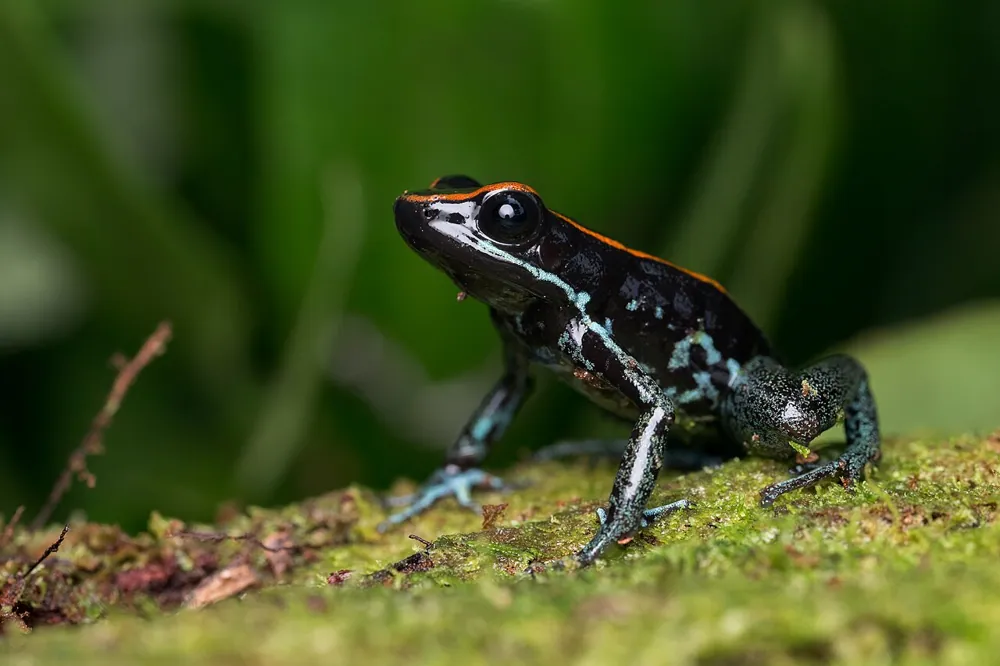
 Engeri y'okukitegeera
- The body is black, but it can look glittery because of pigments in the skin.1
- Two stripes run down the back from just above the vent to the tip of the nose. They are usually fire orange, but can be golden, yellow or green.1
- The legs are mottled blue, and the sides often have a blue or green marble pattern.1
- It is a fairly large poison frog for its genus, with a smooth, sloping back. Its shoulder blades are usually hidden under the skin, so it can look a little plump.1
- Females are typically larger than males. Adults reach about 3.5 cm long.1
Kitera okutabulwa ne: The related P. bicolor and P. terribilis have visible shoulder blades under the skin, which the Golfodulcean poison frog usually lacks, so it looks smoother and rounder.1
Amaanyi g'obutwa
Olususu lwakyo lwa butwa. Kya kabi okukwatako, okukomba oba okulya.
Obutwa bwakyo bukola ki?
Its skin contains batrachotoxin, a neurotoxic alkaloid poison, which attacks the nerves. A large enough dose causes severe pain, then tonic-clonic seizures (violent convulsions) and paralysis.1
Kirina akabi kenkana wa eri abantu?
Akabi eri abantu: Kya bulumiKisobola okuluma ddala, naye kumpi tekiba kya kabi kinene.It is highly toxic, though it is only the fourth most toxic species in the genus Phyllobates. The poison is in the skin, so the risk comes from handling the frog or getting the poison from its skin into the body.1
Kikola ki nga kitidde?
Its bright, multi-coloured body advertises its toxin as a warning to predators.1
 Omuntu bw'aba nga akikutteko oba akiridde
- Omuntu bw'aba nga akutteko emu: naaza bulungi engalo era tokwata ku maaso wadde akamwa. Omwana oba ensolo y'awaka bw'aba ng'agikombye oba agiridde: kuba ekifo ekikola ku butwa (poison centre) oba ennamba y'ebigwa bitalaze.
Bulijjo sooka kuba ennamba y'ebigwa bitalaze (112, 000, 911). Buno bulagirizi bwa bujjanjabi obusooka obwa bulijjo, si kuwabula kwa musawo. Obujjanjabi obusooka obw'omusingi
 Weekuume
- Tokwatako, tokwata wadde okusoomooza ensolo ey'omu nsiko, ne bw'eba ntono, era ne bw'eba erabika nga yeebase oba nga efudde.
- Gireke n'ebbanga. Bw'osisinkana emu, beera mukkakkamu, dda emabega mpola era gireke egende mu kkubo lyayo.
- Bw'oba okikutteko oba okiridde: tokolokota maaso go wadde akamwa, naaza engalo zo era funa obuyambi bw'abasawo.
Tekikunoonya. Obutwa bwakyo buliwo bwokka tewabaawo kikirya. Ebirala ku kwekuuma
Wa mu nsi?
Kinene kyenkana wa?
Kiwanvu kyenkana wa?
 kiwanvu nga pepa kiripu
 kyandisobodde okudduka mita 100 mu sikonda 100 (omuntu asinga embiro yeetaaga 9,6)
Golfodulcean poison frog kinene kyenkana wa bw'ogeraageranya ne GGWE?
Kubala bwokka mu browser yo. Tewali kitterekebwa wadde okusindikibwa wonna.
Kidduka kyenkana wa?


Ebituufu
It is one of the few frogs whose poison is named batrachotoxin, a potent nerve toxin.1
Its climbing toe pads stick to leaves in a similar way to geckos, and it can climb out of an unsealed container.1
Male frogs carry their tadpoles on their backs, often for 1 to 2 days, to puddles, pools in palm leaves, or water-filled tree holes.1
Frogs in captivity have no toxin, which shows that their poison comes from what they eat.1
Its skin holds a large amount of poison, because it is comparatively large for a poison dart frog.1
The tadpoles become frogs after about 45 days, and the young frogs become sexually mature after ten months.1
Ku bakugu mu busagwa
- Erinnya erya ssaayansi
- Phyllobates vittatus
- Ekibinja
- Ebikere eby'obutwa, ebikere ebinene (toads) ne newts
- Amaka
- Dendrobatidae2
- Ensengeka
- Anura
- Ssemazinga
- Amerika ey'Obukiikakkono
- Abaana abawere
- During the breeding season, the female lays 7 to 21 eggs per clutch on leaves, about every one or two weeks, and the male guards the eggs and carries the hatched tadpoles on his back to water.1
- Akabi eri abantu
- 2 / 5: Kya bulumi3
Ebituufu we biva
- Golfodulcean poison frog (Wikipedia (CC BY-SA 4.0))
- Phyllobates vittatus (iNaturalist): amannya n'ensengeka y'ebika.
- Venom Wiki: omutendera gw'akabi, obunene obwa bulijjo n'okuteebereza kw'embiro bibyaffe. Laba engeri gye tubibalamu: Engeri gye tupimamu akabi.
Buli kituufu ku lupapula luno kirina ennamba eraga we kyava. Bwe tuba tukoze ensobi, tusonyiwe, tuli bayagazi ba nsolo, so si magazini ya ssaayansi. Tubuulire ku [email protected] tujja kugitereeza.
 Enjaba erumwa enjala! Venom Wiki pulojekiti ya muntu omu: ya bwereere, tewali birango era tewali bikulondoola. Akasiimo akatono kayamba okugikuuma ku yintaneti.Liisa enjaba
Ebirala okuva mu kibinja kye kimu: Ebikere eby'obutwa, ebikere ebinene (toads) ne newts
 Cane toadEbikere eby'obutwa, ebikere ebinene (toads) ne newtsKyetaaga omusawoTokwatako
 Strawberry poison-dart frogEbikere eby'obutwa, ebikere ebinene (toads) ne newtsKiruma bwokkaTokwatako
 California newtEbikere eby'obutwa, ebikere ebinene (toads) ne newtsKisobola okuttaTokwatako
 Rough-skinned newtEbikere eby'obutwa, ebikere ebinene (toads) ne newtsKisobola okuttaTokwatako
 Colorado River toadEbikere eby'obutwa, ebikere ebinene (toads) ne newtsKyetaaga omusawoTokwatako
 Panamanian golden frogEbikere eby'obutwa, ebikere ebinene (toads) ne newtsKyetaaga omusawoTokwatako
Era kibeera mu: Amerika ey'Obukiikakkono
 TerciopeloPit vipers (emisota egiwulira ebbugumu)Kitta
 Eastern coral snakeEmisota gya korali (coral snakes)Kisobola okutta
 Eastern diamondback rattlesnakeRattlesnakeKisobola okutta
 Eyelash viperPit vipers (emisota egiwulira ebbugumu)Kisobola okutta
 Timber rattlesnakeRattlesnakeKisobola okutta
 Western diamondback rattlesnakeRattlesnakeKisobola okutta