
 Afirika
 Asiya
Asiya Bulaaya
 Amerika ey'Obukiikaddyo
 Awusitureeliya ne Oseyaniya
 Antakitika
 Oseyani ya Pasifiki
 Oseyani ya Atlantiki
 Oseyani y'e Buyindi
 Oseyani ya Arakitiki
 Ennyanja ya Mediterenia
 Ennyanja Emmyufu
 Ennyanja ya Karibiyani
 Ennyanja ya Korali
 Ennyanja ya China ey'Obukiikaddyo
 Ennyanja ya Bufilipino
 Ennyanja ya Andaman
 Ennyanja ey'Obukiikakkono (North Sea)
 Ennyanja ya Timor ne Arafura
 Ekikono kya Bengal
 Ekikono kya Kalifoniya
Red widow
 Kiruma
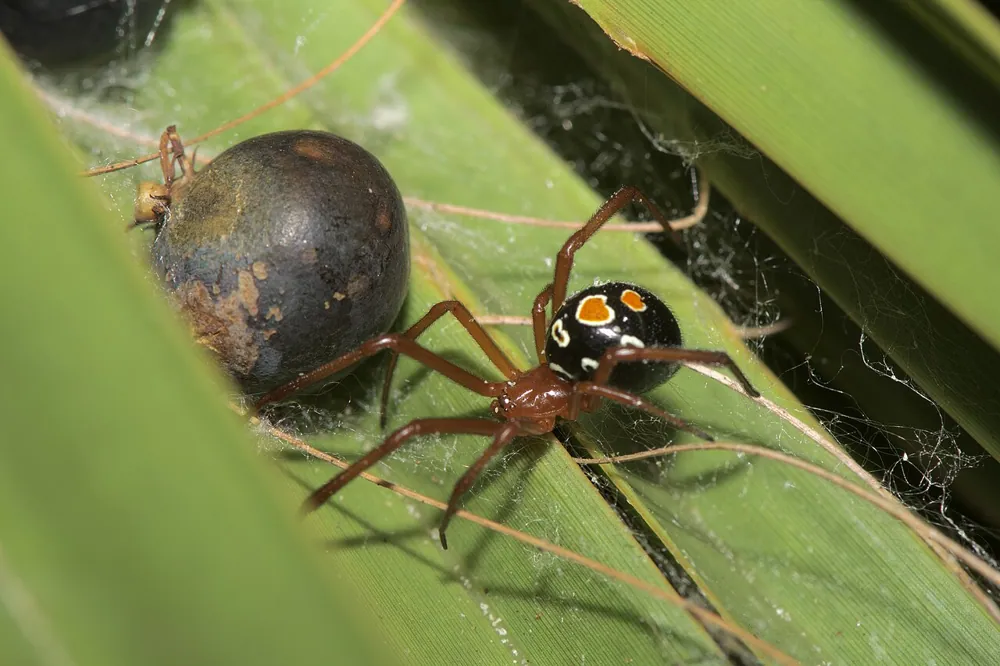
The red widow is a venomous spider that lives only in Florida, in the dry, sandy scrub where sand pine trees grow. It is a close relative of the black widow, but it rarely comes into contact with people, so it is not often met. Its bright red colours make it easy to recognise.1

 Engeri y'okukitegeera
- The cephalothorax (the front part of the body) is red-orange.1
- The abdomen is black, with yellow rings outlining rows of red spots.1
- The legs are vermilion red.1
- The underside does not have the familiar hourglass marking. It usually has one or two small red marks instead.1
- Females are almost double the size of males.1
Kitera okutabulwa ne: It is closely related to the black widow (Latrodectus mactans). The two can be told apart by features of the male and female genitalia, which are examined under magnification. The red widow's male embolus has one fewer loop, and the female's connecting ducts to the spermatheca also have one fewer loop.1
Amaanyi g'obusagwa
Obusagwa buyita mu mannyo gaakyo amawanvu (fangs) oba mu mannyo amalala nga kiruma.
Obusagwa bwakyo bukola ki?
The red widow is venomous like other members of the genus Latrodectus. In a documented bite, the main effect was a mildly painful throbbing sensation that lasted several hours. The median lethal dose (LD50) of its venom in mice is 2.20 mg/kg, and each spider contains about 0.157 mg of venom.1
Kirina akabi kenkana wa eri abantu?
Akabi eri abantu: Kya bulumiKisobola okuluma ddala, naye kumpi tekiba kya kabi kinene.No bites from this spider are recorded in the medical literature. It seldom comes into contact with humans, unlike the black and brown widows, which live close to people. One documented bite caused a mildly painful throbbing that lasted several hours.1
 Bwe kiruma
- Naaza ekifo ekirumiddwa era okiteekeko ayisi olw'obulumi. Funa obuyambi bw'abasawo singa obulumi bungi, busaasaana oba omuntu awulira bubi.
Bulijjo sooka kuba ennamba y'ebigwa bitalaze (112, 000, 911). Buno bulagirizi bwa bujjanjabi obusooka obwa bulijjo, si kuwabula kwa musawo. Obujjanjabi obusooka obw'omusingi
 Weekuume
- Tokwatako, tokwata wadde okusoomooza ensolo ey'omu nsiko, ne bw'eba ntono, era ne bw'eba erabika nga yeebase oba nga efudde.
- Gireke n'ebbanga. Bw'osisinkana emu, beera mukkakkamu, dda emabega mpola era gireke egende mu kkubo lyayo.
- Bw'emu ekuluma: beera mukkakkamu, totambula, kuba ennamba y'ebigwa bitalaze (112, 000, 911) oba tuuka mu ddwaliro mangu. Jjukira bwe yali efaanana, ekifaananyi kiyamba.
Tekikunoonya. Kikozesa obusagwa bwakyo okukwata emmere oba okwekuuma, era kyandisinze kwekweka. Ebirala ku kwekuuma
Wa mu nsi?
Kinene kyenkana wa?
Kiwanvu kyenkana wa?
 kiwanvu nga pepa kiripu
Red widow kinene kyenkana wa bw'ogeraageranya ne GGWE?
Kubala bwokka mu browser yo. Tewali kitterekebwa wadde okusindikibwa wonna.
Kidduka kyenkana wa?


Ebituufu
A bite was filmed and documented in 2023 by biologist Spencer Hoffman, one of the few recorded bites from this species.1
Females are almost double the size of males.1
Its predators are thought to include sphecid wasps and the Florida scrub jay.1
It lives in sand-pine scrub, a habitat found only in Florida and coastal Alabama.1
Omumenyi w'enfumo
Enfumo: All widow spiders have the hourglass marking on the underside.
Amazima: The red widow does not have the familiar hourglass marking. It usually has one or two small red marks instead.1
Ku bakugu mu busagwa
Ebituufu we biva
- Latrodectus bishopi (Wikipedia (CC BY-SA 4.0))
- Latrodectus bishopi (iNaturalist): amannya n'ensengeka y'ebika.
- Venom Wiki: omutendera gw'akabi, obunene obwa bulijjo n'okuteebereza kw'embiro bibyaffe. Laba engeri gye tubibalamu: Engeri gye tupimamu akabi.
Buli kituufu ku lupapula luno kirina ennamba eraga we kyava. Bwe tuba tukoze ensobi, tusonyiwe, tuli bayagazi ba nsolo, so si magazini ya ssaayansi. Tubuulire ku [email protected] tujja kugitereeza.
 Enjaba erumwa enjala! Venom Wiki pulojekiti ya muntu omu: ya bwereere, tewali birango era tewali bikulondoola. Akasiimo akatono kayamba okugikuuma ku yintaneti.Liisa enjaba
Ebirala okuva mu kibinja kye kimu: Nnabbubi
 Brown recluse
 Southern black widow
 Northern black widow
 Western black widow
 Bold jumping spider
 Golden silk orb-weaver
Era kibeera mu: Amerika ey'Obukiikakkono
 TerciopeloPit vipers (emisota egiwulira ebbugumu)Kitta
 Eastern coral snakeEmisota gya korali (coral snakes)Kisobola okutta
 Eastern diamondback rattlesnakeRattlesnakeKisobola okutta
 Eyelash viperPit vipers (emisota egiwulira ebbugumu)Kisobola okutta
 Timber rattlesnakeRattlesnakeKisobola okutta
 Western diamondback rattlesnakeRattlesnakeKisobola okutta