
 Afirika
 Asiya
Asiya Bulaaya
 Amerika ey'Obukiikaddyo
 Awusitureeliya ne Oseyaniya
 Antakitika
 Oseyani ya Pasifiki
 Oseyani ya Atlantiki
 Oseyani y'e Buyindi
 Oseyani ya Arakitiki
 Ennyanja ya Mediterenia
 Ennyanja Emmyufu
 Ennyanja ya Karibiyani
 Ennyanja ya Korali
 Ennyanja ya China ey'Obukiikaddyo
 Ennyanja ya Bufilipino
 Ennyanja ya Andaman
 Ennyanja ey'Obukiikakkono (North Sea)
 Ennyanja ya Timor ne Arafura
 Ekikono kya Bengal
 Ekikono kya Kalifoniya
Saddleback caterpillar
 Ebyoya ebibojja
The saddleback caterpillar is the larva of a moth found in eastern North America and Mexico. It is green with a brown saddle-shaped marking on its back, and its spiny hairs can cause a painful rash. Gardeners who handle plants where it lives are most at risk of contact.1

 Engeri y'okukitegeera
- Primarily lime-green, with brown at both ends.1
- A dark brown centre marking, outlined in white and black, that looks like a saddle.1
- A pair of fleshy horns, called tentacles, at each end of the body, which are orange or black as the caterpillar grows.1
- Tufts of spines along the body, with a row of orange spines along the sides.1
- Some larvae have a false face at the rear, with two pale dots that look like large eyes.1
Amaanyi g'obusagwa
Obwoya obutono oba obusongovu bukutukira mu lususu ne bubojja.
Obusagwa bwakyo bukola ki?
The hairs and spines contain an irritating venom that is released when they touch skin or are broken. Contact causes a painful, swollen rash and sometimes nausea. Severe reactions are possible and can include migraines, breathing trouble related to asthma, anaphylactic shock (a dangerous allergic reaction) and bleeding. Symptoms can last from a few hours to a few days, depending on how sensitive a person is.1
Kirina akabi kenkana wa eri abantu?
Akabi eri abantu: Kya bulumiKisobola okuluma ddala, naye kumpi tekiba kya kabi kinene.This caterpillar has one of the strongest stings of its kind. Gardeners are most at risk because the caterpillar is common on ornamental plants. Symptoms vary from mild to severe, and the sensitivity of the person affected makes a difference.1
 Amawulire amalungi: abasawo balina eddagala (antivenom) oba obujjanjabi ku kino.1
Kikola ki nga kitidde?
When threatened, the larva curls outwards so its spines are hard for a predator to avoid, and its bright colours warn of its toxicity.1
 Bw'okwata ku byoya byakyo
- Remove the spines from the skin immediately using adhesive tape over the affected area, with a new piece of tape for each treatment, to stop the venom spreading. Ice packs, corticosteroids and antihistamines (taken orally or applied to the skin) have been reported to help relieve pain. Symptoms are relieved with prescribed medication on a case-by-case basis.1
- Ku byoya by'ebisaanyi ebibojja: bijjeeko ne tteepu ekwata, oluvannyuma naaza olususu. Tokolokota.
- Ku kulumwa: naaza era nyogoza. Funa obuyambi bw'abasawo singa omuntu awulira bubi oba omusaayi gumuvaamu mangu.
Bulijjo sooka kuba ennamba y'ebigwa bitalaze (112, 000, 911). Buno bulagirizi bwa bujjanjabi obusooka obwa bulijjo, si kuwabula kwa musawo. Obujjanjabi obusooka obw'omusingi
 Weekuume
- Tokwatako, tokwata wadde okusoomooza ensolo ey'omu nsiko, ne bw'eba ntono, era ne bw'eba erabika nga yeebase oba nga efudde.
- Gireke n'ebbanga. Bw'osisinkana emu, beera mukkakkamu, dda emabega mpola era gireke egende mu kkubo lyayo.
- Bw'okwata ku byoya byayo: beera mukkakkamu, totambula, kuba ennamba y'ebigwa bitalaze (112, 000, 911) oba tuuka mu ddwaliro mangu. Jjukira bwe yali efaanana, ekifaananyi kiyamba.
Tekikunoonya. Kikozesa obusagwa bwakyo okukwata emmere oba okwekuuma, era kyandisinze kwekweka. Ebirala ku kwekuuma
Wa mu nsi?
Kinene kyenkana wa?
Kiwanvu kyenkana wa?
 kiwanvu nga pepa kiripu
 kirwawo okusinga ekkovu ly'omu nnimiro
Saddleback caterpillar kinene kyenkana wa bw'ogeraageranya ne GGWE?
Kubala bwokka mu browser yo. Tewali kitterekebwa wadde okusindikibwa wonna.
Kidduka kyenkana wa?

Ebituufu
The false face on the rear end is thought to confuse predators, which may attack the wrong end.1
Its cocoon is made of silk mixed with its stinging spines, which protect the pupa during metamorphosis.1
Braconid wasps often lay their eggs inside these caterpillars, and the wasp larvae feed from the inside and later emerge through holes in the body.1
Like other slug caterpillars, it moves on suckers and mucus, which help it roll and stick to surfaces.1
The adult moth has no sting and lives about 10 days on average.1
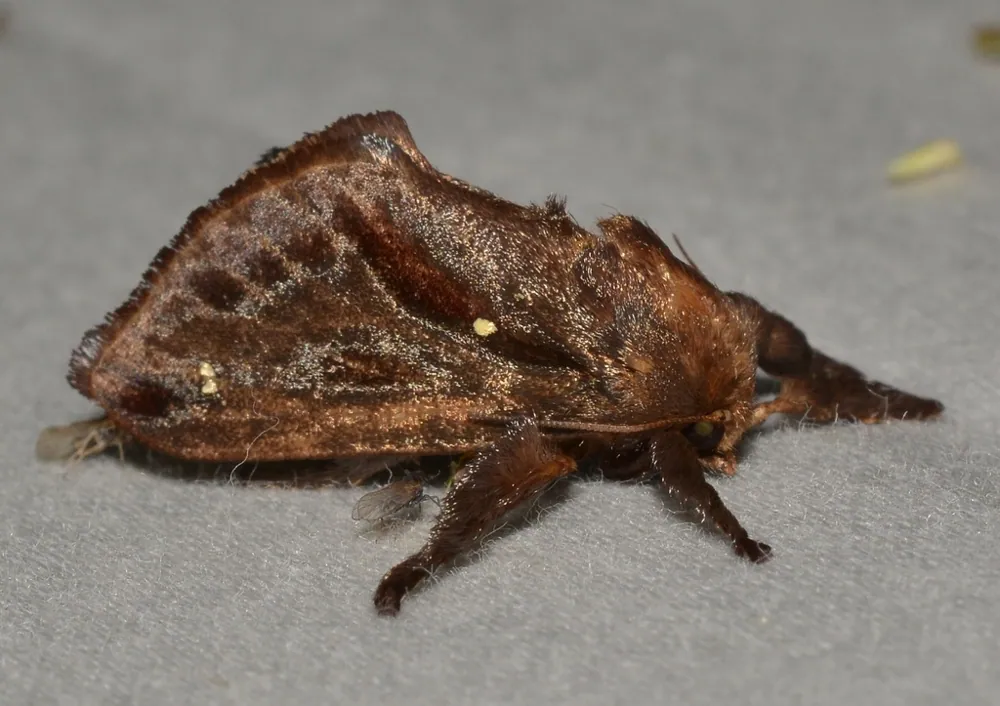
The adult moth loses the caterpillar's bright colours and has velvety dark brown forewings and cream hindwings.1
Ku bakugu mu busagwa
Ebituufu we biva
- Saddleback caterpillar (Wikipedia (CC BY-SA 4.0))
- Acharia stimulea (iNaturalist): amannya n'ensengeka y'ebika.
- Venom Wiki: omutendera gw'akabi, obunene obwa bulijjo n'okuteebereza kw'embiro bibyaffe. Laba engeri gye tubibalamu: Engeri gye tupimamu akabi.
Buli kituufu ku lupapula luno kirina ennamba eraga we kyava. Bwe tuba tukoze ensobi, tusonyiwe, tuli bayagazi ba nsolo, so si magazini ya ssaayansi. Tubuulire ku [email protected] tujja kugitereeza.
 Enjaba erumwa enjala! Venom Wiki pulojekiti ya muntu omu: ya bwereere, tewali birango era tewali bikulondoola. Akasiimo akatono kayamba okugikuuma ku yintaneti.Liisa enjaba
Ebirala okuva mu kibinja kye kimu: Ebisaanyi n'ebiwuka
 Giant water bugEbisaanyi n'ebiwukaKiruma bwokka
 Puss caterpillarEbisaanyi n'ebiwukaKiruma bwokkaTokwatako
 Wheel bugEbisaanyi n'ebiwukaKiruma bwokka
 Giant vinegaroonEbisaanyi n'ebiwukaTekirina kabi
 Rhodnius kissing bugEbisaanyi n'ebiwukaKyetaaga omusawo
 Black-waved flannel mothEbisaanyi n'ebiwukaKiruma bwokkaTokwatako
Era kibeera mu: Amerika ey'Obukiikakkono
 TerciopeloPit vipers (emisota egiwulira ebbugumu)Kitta
 Eastern coral snakeEmisota gya korali (coral snakes)Kisobola okutta
 Eastern diamondback rattlesnakeRattlesnakeKisobola okutta
 Eyelash viperPit vipers (emisota egiwulira ebbugumu)Kisobola okutta
 Timber rattlesnakeRattlesnakeKisobola okutta
 Western diamondback rattlesnakeRattlesnakeKisobola okutta