
 Afrika
 Azia
Azia Erópa
Erópa Amerika ya Sude
 Australia & Océanie
 Antarctique
 Océan Pacifique
 Océan Atlantique
 Océan Indien
 Océan Arctique
 Mer Méditerranée
 Mer Rouge
 Mer des Caraïbes
 Mer de Corail
 Mer de Chine méridionale
 Mer des Philippines
 Mer d'Andaman
 Mer du Nord
 Mer de Timor & Mer d'Arafura
 Golfe du Bengale
 Golfe de Californie
Brown-tail moth
 Nsuki oyo etubaka
The brown-tail moth is a moth whose caterpillars are covered in tiny irritating hairs. It is native to Europe, neighbouring parts of Asia and the north coast of Africa. Its hairs can cause a very itchy rash, so it matters to anyone who works or plays near trees it feeds on.1

 Ndenge ya koyeba yango
- Adults have pure white upper wings and a hairy white body with a tuft of brown hair at the tip of the tail end.1
- Adults have a wingspan of 36 to 42 millimetres.1
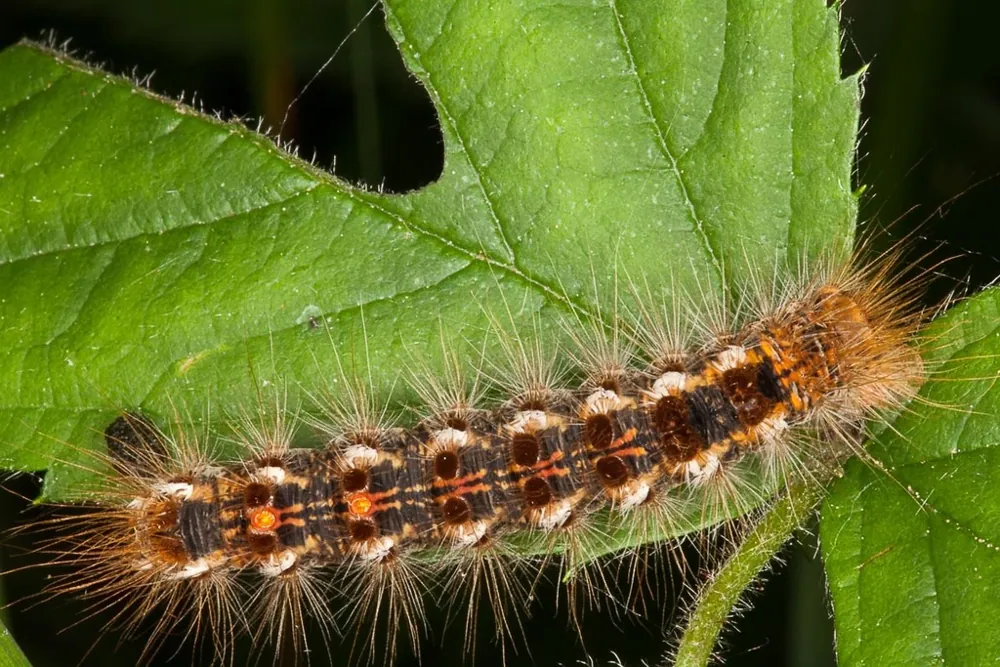
- Caterpillars are very hairy, brown with white markings, and have two prominent red spots toward the tail end.1
- In late autumn and winter, silken tents hang on branch tips, which are a sign that the caterpillars are present.1
Bakosanaka yango mbala mingi na: Euproctis similis, also native to Europe, is similar as an adult but the female has a yellow tail tuft. Hyphantria cunea, native to North America, is similar too, but it lacks the coloured tail tuft.1
Makasi ya venin
Nsuki to ba poil ya mike ebukanaka na kati ya loposo mpe etubaka.
Venin na yango esalaka nini?
The hairs are not venom injected by a bite or sting. They are toxic and irritating to skin. Barbed hairs lodge in the skin and cause physical irritation, and chemicals in the hairs also irritate it. If inhaled, the hairs can cause breathing difficulties similar to asthma. The toxins stay active for up to three years after the hairs are shed.1
Likama na yango mpo na bato ezali boni?
Likama mpo na bato: Epesaka pasiEkoki kopesa pasi mingi, kasi pene na ntango nyonso ezalaka likambo monene te.Contact with the hairs causes a very itchy rash that can last for weeks. Doctors reported rashes worse than poison ivy rash in the early 1900s. Breathing difficulties can occur if the hairs are inhaled.1
Esalaka nini ntango ebangi?
Its hairs protect the caterpillars from predators, and the caterpillars use some hairs in their cocoons.1
 Soki osimbi nsuki na yango
- Mpo na nsuki ya mbinzo oyo etubaka: longola yango na scotch, sima sukola loposo. Kofrotter loposo te.
- Mpo na kosuama: sukola mpe pesa malili. Luka lisalisi ya monganga soki moto ayoki nzoto malamu te to soki makila ezali kobima ye pete.
Benga ntango nyonso nimero ya urgence liboso (112, 000, 911). Oyo ezali toli ya lisalisi ya liboso, ezali toli ya monganga te. Makambo ya moboko ya lisalisi ya liboso
 Zala na libateli
- Ata mokolo moko te, simba, kanga to silikisa nyama ya zamba te, ata ya moke, mpe ata soki emonani lokola elali to ekufi.
- Tika yango esika. Soki okutani na moko, zala kimia, zonga sima malembe mpe tika ekende nzela na yango.
- Soki osimbi nsuki na yango: zala kimia, ningana te, benga nimero ya urgence na yo (112, 000, 911) to kende na lopitalo noki. Kanisa ndenge ezalaki, foto esalisaka.
Ezali koluka yo te. Esalelaka venin na yango mpo na kokanga bilei to komibatela, mpe elingaka mingi kobombama. Makambo mosusu mpo na komibatela
Monene na yango boni?
Molai na yango boni?
 mokuse koleka mosapi na yo ya moke
 malembe koleka escargot ya elanga
Brown-tail moth azali monene boni soki tokokanisi na YO?
Kaka ba calcul na navigateur na yo. Eloko moko te ebombamaka to etindamaka esika moko.
Mbangu na yango boni?

Makambo ya solo
The hairs of the caterpillars can cause a rash even when no one touches a caterpillar, because shed hairs can blow in the wind.1
Brown-tail moths were described in outbreaks in Paris, London and Berlin as far back as the 1500s, when they stripped trees of leaves.1
The species spends about nine months of its year as caterpillars, which is unusually long for a moth.1
Caterpillars spend the winter together in silken tents built at branch tips, rather than spreading out.1
A parasitic fly introduced to North America in 1906 to control spongy moths also strongly affected brown-tail moths.1
Solo to lokuta?
Lokuta: You can only get the rash by touching the caterpillars.
Solo: Hairs are shed and can become windblown, and they can be carried indoors on clothing and shoes, so a rash can occur without direct contact with the caterpillars.1
Esika makambo euti
- Brown-tail moth (Wikipedia (CC BY-SA 4.0))
- Euproctis chrysorrhoea (iNaturalist): bankombo mpe classification.
- Venom Wiki: niveau ya likama, monene ya momesano mpe kokanisa ya mbangu ezali ya biso moko. Tala ndenge tolukaka yango: Ndenge tomekaka likama.
Likambo nyonso na lokasa oyo ezali na nimero oyo elakisi source na yango. Soki tosali libunga, limbisa biso, tozali bato oyo balingaka banyama, zulunale ya siansi te. Yebisa biso na [email protected] mpe tokobongisa yango.
 Scorpion azali na nzala! Venom Wiki ezali mosala ya moto moko: ya ofele, pibilisite te mpe trackers te. Mwa mbongo moke ya kosalisa esalisaka mpo ete etikala na internet.Pesa scorpion bilei
Mosusu ya ebota moko: Ba mbinzo & ba insecte
 Oak processionaryBa mbinzo & ba insecteEpesaka kaka pasiKosimba te
 Pine processionaryBa mbinzo & ba insecteEpesaka kaka pasiKosimba te
 Common bombardier beetleBa mbinzo & ba insecteEzangi likama
 Asian giant water bugBa mbinzo & ba insecteEpesaka kaka pasi
 Blue-striped nettle grubBa mbinzo & ba insecteEpesaka kaka pasiKosimba te
 Masked hunterBa mbinzo & ba insecteEpesaka kaka pasi
Ezalaka mpe na: Erópa
 Common European adderBa vipère & ba adderEsengeli monganga
 Spanish flyBanyama mosusu ya poisonEsengeli mongangaKosimba te
 Common waspNzoi, ba guêpe & ba frelonEpesaka kaka pasi
 European hornetNzoi, ba guêpe & ba frelonEpesaka kaka pasi
 Fire salamanderBa grenouille ya poison, ba crapaud & ba tritonEpesaka kaka pasiKosimba te
 Western honey beeNzoi, ba guêpe & ba frelonEpesaka kaka pasi