
 Afrika
 Azia
Azia Erópa
Erópa Amerika ya Sude
 Australia & Océanie
 Antarctique
 Océan Pacifique
 Océan Atlantique
 Océan Indien
 Océan Arctique
 Mer Méditerranée
 Mer Rouge
 Mer des Caraïbes
 Mer de Corail
 Mer de Chine méridionale
 Mer des Philippines
 Mer d'Andaman
 Mer du Nord
 Mer de Timor & Mer d'Arafura
 Golfe du Bengale
 Golfe de Californie
Chilean six-eyed sand spider
 Kosua
KosuaThe Chilean six-eyed sand spider is a small spider that lives in the deserts of northern and central Chile. It hides under rocks and comes out at night. Its venom has effects similar to those of the Chilean recluse spider, which is why it matters to people who live nearby.1


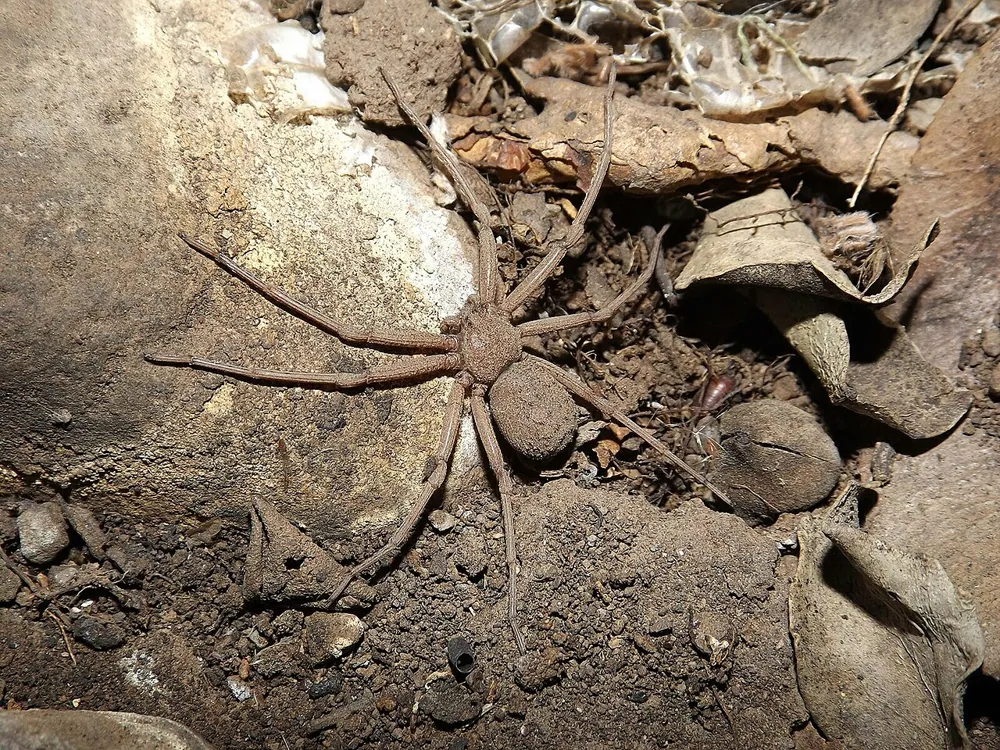
 Ndenge ya koyeba yango
- Body length of 12 to 20 mm1
- Active at night, with nocturnal habits1
- Shelters under rocks on sandy ground1
- Very common in urban areas with household waste1
Bakosanaka yango mbala mingi na: Older records under the name Sicarius terrosus may actually describe other species, such as Sicarius levii. Names in older books can therefore be unreliable.1
Makasi ya venin
Venin ebimaka na nzela ya mino na yango ntango esui.
Venin na yango esalaka nini?
Its venom contains an enzyme called sphingomyelinase D, which has effects similar to those of the Chilean recluse spider. In laboratory tests the venom broke down red blood cells (haemolysis) and damaged skin cells, and 50 μg was enough to cause dermonecrosis, or the death of skin tissue. The venom also broke down fibrinogen, a protein needed for blood to clot.1
Likama na yango mpo na bato ezali boni?
Likama mpo na bato: Epesaka pasiEkoki kopesa pasi mingi, kasi pene na ntango nyonso ezalaka likambo monene te.Laboratory work shows that the venom can damage human tissue. Adult spiders carry up to eight times the amount of venom tested, so bites from adults could cause more serious lesions.1
 Soki esui
- Sukola esika esui mpe tia sachet ya glace likolo na yango mpo na pasi. Luka lisalisi ya monganga soki pasi ezali makasi, ezali kopalangana to moto ayoki nzoto malamu te.
Benga ntango nyonso nimero ya urgence liboso (112, 000, 911). Oyo ezali toli ya lisalisi ya liboso, ezali toli ya monganga te. Makambo ya moboko ya lisalisi ya liboso
 Zala na libateli
- Ata mokolo moko te, simba, kanga to silikisa nyama ya zamba te, ata ya moke, mpe ata soki emonani lokola elali to ekufi.
- Tika yango esika. Soki okutani na moko, zala kimia, zonga sima malembe mpe tika ekende nzela na yango.
- Soki moko esui yo: zala kimia, ningana te, benga nimero ya urgence na yo (112, 000, 911) to kende na lopitalo noki. Kanisa ndenge ezalaki, foto esalisaka.
Ezali koluka yo te. Esalelaka venin na yango mpo na kokanga bilei to komibatela, mpe elingaka mingi kobombama. Makambo mosusu mpo na komibatela
Monene na yango boni?
Molai na yango boni?
 pene na molai ya trombone
 ekoki kopota metre 100 na sekonde 330 (moto ya mbangu koleka asengaka 9,6)
Chilean six-eyed sand spider azali monene boni soki tokokanisi na YO?
Kaka ba calcul na navigateur na yo. Eloko moko te ebombamaka to etindamaka esika moko.
Mbangu na yango boni?


Makambo ya solo
In 2020 a 20 mm spider was recorded preying on a 28 mm gecko, which is larger than the spider itself.1
Its venom breaks down fibrinogen, a clotting protein, faster than the venom of the Loxosceles species it was compared with.1
Scientists found that 50 μg of its venom was enough to cause dermonecrosis in laboratory tests.1
It is extremely common in Chilean cities where household waste is plentiful.1
Solo to lokuta?
Lokuta: The species is known as Sicarius terrosus.
Solo: The correct name is Sicarius thomisoides. The name terrosus was used for this species for a long time, but it was often used wrongly for other species too.1
Esika makambo euti
- Sicarius thomisoides (Wikipedia (CC BY-SA 4.0))
- Sicarius thomisoides (iNaturalist): bankombo mpe classification.
- Venom Wiki: niveau ya likama, monene ya momesano mpe kokanisa ya mbangu ezali ya biso moko. Tala ndenge tolukaka yango: Ndenge tomekaka likama.
Likambo nyonso na lokasa oyo ezali na nimero oyo elakisi source na yango. Soki tosali libunga, limbisa biso, tozali bato oyo balingaka banyama, zulunale ya siansi te. Yebisa biso na [email protected] mpe tokobongisa yango.
 Scorpion azali na nzala! Venom Wiki ezali mosala ya moto moko: ya ofele, pibilisite te mpe trackers te. Mwa mbongo moke ya kosalisa esalisaka mpo ete etikala na internet.Pesa scorpion bilei
Mosusu ya ebota moko: Ba tandambula
 Brazilian wandering spider
 Amazon wandering spider
 Chilean recluse
 Golden silk orb-weaver
 Keyserling's wandering spider
 Argentine black widow
Ezalaka mpe na: Amerika ya Sude
 Golden poison frogBa grenouille ya poison, ba crapaud & ba tritonEkoki kobomaKosimba te
 TerciopeloBa vipère à fossettesEkoki koboma
 Eyelash viperBa vipère à fossettesEkoki koboma
 Golden lanceheadBa vipère à fossettesEkoki koboma
 South American bushmasterBa vipère à fossettesEkoki koboma
 Cane toadBa grenouille ya poison, ba crapaud & ba tritonEsengeli mongangaKosimba te