
 Afrika
 Azia
Azia Erópa
Erópa Amerika ya Sude
 Australia & Océanie
 Antarctique
 Océan Pacifique
 Océan Atlantique
 Océan Indien
 Océan Arctique
 Mer Méditerranée
 Mer Rouge
 Mer des Caraïbes
 Mer de Corail
 Mer de Chine méridionale
 Mer des Philippines
 Mer d'Andaman
 Mer du Nord
 Mer de Timor & Mer d'Arafura
 Golfe du Bengale
 Golfe de Californie
Garden tiger moth
 Nsuki oyo etubaka
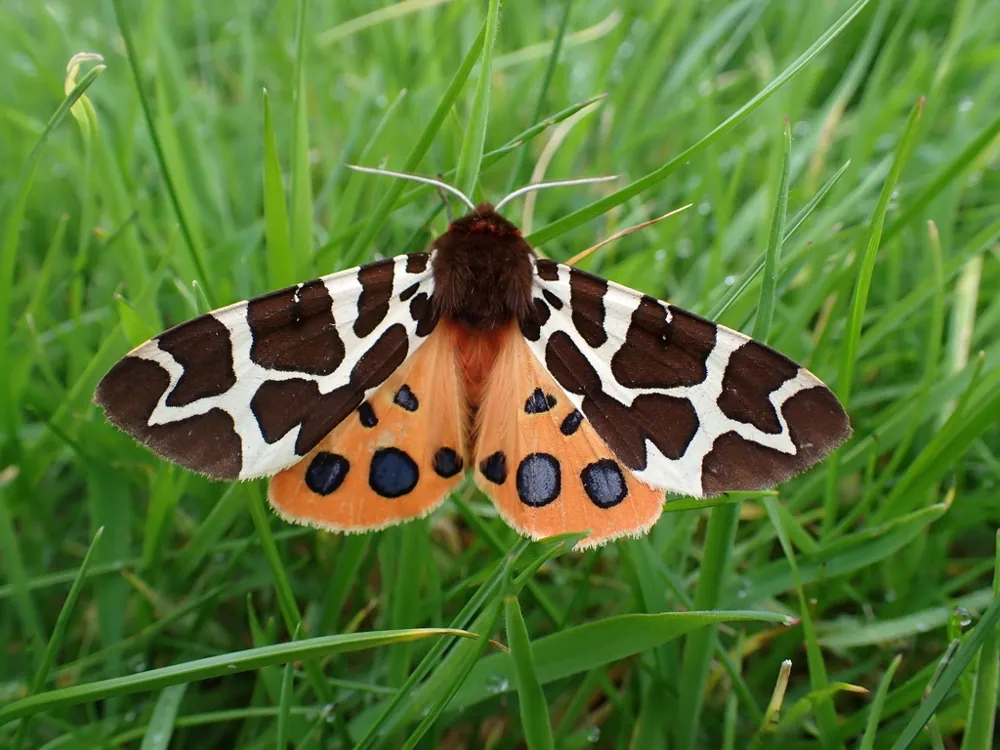
The garden tiger moth is a moth with bold patterned wings that warn predators it is unsafe to eat. It lives in cool, temperate parts of the northern United States, Canada, Europe and Asia. Its caterpillars are known as 'woolly bears' because of their fuzzy look.1

 Ndenge ya koyeba yango
- Adults have a wingspan of 4.5 to 6.5 cm.1
- The front wings are brown with a white pattern, which is sometimes missing.1
- The back wings are orange with dark blue dots that have black outlines.1
- The moth often hides its orange hindwings under its brown forewings when resting.1
- Caterpillars are fuzzy and can grow up to 6 cm long.1
Makasi ya venin
Nsuki to ba poil ya mike ebukanaka na kati ya loposo mpe etubaka.
Venin na yango esalaka nini?
This moth does not inject venom. Its body fluids are poisonous and contain neurotoxic choline esters, which are nerve-affecting chemicals that interfere with the acetylcholine receptor. The full effects of these toxins are not yet known. Caterpillars have hollow hairs that often contain irritating compounds.1
Likama na yango mpo na bato ezali boni?
Likama mpo na bato: Ya mokeLokola kotuba ya nzoi to moke koleka. Pene na likama te mpo na bato.Esalaka nini ntango ebangi?
When threatened, adults can spray an irritating compound from glands that are exposed at that moment, and their bright wing patterns warn predators.1
 Soki osimbi nsuki na yango
- Mpo na nsuki ya mbinzo oyo etubaka: longola yango na scotch, sima sukola loposo. Kofrotter loposo te.
- Mpo na kosuama: sukola mpe pesa malili. Luka lisalisi ya monganga soki moto ayoki nzoto malamu te to soki makila ezali kobima ye pete.
Benga ntango nyonso nimero ya urgence liboso (112, 000, 911). Oyo ezali toli ya lisalisi ya liboso, ezali toli ya monganga te. Makambo ya moboko ya lisalisi ya liboso
 Zala na libateli
- Ata mokolo moko te, simba, kanga to silikisa nyama ya zamba te, ata ya moke, mpe ata soki emonani lokola elali to ekufi.
- Tika yango esika. Soki okutani na moko, zala kimia, zonga sima malembe mpe tika ekende nzela na yango.
- Soki osimbi nsuki na yango: zala kimia, ningana te, benga nimero ya urgence na yo (112, 000, 911) to kende na lopitalo noki. Kanisa ndenge ezalaki, foto esalisaka.
Ezali koluka yo te. Esalelaka venin na yango mpo na kokanga bilei to komibatela, mpe elingaka mingi kobombama. Makambo mosusu mpo na komibatela
Monene na yango boni?
Molai na yango boni?
 molai lokola ba brique ya masano 2 na molongo
 malembe koleka escargot ya elanga
Garden tiger moth azali monene boni soki tokokanisi na YO?
Kaka ba calcul na navigateur na yo. Eloko moko te ebombamaka to etindamaka esika moko.
Mbangu na yango boni?

Makambo ya solo
Adults can make rasping sounds with their wings and high-pitched squeaks that people can hear, and bats tend to avoid them.1
Caterpillars can break down the toxins in their host plants and reuse them in altered form for their own protection.1
The French entomologist Oberthür described about 500 different wing pattern and colour variants.1
Adults are mostly active at night, from June to September.1
Mpo na ba expert ya venin
- Kombo ya siansi
- Arctia caja
- Ebota
- Ba mbinzo & ba insecte
- Libota
- Erebidae2
- Molongo
- Lepidoptera
- Bakontina
- Erópa, Azia, Amerika ya Nord
- Bana
- Eggs are laid on the surfaces of leaves, and the caterpillars hatch and begin feeding soon after.1
- Ndenge ezali kobika na zamba
- Protected in the UK under the Biodiversity Action Plan, after its UK numbers fell by 89% over 30 years1
- Likama mpo na bato
- 1 / 5: Ya moke3
Esika makambo euti
- Garden tiger moth (Wikipedia (CC BY-SA 4.0))
- Arctia caja (iNaturalist): bankombo mpe classification.
- Venom Wiki: niveau ya likama, monene ya momesano mpe kokanisa ya mbangu ezali ya biso moko. Tala ndenge tolukaka yango: Ndenge tomekaka likama.
Likambo nyonso na lokasa oyo ezali na nimero oyo elakisi source na yango. Soki tosali libunga, limbisa biso, tozali bato oyo balingaka banyama, zulunale ya siansi te. Yebisa biso na [email protected] mpe tokobongisa yango.
 Scorpion azali na nzala! Venom Wiki ezali mosala ya moto moko: ya ofele, pibilisite te mpe trackers te. Mwa mbongo moke ya kosalisa esalisaka mpo ete etikala na internet.Pesa scorpion bilei
Mosusu ya ebota moko: Ba mbinzo & ba insecte
 Giant water bugBa mbinzo & ba insecteEpesaka kaka pasi
 Oak processionaryBa mbinzo & ba insecteEpesaka kaka pasiKosimba te
 Pine processionaryBa mbinzo & ba insecteEpesaka kaka pasiKosimba te
 Puss caterpillarBa mbinzo & ba insecteEpesaka kaka pasiKosimba te
 Saddleback caterpillarBa mbinzo & ba insecteEpesaka kaka pasiKosimba te
 Wheel bugBa mbinzo & ba insecteEpesaka kaka pasi
Ezalaka mpe na: Erópa
 Common European adderBa vipère & ba adderEsengeli monganga
 Spanish flyBanyama mosusu ya poisonEsengeli mongangaKosimba te
 Common waspNzoi, ba guêpe & ba frelonEpesaka kaka pasi
 European hornetNzoi, ba guêpe & ba frelonEpesaka kaka pasi
 Fire salamanderBa grenouille ya poison, ba crapaud & ba tritonEpesaka kaka pasiKosimba te
 Western honey beeNzoi, ba guêpe & ba frelonEpesaka kaka pasi