
 Afrika
 Azia
Azia Erópa
Erópa Amerika ya Sude
 Australia & Océanie
 Antarctique
 Océan Pacifique
 Océan Atlantique
 Océan Indien
 Océan Arctique
 Mer Méditerranée
 Mer Rouge
 Mer des Caraïbes
 Mer de Corail
 Mer de Chine méridionale
 Mer des Philippines
 Mer d'Andaman
 Mer du Nord
 Mer de Timor & Mer d'Arafura
 Golfe du Bengale
 Golfe de Californie
Hundred-pace viper
 Kosua
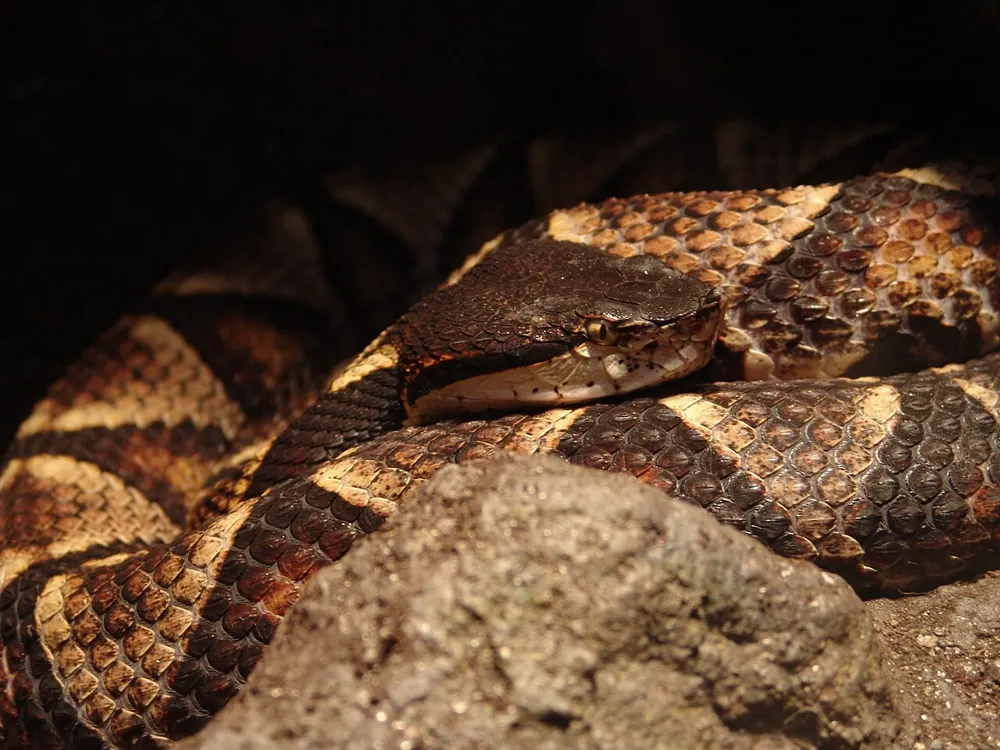
KosuaThe hundred-pace viper is a pit viper that lives in the mountains and hills of southern China, Taiwan and northern Vietnam. It is venomous, and its bite can be dangerous, so it is important to know what it looks like. Its name comes from a well-known but exaggerated local belief about how far a bite victim can walk.1



 Ndenge ya koyeba yango
- Light brown or greyish brown, with a series of dark brown triangles along each side1
- About 20 light brown, squarish blotches run along the back1
- Top of the head and upper sides are black, with a black streak from the eye to the corner of the mouth1
- Large, triangular head with an upturned snout, and a very stout body1
- Young snakes are much lighter than adults but have the same pattern1
Makasi ya venin
Venin ebimaka na nzela ya mino na yango ntango esui.
Venin na yango esalaka nini?
Its venom is a potent hemotoxin, which damages blood and tissue and is strongly haemorrhagic, meaning it causes bleeding. Bite symptoms include severe pain and bleeding that may begin almost immediately, followed by swelling, blistering, tissue death (necrosis) and ulceration. Heart palpitations may come on suddenly and relatively soon after the bite.1
Likama na yango mpo na bato ezali boni?
Likama mpo na bato: Likama mingiEkoki koboma moto oyo azwi bosalisi te.The species is considered dangerous, and deaths are not unusual. Its large, hinged fangs can deliver large amounts of venom.1
 Nsango malamu: ba monganga bazali na nkisi (antivenin) to bosalisi mpo na yango.1
 Soki esui
- Victims should be treated according to the seriousness of the bite. Cutting off or burning a bitten finger or limb is harmful and can cause further complications. An antivenom is produced in Taiwan.1
- Tika moto aningana te mpe azala kimia, tika lokolo to loboko oyo esui na niveau ya motema, longola ba bague mpe biloko oyo ekangi makasi, mpe kende na lopitalo noki.
Benga ntango nyonso nimero ya urgence liboso (112, 000, 911). Oyo ezali toli ya lisalisi ya liboso, ezali toli ya monganga te. Makambo ya moboko ya lisalisi ya liboso
 Zala na libateli
- Ata mokolo moko te, simba, kanga to silikisa nyama ya zamba te, ata ya moke, mpe ata soki emonani lokola elali to ekufi.
- Tika yango esika. Soki okutani na moko, zala kimia, zonga sima malembe mpe tika ekende nzela na yango.
- Soki moko esui yo: zala kimia, ningana te, benga nimero ya urgence na yo (112, 000, 911) to kende na lopitalo noki. Kanisa ndenge ezalaki, foto esalisaka.
Ezali koluka yo te. Esalelaka venin na yango mpo na kokanga bilei to komibatela, mpe elingaka mingi kobombama. Makambo mosusu mpo na komibatela
Monene na yango boni?
Molai na yango boni?
 molai lokola ba pusu ya ndako 3, zolo kino mokila
 molai lokola bitabe 9 oyo etiami moko na sima ya mosusu
 ekoki kopota metre 100 na sekonde 95 (moto ya mbangu koleka asengaka 9,6)
Hundred-pace viper azali monene boni soki tokokanisi na YO?
Kaka ba calcul na navigateur na yo. Eloko moko te ebombamaka to etindamaka esika moko.
Mbangu na yango boni?


Makambo ya solo
Its popular name, hundred-pacer, is said to come from a belief that a bitten victim can walk only 100 steps before dying.1
A protein from its venom, called ACTX-6, has been shown to cause cell death in isolated cancer cells.1
Its venom is widely used in research. In mice, it attacks the kidneys and the mice die.1
It is one of the few pit vipers that lays eggs. It can keep eggs inside during early incubation, which shortens the time they need to develop after being laid.1
The venom has been used in traditional Chinese medicine for centuries to make antivenin for treating snakebites.1
For the Paiwan people of Taiwan, the viper is the parent of their hero Aljis, and the viper symbol is used on their homes to show power.1
Solo to lokuta?
Lokuta: A person bitten by a hundred-pace viper can only walk 100 steps before dying.
Solo: This belief is an exaggeration. The species is still dangerous, and deaths are not unusual. Believing the myth has led people to amputate or burn bitten fingers or limbs, which causes further harm.1
Esika makambo euti
- Deinagkistrodon (Wikipedia (CC BY-SA 4.0))
- Deinagkistrodon acutus (iNaturalist): bankombo mpe classification.
- Venom Wiki: niveau ya likama, monene ya momesano mpe kokanisa ya mbangu ezali ya biso moko. Tala ndenge tolukaka yango: Ndenge tomekaka likama.
Likambo nyonso na lokasa oyo ezali na nimero oyo elakisi source na yango. Soki tosali libunga, limbisa biso, tozali bato oyo balingaka banyama, zulunale ya siansi te. Yebisa biso na [email protected] mpe tokobongisa yango.
 Scorpion azali na nzala! Venom Wiki ezali mosala ya moto moko: ya ofele, pibilisite te mpe trackers te. Mwa mbongo moke ya kosalisa esalisaka mpo ete etikala na internet.Pesa scorpion bilei
 Brown spotted pit viper
 Habu
Habu Hump-nosed viper
 Malayan pit viper
 Mamushi
 Mangshan pit viper
 Deathstalker
 Indian cobra
 Indian saw-scaled viper
 King cobra
 Puff adder
 Pili ya Russell