
 Afrika
 Azia
Azia Erópa
Erópa Amerika ya Sude
 Australia & Océanie
 Antarctique
 Océan Pacifique
 Océan Atlantique
 Océan Indien
 Océan Arctique
 Mer Méditerranée
 Mer Rouge
 Mer des Caraïbes
 Mer de Corail
 Mer de Chine méridionale
 Mer des Philippines
 Mer d'Andaman
 Mer du Nord
 Mer de Timor & Mer d'Arafura
 Golfe du Bengale
 Golfe de Californie
Lion's mane jellyfish
 Ba tentacule oyo etubaka
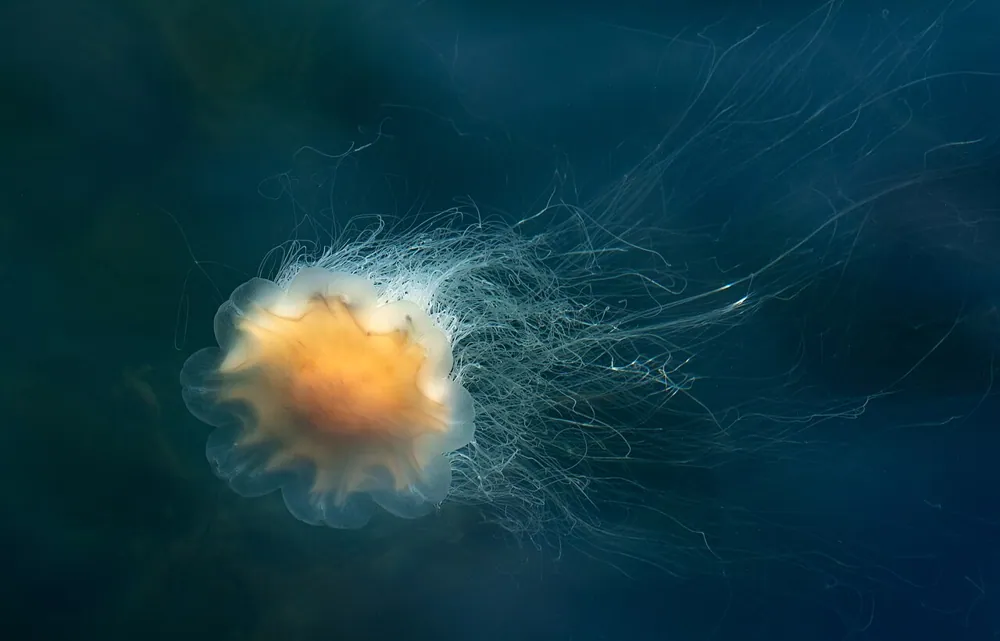
The lion's mane jellyfish is one of the largest jellyfish known, and its bell can be over 2 m across in the far north. It lives in cold northern seas, including the English Channel, the North Sea and the Irish Sea. Its long, trailing stinging tentacles can wash up on beaches in late summer and autumn.1



 Ndenge ya koyeba yango
- Bell is divided into eight lobes, giving it the look of an eight-point star1
- Young ones are light orange or tan, darkening to red and purple as they grow1
- Long, thin, trailing tentacles, with many more tentacles around the mouth1
- Bell is often about 50 cm across in lower latitudes, and much larger in the far north1
- Usually found alone, rarely in groups1
Bakosanaka yango mbala mingi na: The blue jellyfish (Cyanea lamarckii) is sometimes found in the same waters. It is blue rather than red, and smaller, with a bell of about 10 to 20 cm across.1
Makasi ya venin
Ba cellule ya mike nkoto na nkoto oyo etubaka ebetaka ntango eloko moko esimbi yango.
Venin na yango esalaka nini?
Its tentacles carry stinging cells, called nematocysts, which inject a sting when touched. The sting is very painful and feels like intense itching or burning, and it can cause temporary pain and redness where the skin was touched. Stings across large parts of the body can cause whole-body (systemic) effects, and medical attention is recommended in that case.1
Likama na yango mpo na bato ezali boni?
Likama mpo na bato: Epesaka pasiEkoki kopesa pasi mingi, kasi pene na ntango nyonso ezalaka likambo monene te.Stings are not known to be fatal in healthy people, and there is normally no real danger, though people with special allergies may be at risk. Rare severe stings in deep water can cause panic, which may lead to drowning. In July 2010, about 150 beachgoers were stung by the remains of one broken-up jellyfish on a beach in New Hampshire, US.1
 Soki etubi
- Vinegar can be used to deactivate the stinging cells. If you have touched a large number of tentacles, get medical attention after exposure.1
- Bima na mai mpe longola ba tentacule nyonso (na ba gants to na elamba).
- Mpo na ba méduse-boîte ya mai ya molunge: sopa vinaigre na esika etubami mpo na sekonde 30 to koleka, benga lisalisi mpe bongisama mpo na kosala RCP (massage ya motema). Mpo na ba bluebottle mpe mingi mosusu: sukola na mai ya mbu, sima na mai ya moto mpo na pasi.
Benga ntango nyonso nimero ya urgence liboso (112, 000, 911). Oyo ezali toli ya lisalisi ya liboso, ezali toli ya monganga te. Makambo ya moboko ya lisalisi ya liboso
 Zala na libateli
- Ata mokolo moko te, simba, kanga to silikisa nyama ya zamba te, ata ya moke, mpe ata soki emonani lokola elali to ekufi.
- Tika yango esika. Soki okutani na moko, zala kimia, zonga sima malembe mpe tika ekende nzela na yango.
- Soki moko etubi yo: zala kimia, ningana te, benga nimero ya urgence na yo (112, 000, 911) to kende na lopitalo noki. Kanisa ndenge ezalaki, foto esalisaka.
Ezali koluka yo te. Esalelaka venin na yango mpo na kokanga bilei to komibatela, mpe elingaka mingi kobombama. Makambo mosusu mpo na komibatela
Wapi na mokili?
Monene na yango boni?
Molai na yango boni?
 molai lokola ba pusu ya ndako 4, zolo kino mokila
 molai lokola bitabe 12 oyo etiami moko na sima ya mosusu
 ekoki kobeta mai molai ya piscine monene (50 m) na sekonde 140
Lion's mane jellyfish azali monene boni soki tokokanisi na YO?
Kaka ba calcul na navigateur na yo. Eloko moko te ebombamaka to etindamaka esika moko.
Mbangu na yango boni?

Makambo ya solo
The longest recorded tentacles were 36.6 m long, longer than a blue whale.1
Its tentacles can still sting for up to 25 days after they have detached from the jellyfish.1
Each of the eight lobes of its bell has about 70 to 150 tentacles, and it has around 1,200 tentacles near its mouth.1
The leatherback sea turtle feeds almost exclusively on lion's mane jellyfish in large numbers during summer around Eastern Canada.1
Unlike most jellyfish that drift in groups, the lion's mane is completely solitary.1
Solo to lokuta?
Lokuta: The lion's mane jellyfish is the longest animal in the world.
Solo: This claim was made on a TV show, but it was corrected. A bootlace worm reported in 1864 was said to be over 55 m long, and that report is doubted because bootlace worms can stretch well beyond their natural length. If that report is wrong, the lion's mane would be the longest animal.1
Mpo na ba expert ya venin
- Kombo ya siansi
- Cyanea capillata
- Ebota
- Ba méduse & banyama ya mbu oyo etubaka
- Libota
- Cyaneidae2
- Molongo
- Semaeostomeae
- Bakontina
- Océan Arctique, Océan Atlantique, Océan Pacifique, Mer du Nord, Ba océan
- Bana
- The female carries fertilised eggs in a tentacle, and they grow into larvae that settle on a hard surface and become polyps, which then produce young jellyfish called ephyrae.1
- Molai ya bomoi
- pene na mibu 11
- Likama mpo na bato
- 2 / 5: Epesaka pasi3
Esika makambo euti
- Lion's mane jellyfish (Wikipedia (CC BY-SA 4.0))
- Cyanea capillata (iNaturalist): bankombo mpe classification.
- Venom Wiki: niveau ya likama, monene ya momesano mpe kokanisa ya mbangu ezali ya biso moko. Tala ndenge tolukaka yango: Ndenge tomekaka likama.
Likambo nyonso na lokasa oyo ezali na nimero oyo elakisi source na yango. Soki tosali libunga, limbisa biso, tozali bato oyo balingaka banyama, zulunale ya siansi te. Yebisa biso na [email protected] mpe tokobongisa yango.
 Scorpion azali na nzala! Venom Wiki ezali mosala ya moto moko: ya ofele, pibilisite te mpe trackers te. Mwa mbongo moke ya kosalisa esalisaka mpo ete etikala na internet.Pesa scorpion bilei
Mosusu ya ebota moko: Ba méduse & banyama ya mbu oyo etubaka
 Australian box jellyfishBa méduse & banyama ya mbu oyo etubakaEkoki kobomaKosimba te
 Irukandji jellyfishBa méduse & banyama ya mbu oyo etubakaEkoki kobomaKosimba te
 Portuguese man o' warBa méduse & banyama ya mbu oyo etubakaEsengeli mongangaKosimba te
 Moon jellyfishBa méduse & banyama ya mbu oyo etubakaEzangi likama
 Common kingslayerBa méduse & banyama ya mbu oyo etubakaEkoki kobomaKosimba te
 Hell's fire anemoneBa méduse & banyama ya mbu oyo etubakaEsengeli mongangaKosimba te
 Greenland shark
 Spiny dogfish
 Bootlace worm