
 Afrika
 Azia
Azia Erópa
Erópa Amerika ya Sude
 Australia & Océanie
 Antarctique
 Océan Pacifique
 Océan Atlantique
 Océan Indien
 Océan Arctique
 Mer Méditerranée
 Mer Rouge
 Mer des Caraïbes
 Mer de Corail
 Mer de Chine méridionale
 Mer des Philippines
 Mer d'Andaman
 Mer du Nord
 Mer de Timor & Mer d'Arafura
 Golfe du Bengale
 Golfe de Californie
Irukandji jellyfish
 Ba tentacule oyo etubaka
The Irukandji jellyfish is a tiny box jellyfish with a sting that can cause a serious illness called Irukandji syndrome. It lives in the open water near Australia, and it is hard to spot because it is so small.1



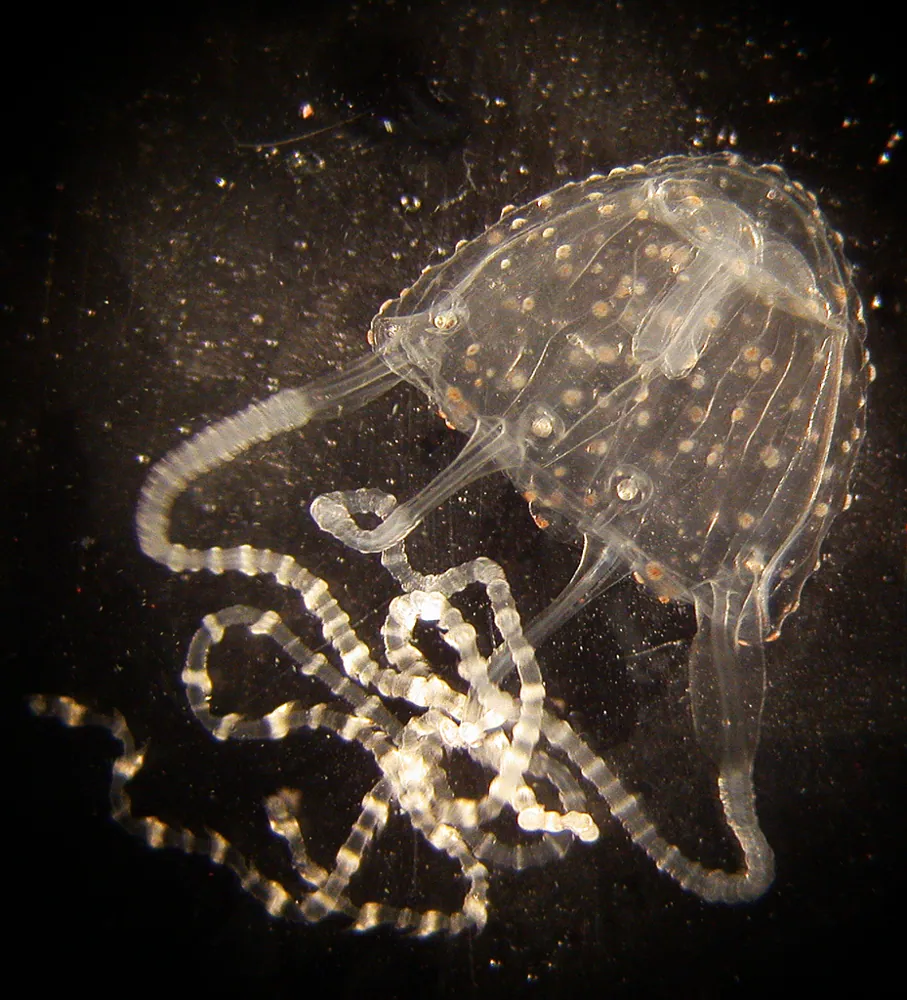
 Ndenge ya koyeba yango
- The bell is square-shaped and very small, about 12 mm high and 30 mm across.1
- It has four long tentacles, one from each corner of the bell.1
- The tentacles range from 5 to 50 cm long.1
- Its small size means it often goes unseen in open water.1
Bakosanaka yango mbala mingi na: The common name Irukandji jellyfish is also used for other Irukandji jellyfish, such as Malo kingi. The name alone does not tell them apart.1
Makasi ya venin
Ba cellule ya mike nkoto na nkoto oyo etubaka ebetaka ntango eloko moko esimbi yango.
Venin na yango esalaka nini?
This jellyfish is extremely venomous. Its venom comes from stinging cells called nematocysts in its tentacles and bell, and it changes as the jellyfish matures. A sting can cause Irukandji syndrome, with muscle aches, back pain, nausea, headaches, chest and stomach pains, sweating, high blood pressure and difficulty breathing.1
Likama na yango mpo na bato ezali boni?
Likama mpo na bato: Likama mingiEkoki koboma moto oyo azwi bosalisi te.Irukandji syndrome can be severe, and the symptoms are described in detail in medical accounts. Most reported incidents have been in Australia during the warm summer season. Because the jellyfish is so small, people often do not see it before they are stung.1
 Soki etubi
- In hospital, patients are given intravenous morphine, hydromorphone or fentanyl for pain. Pethidine is avoided because of its toxic metabolite norpethidine.1
- Bima na mai mpe longola ba tentacule nyonso (na ba gants to na elamba).
- Mpo na ba méduse-boîte ya mai ya molunge: sopa vinaigre na esika etubami mpo na sekonde 30 to koleka, benga lisalisi mpe bongisama mpo na kosala RCP (massage ya motema). Mpo na ba bluebottle mpe mingi mosusu: sukola na mai ya mbu, sima na mai ya moto mpo na pasi.
Benga ntango nyonso nimero ya urgence liboso (112, 000, 911). Oyo ezali toli ya lisalisi ya liboso, ezali toli ya monganga te. Makambo ya moboko ya lisalisi ya liboso
 Zala na libateli
- Ata mokolo moko te, simba, kanga to silikisa nyama ya zamba te, ata ya moke, mpe ata soki emonani lokola elali to ekufi.
- Tika yango esika. Soki okutani na moko, zala kimia, zonga sima malembe mpe tika ekende nzela na yango.
- Soki moko etubi yo: zala kimia, ningana te, benga nimero ya urgence na yo (112, 000, 911) to kende na lopitalo noki. Kanisa ndenge ezalaki, foto esalisaka.
Ezali koluka yo te. Esalelaka venin na yango mpo na kokanga bilei to komibatela, mpe elingaka mingi kobombama. Makambo mosusu mpo na komibatela
Wapi na mokili?
Monene na yango boni?
Molai na yango boni?
 mokuse koleka mosapi na yo ya moke
 ekoki kobeta mai molai ya piscine monene (50 m) na sekonde 36
Irukandji jellyfish azali monene boni soki tokokanisi na YO?
Kaka ba calcul na navigateur na yo. Eloko moko te ebombamaka to etindamaka esika moko.
Mbangu na yango boni?
Makambo ya solo
Jack Barnes of Cairns, Australia, discovered the species. During an exploration aimed at finding the cause of Irukandji syndrome, he allowed himself, a lifeguard and his 9-year-old son to be stung.1
Irukandji syndrome, which this jellyfish can cause, was first identified after a group of swimmers were stung in open water near North Queensland, Australia.1
Its venom changes in composition as the jellyfish grows, matching its change in prey from invertebrates to fish.1
Its life cycle alternates between a young form that attaches to a reef or rock and an adult form that swims freely in the water.1
This jellyfish is a type of box jellyfish, a group known for potent venom.1
Mpo na ba expert ya venin
- Kombo ya siansi
- Carukia barnesi
- Ebota
- Ba méduse & banyama ya mbu oyo etubaka
- Libota
- Carukiidae2
- Molongo
- Carybdeida
- Bakontina
- Océan Indien, Océan Pacifique, Mer de Corail, Mer de Timor & Mer d'Arafura, Ba océan
- Bana
- Young jellyfish begin as a swimming planula larva, which settles on a reef or rock and grows into a polyp. The polyp later forms a colony that develops into an adult medusa.1
- Likama mpo na bato
- 4 / 5: Likama mingi3
Esika makambo euti
- Carukia barnesi (Wikipedia (CC BY-SA 4.0))
- Carukia barnesi (iNaturalist): bankombo mpe classification.
- Venom Wiki: niveau ya likama, monene ya momesano mpe kokanisa ya mbangu ezali ya biso moko. Tala ndenge tolukaka yango: Ndenge tomekaka likama.
Likambo nyonso na lokasa oyo ezali na nimero oyo elakisi source na yango. Soki tosali libunga, limbisa biso, tozali bato oyo balingaka banyama, zulunale ya siansi te. Yebisa biso na [email protected] mpe tokobongisa yango.
 Scorpion azali na nzala! Venom Wiki ezali mosala ya moto moko: ya ofele, pibilisite te mpe trackers te. Mwa mbongo moke ya kosalisa esalisaka mpo ete etikala na internet.Pesa scorpion bilei
Mosusu ya ebota moko: Ba méduse & banyama ya mbu oyo etubaka
 Australian box jellyfishBa méduse & banyama ya mbu oyo etubakaEkoki kobomaKosimba te
 Portuguese man o' warBa méduse & banyama ya mbu oyo etubakaEsengeli mongangaKosimba te
 Lion's mane jellyfishBa méduse & banyama ya mbu oyo etubakaEpesaka kaka pasiKosimba te
 Moon jellyfishBa méduse & banyama ya mbu oyo etubakaEzangi likama
 Common kingslayerBa méduse & banyama ya mbu oyo etubakaEkoki kobomaKosimba te
 Hell's fire anemoneBa méduse & banyama ya mbu oyo etubakaEsengeli mongangaKosimba te
Ezalaka mpe na: Océan Indien
 Geography coneBa escargot cône & ba pieuvreEkoki koboma
 Greater blue-ringed octopusBa escargot cône & ba pieuvreEkoki koboma
 Southern blue-ringed octopusBa escargot cône & ba pieuvreEkoki koboma
 Hawksbill sea turtleBanyama mosusu ya poisonEkoki koboma
 Reef stonefishMbisi ya veninEkoki kobomaKosimba te
 Crown-of-thorns starfishBa oursin, ba étoile ya mbu & ba verEsengeli mongangaKosimba te