
 Afrika
 Azia
Azia Erópa
Erópa Amerika ya Sude
 Australia & Océanie
 Antarctique
 Océan Pacifique
 Océan Atlantique
 Océan Indien
 Océan Arctique
 Mer Méditerranée
 Mer Rouge
 Mer des Caraïbes
 Mer de Corail
 Mer de Chine méridionale
 Mer des Philippines
 Mer d'Andaman
 Mer du Nord
 Mer de Timor & Mer d'Arafura
 Golfe du Bengale
 Golfe de Californie
West African night adder
 Kosua
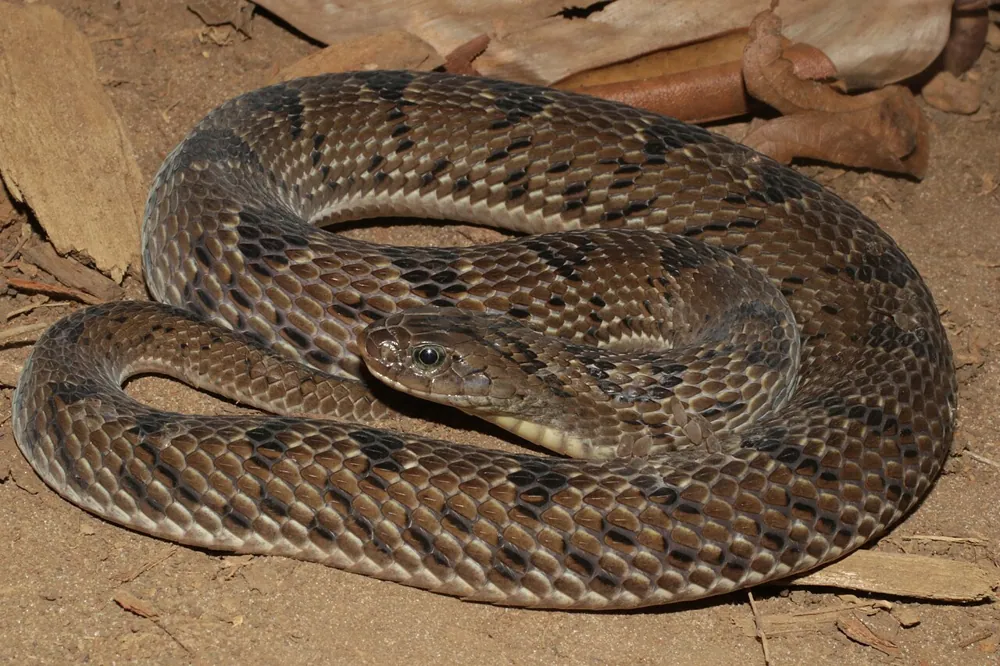
KosuaThe West African night adder is a small, stout snake that lives in forests, savannas and dry semi-desert across West and Central Africa. It is venomous, but its bite usually causes only mild symptoms. It is known for hunting frogs and toads.1

 Ndenge ya koyeba yango
- Small and stout, usually 30 to 60 cm (12 to 24 in) long including the tail.1
- Brown background colour, sometimes grey, olive or light green, with a row of dark brown or blackish patches down the back.1
- Flanks sprinkled with black scales.1
- A distinct V-shaped mark on the head. It is solid black in young snakes and brown with a black outline in adults.1
- Some snakes, especially from drier areas, have no back pattern at all, which makes them hard to identify. Those from DR Congo are often plain brown.1
Makasi ya venin
Venin ebimaka na nzela ya mino na yango ntango esui.
Venin na yango esalaka nini?
Bites cause mild symptoms, including pain, moderate swelling, swollen lymph nodes near the bite (local lymphadenitis) and a mild fever. Blistering has not been reported, and tissue death (necrosis) is rare and usually happens only as a secondary effect. The symptoms usually fade after two to three days, normally without complications.1
Likama na yango mpo na bato ezali boni?
Likama mpo na bato: Epesaka pasiEkoki kopesa pasi mingi, kasi pene na ntango nyonso ezalaka likambo monene te.Bites from this snake are described as causing mild symptoms that normally clear up without complications.1
 Soki esui
- Tika moto aningana te mpe azala kimia, tika lokolo to loboko oyo esui na niveau ya motema, longola ba bague mpe biloko oyo ekangi makasi, mpe kende na lopitalo noki.
Benga ntango nyonso nimero ya urgence liboso (112, 000, 911). Oyo ezali toli ya lisalisi ya liboso, ezali toli ya monganga te. Makambo ya moboko ya lisalisi ya liboso
 Zala na libateli
- Ata mokolo moko te, simba, kanga to silikisa nyama ya zamba te, ata ya moke, mpe ata soki emonani lokola elali to ekufi.
- Tika yango esika. Soki okutani na moko, zala kimia, zonga sima malembe mpe tika ekende nzela na yango.
- Soki moko esui yo: zala kimia, ningana te, benga nimero ya urgence na yo (112, 000, 911) to kende na lopitalo noki. Kanisa ndenge ezalaki, foto esalisaka.
Ezali koluka yo te. Esalelaka venin na yango mpo na kokanga bilei to komibatela, mpe elingaka mingi kobombama. Makambo mosusu mpo na komibatela
Monene na yango boni?
Molai na yango boni?
 molai lokola bitabe 4 oyo etiami moko na sima ya mosusu
 ekoki kopota metre 100 na sekonde 110 (moto ya mbangu koleka asengaka 9,6)
West African night adder azali monene boni soki tokokanisi na YO?
Kaka ba calcul na navigateur na yo. Eloko moko te ebombamaka to etindamaka esika moko.
Mbangu na yango boni?


Makambo ya solo
Despite its name, the night adder is active at any time of day or night, and it has sometimes been seen basking in the sun.1
It is a slow-moving snake, but it can strike quickly. It tends to lash at its target rather than stab.1
It is most active in the rainy season, from March to October, when its prey is plentiful. It almost disappears during the dry season.1
Its back pattern varies a lot. Some snakes have no pattern at all, and snakes from DR Congo are often a uniform brown.1
Esika makambo euti
- Causus maculatus (Wikipedia (CC BY-SA 4.0))
- Causus maculatus (iNaturalist): bankombo mpe classification.
- Venom Wiki: niveau ya likama, monene ya momesano mpe kokanisa ya mbangu ezali ya biso moko. Tala ndenge tolukaka yango: Ndenge tomekaka likama.
Likambo nyonso na lokasa oyo ezali na nimero oyo elakisi source na yango. Soki tosali libunga, limbisa biso, tozali bato oyo balingaka banyama, zulunale ya siansi te. Yebisa biso na [email protected] mpe tokobongisa yango.
 Scorpion azali na nzala! Venom Wiki ezali mosala ya moto moko: ya ofele, pibilisite te mpe trackers te. Mwa mbongo moke ya kosalisa esalisaka mpo ete etikala na internet.Pesa scorpion bilei
Mosusu ya ebota moko: Ba vipère & ba adder
 Puff adderBa vipère & ba adderEkoki koboma
 Gaboon viperBa vipère & ba adderEkoki koboma
 Northeast African carpet viperBa vipère & ba adderEkoki koboma
 West African carpet viperBa vipère & ba adderEkoki koboma
 Rhinoceros viperBa vipère & ba adderEkoki koboma
 West African Gaboon viperBa vipère & ba adderEkoki koboma
 Black mamba
 Deathstalker
 Egyptian cobra
 Boomslang
 Fat-tailed scorpion
 Western honey bee