
 Afrika
 Asia
Asia Eropah
 Amerika Selatan
 Australia & Oceania
 Antartika
 Lautan Pasifik
 Lautan Atlantik
 Lautan Hindi
 Lautan Artik
 Laut Mediterranean
 Laut Merah
 Laut Caribbean
 Laut Karang
 Laut China Selatan
 Laut Filipina
 Laut Andaman
 Laut Utara
 Laut Timor & Laut Arafura
 Teluk Benggala
 Teluk California
Black long-spined urchin
 Duri berbisa
The black long-spined urchin is a sea urchin with very long, hollow spines. It lives on coral reefs, sand flats and seagrass beds across the Indo-Pacific, and it is one of the most widespread sea urchins in that region. Its spines can deliver a mild venom, so it is best to watch where you put your feet.1


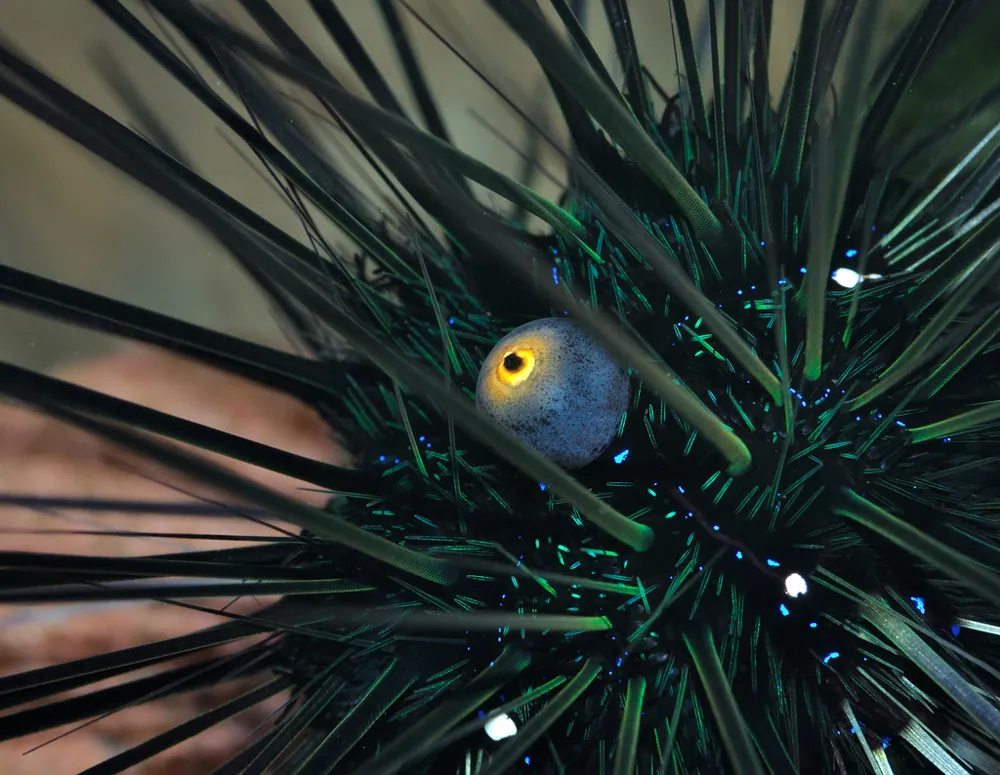
 Cara mengenalinya
- Black, near-spherical body (test) with extremely long, narrow, hollow spines, often black but sometimes brown-banded1
- Five white spots on the body, which separate it from other Diadema species1
- A bright orange ring around the periproctal cone (the 'anal cone'), which is often mistaken for an eye1
- Bluish spots on the genital plates and a line of blue spots along the body1
- Adults are no more than 70 mm across the body and about 40 mm high1
Sering dikelirukan dengan: Other Diadema species are similar in shape and spines, but they lack the five white spots that mark this species. Its orange ring and blue spots also help to tell it apart.1
Kuasa bisa
Duri tajam membawa bisa. Memijak atau memegangnya menyakitkan.
Apa kesan bisanya?
The spines are hollow and contain a mild venom. The toxin mostly causes swelling and pain, which spreads gradually over several hours. The venom is not fatal to humans. The spines themselves are a bigger problem, because they are brittle and needle-like, break off in flesh and are difficult to remove.1
Berapa bahaya ia kepada manusia?
Bahaya kepada manusia: MenyakitkanIa boleh jadi sangat sakit, tetapi hampir tidak pernah serius.The venom is only mild, and the species is not considered a serious threat to humans. Stepping on it can cause painful stings.1
Apa yang ia buat apabila takut?
When threatened by a sudden impact or by spines snapping, it rapidly flips its body over and 'runs' on the tips of its longest spines.1
 Jika durinya menikam kamu
- Rendam luka dalam air panas, sepanas yang orang itu boleh tahan tanpa melecur, dan dapatkan bantuan perubatan untuk mengeluarkan duri. Jangan korek sendiri.
Sentiasa hubungi nombor kecemasan dahulu (112, 000, 911). Ini panduan pertolongan cemas umum, bukan nasihat perubatan. Asas pertolongan cemas
 Kekal selamat
- Jangan sesekali sentuh, tangkap atau usik haiwan liar, walaupun yang kecil, dan walaupun ia nampak tidur atau mati.
- Beri ia ruang. Jika kamu terjumpa, bertenang, undur perlahan-lahan dan biarkan ia pergi.
- Jika durinya menikam kamu: bertenang, jangan bergerak, hubungi nombor kecemasan (112, 000, 911) atau pergi ke hospital dengan segera. Ingat rupanya, gambar boleh membantu.
Ia bukan mahu memburu kamu. Ia guna bisanya untuk menangkap makanan atau melindungi diri, dan ia lebih suka bersembunyi. Lagi tentang keselamatan
Di mana di dunia?
Berapa besar ia?
Berapa panjang ia?
Berapa berat ia?

 sepanjang 2 blok binaan mainan disusun sebaris
 lebih perlahan daripada siput kebun
Berapa besar Black long-spined urchin berbanding KAMU?
Hanya matematik dalam pelayar kamu. Tiada apa yang disimpan atau dihantar ke mana-mana.
Berapa laju ia?

Fakta
It can move 760 mm in just 7 seconds by rolling and walking on the tips of its spines.1
It has no eye, but it has a diffuse light-sensing system that lets it detect light levels and the size and colour of objects.1
In 2006, living specimens were found off Turkey, making it the first invasive Erythrean sea urchin recorded in the Mediterranean.1
Goose barnacles of the genus Microlepas are known to live on it as parasites.1
It is considered one of the oldest living species in its genus, Diadema.1
Pemecah mitos
Mitos: Black long-spined urchins are deadly and their stings can kill people.
Hakikat: Their venom is mild and is not fatal to humans. The main problems are pain, swelling and spines that break off in the skin.1
Untuk pakar bisa
- Nama saintifik
- Diadema setosum
- Kumpulan
- Landak laut, tapak sulaiman & cacing
- Keluarga
- Diadematidae2
- Susunan
- Diadematoida
- Benua-benua
- Lautan Hindi, Lautan Pasifik, Laut Merah, Laut Karang, Laut Filipina, Laut Arab & Teluk Parsi, Laut Timor & Laut Arafura, Teluk Benggala, Lautan
- Anak
- It is a broadcast spawner, releasing eggs and sperm into the water. Spawning happens seasonally or year-round depending on the location, and in some places it follows the full moon.1
- Bahaya kepada manusia
- 2 / 5: Menyakitkan3
Dari mana fakta datang
- Diadema setosum (Wikipedia (CC BY-SA 4.0))
- Diadema setosum (iNaturalist): nama dan pengelasan.
- Venom Wiki: tahap bahaya, saiz biasa dan anggaran kelajuan adalah penilaian kami sendiri. Lihat cara kami mengiranya: Cara kami menilai bahaya.
Setiap fakta di halaman ini ada nombor yang menunjuk kepada sumbernya. Jika kami tersilap, maaf, kami peminat haiwan, bukan jurnal sains. Beritahu kami di [email protected] dan kami akan betulkan.
 Kala jengking lapar! Venom Wiki ialah projek seorang lelaki: percuma, tanpa iklan dan tanpa penjejak. Sedikit sumbangan membantu memastikannya terus dalam talian.Beri kala jengking makan
Lagi dari kumpulan yang sama: Landak laut, tapak sulaiman & cacing
 Crown-of-thorns starfishLandak laut, tapak sulaiman & cacingPerlu jumpa doktorJangan sentuh
 Flower urchinLandak laut, tapak sulaiman & cacingBoleh membunuh
 Fire urchinLandak laut, tapak sulaiman & cacingPerlu jumpa doktorJangan sentuh
 Bearded firewormLandak laut, tapak sulaiman & cacingSakit sahajaJangan sentuh
 BloodwormLandak laut, tapak sulaiman & cacingSakit sahaja
 Bobbit wormLandak laut, tapak sulaiman & cacingSakit sahaja
Juga hidup di: Lautan Hindi
 Obor-obor kotak AustraliaObor-obor & penyengat lautMembawa mautJangan sentuh
 Siput kon geografiSiput kon & sotong kuritaMembawa maut
 Kurita cincin biru besarSiput kon & sotong kuritaMembawa maut
 Kurita cincin biru selatanSiput kon & sotong kuritaMembawa maut
 Hawksbill sea turtleHaiwan beracun lainBoleh membunuh
 Irukandji jellyfishObor-obor & penyengat lautBoleh membunuhJangan sentuh