
 Afrika
 Asia
Asia Eropah
 Amerika Selatan
 Australia & Oceania
 Antartika
 Lautan Pasifik
 Lautan Atlantik
 Lautan Hindi
 Lautan Artik
 Laut Mediterranean
 Laut Merah
 Laut Caribbean
 Laut Karang
 Laut China Selatan
 Laut Filipina
 Laut Andaman
 Laut Utara
 Laut Timor & Laut Arafura
 Teluk Benggala
 Teluk California
Flower urchin
 Sengatan
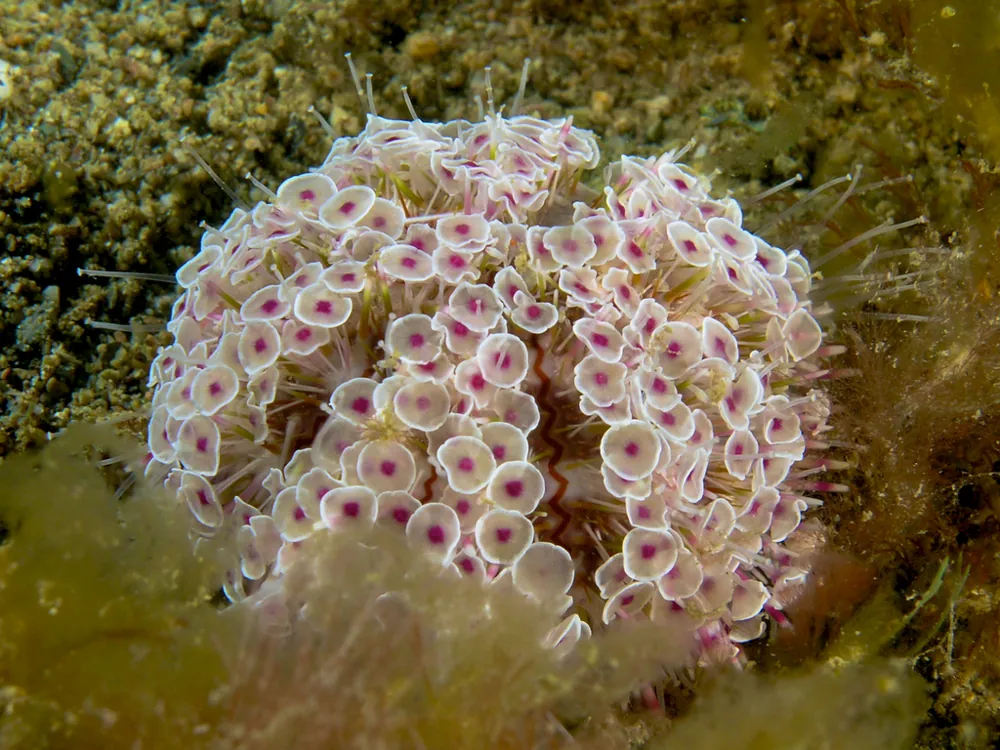
The flower urchin is a sea urchin with flower-shaped claws that can sting. It lives on coral reefs, in seagrass beds and on rocky or sandy sea floors across the Indo-West Pacific. It is one of the sea urchins most likely to cause a painful and medically significant sting.1
 Cara mengenalinya
- Flower-like claws (globiferous pedicellariae) that are pinkish-white to yellowish-white, with a central purple dot and a bright white rim1
- A rigid shell (test) that is deep red and grey, with a purple zigzag pattern along each of the five ambulacral segments; rarely it is greenish or pale purple1
- Short, blunt spines, usually hidden beneath the flower-like claws1
- A body diameter of about 15 to 20 cm1
Sering dikelirukan dengan: Other Toxopneustes urchins look similar. Toxopneustes roseus has a uniform pink, brown or purple test and lives only in the eastern Pacific. Toxopneustes elegans, found only around Japan, has a dark stripe just below the tips of its spines. Toxopneustes maculatus is very rare, known from Réunion, Christmas Island and Palmyra Atoll, and has bright violet on its underside and a violet band around its middle.1
Kuasa bisa
Bisa keluar melalui penyengat.
Apa kesan bisanya?
Its venom is made in glands at the base of the flower-like claws, not in the spines. The claws have sharp fang-like tips that can penetrate human skin, and when touched they snap shut and inject venom. The sting is described as extremely painful and medically significant.1
Berapa bahaya ia kepada manusia?
Bahaya kepada manusia: Sangat berbahayaIa boleh membunuh orang yang tidak mendapat rawatan.It is considered highly dangerous to people. Its stings are extremely painful and medically significant. Larger individuals with bigger claws are thought to be more dangerous, because the strength of the venom is linked to claw size.1
Apa yang ia buat apabila takut?
When touched or brushed against, its flower-like claws snap shut and inject venom. The claws can break off and stay attached to the skin, continuing to inject venom for several hours.1
 Jika ia menyengat
- Rendam luka dalam air panas, sepanas yang orang itu boleh tahan tanpa melecur, dan dapatkan bantuan perubatan untuk mengeluarkan duri. Jangan korek sendiri.
Sentiasa hubungi nombor kecemasan dahulu (112, 000, 911). Ini panduan pertolongan cemas umum, bukan nasihat perubatan. Asas pertolongan cemas
 Kekal selamat
- Jangan sesekali sentuh, tangkap atau usik haiwan liar, walaupun yang kecil, dan walaupun ia nampak tidur atau mati.
- Beri ia ruang. Jika kamu terjumpa, bertenang, undur perlahan-lahan dan biarkan ia pergi.
- Jika ia menyengat kamu: bertenang, jangan bergerak, hubungi nombor kecemasan (112, 000, 911) atau pergi ke hospital dengan segera. Ingat rupanya, gambar boleh membantu.
Ia bukan mahu memburu kamu. Ia guna bisanya untuk menangkap makanan atau melindungi diri, dan ia lebih suka bersembunyi. Lagi tentang keselamatan
Di mana di dunia?
Berapa besar ia?
Berapa panjang ia?
 sepanjang 6 blok binaan mainan disusun sebaris
 lebih perlahan daripada siput kebun
Berapa besar Flower urchin berbanding KAMU?
Hanya matematik dalam pelayar kamu. Tiada apa yang disimpan atau dihantar ke mana-mana.
Berapa laju ia?

Fakta
Unlike most venomous sea urchins, it does not sting through its spines. Its venom is delivered through the claws.1
A zebra crab, Zebrida adamsii, often lives attached to its shell. The crab is thought to be immune to its venom.1
Its flower-like claws are the source of its common name and are its most striking feature.1
Tiny shrimp, Athanas areteformis, sometimes live among its spines.1
In the seashell trade, its empty shells are called "mushroom urchins" because they look like mushroom caps.1
Pemecah mitos
Mitos: Sea urchins sting with their spines.
Hakikat: Flower urchins do not deliver venom through their spines. Their venom comes from the flower-like claws, which snap shut and inject it.1
Untuk pakar bisa
- Nama saintifik
- Toxopneustes pileolus
- Kumpulan
- Landak laut, tapak sulaiman & cacing
- Keluarga
- Toxopneustidae2
- Susunan
- Camarodonta
- Benua-benua
- Lautan Hindi, Lautan Pasifik, Laut Merah, Laut Karang, Laut Filipina, Laut Timor & Laut Arafura, Teluk Benggala, Lautan
- Anak
- Eggs and sperm are released into the water during mass spawning events, and fertilisation happens outside the body.1
- Bahaya kepada manusia
- 4 / 5: Sangat berbahaya3
Dari mana fakta datang
- Toxopneustes pileolus (Wikipedia (CC BY-SA 4.0))
- Toxopneustes pileolus (iNaturalist): nama dan pengelasan.
- Venom Wiki: tahap bahaya, saiz biasa dan anggaran kelajuan adalah penilaian kami sendiri. Lihat cara kami mengiranya: Cara kami menilai bahaya.
Setiap fakta di halaman ini ada nombor yang menunjuk kepada sumbernya. Jika kami tersilap, maaf, kami peminat haiwan, bukan jurnal sains. Beritahu kami di [email protected] dan kami akan betulkan.
 Kala jengking lapar! Venom Wiki ialah projek seorang lelaki: percuma, tanpa iklan dan tanpa penjejak. Sedikit sumbangan membantu memastikannya terus dalam talian.Beri kala jengking makan
Lagi dari kumpulan yang sama: Landak laut, tapak sulaiman & cacing
 Crown-of-thorns starfishLandak laut, tapak sulaiman & cacingPerlu jumpa doktorJangan sentuh
 Fire urchinLandak laut, tapak sulaiman & cacingPerlu jumpa doktorJangan sentuh
 Bearded firewormLandak laut, tapak sulaiman & cacingSakit sahajaJangan sentuh
 Black long-spined urchinLandak laut, tapak sulaiman & cacingSakit sahajaJangan sentuh
 BloodwormLandak laut, tapak sulaiman & cacingSakit sahaja
 Bobbit wormLandak laut, tapak sulaiman & cacingSakit sahaja
Juga hidup di: Lautan Hindi
 Australian box jellyfishObor-obor & penyengat lautMembawa mautJangan sentuh
 Geography coneSiput kon & sotong kuritaMembawa maut
 Greater blue-ringed octopusSiput kon & sotong kuritaMembawa maut
 Southern blue-ringed octopusSiput kon & sotong kuritaMembawa maut
 Hawksbill sea turtleHaiwan beracun lainBoleh membunuh
 Irukandji jellyfishObor-obor & penyengat lautBoleh membunuhJangan sentuh