
 Afrika
 Asia
Asia Eropah
 Amerika Selatan
 Australia & Oceania
 Antartika
 Lautan Pasifik
 Lautan Atlantik
 Lautan Hindi
 Lautan Artik
 Laut Mediterranean
 Laut Merah
 Laut Caribbean
 Laut Karang
 Laut China Selatan
 Laut Filipina
 Laut Andaman
 Laut Utara
 Laut Timor & Laut Arafura
 Teluk Benggala
 Teluk California
House centipede
 Gigitan
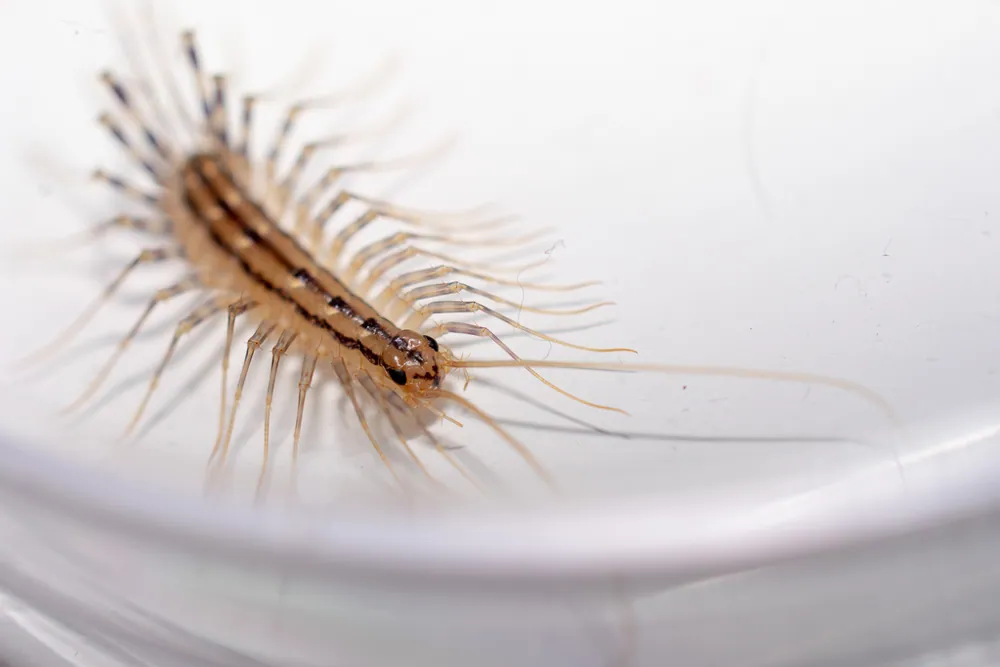
The house centipede is a long-legged, yellowish-grey centipede that often shares homes with people. It comes from the Mediterranean region and has spread across much of the world. It is fast, has very long legs, and eats household pests, so it is useful to have around.1
 Cara mengenalinya
- Typically yellowish-grey, with three dark stripes running down the length of its body.1
- Up to 15 pairs of long legs, which also have dark stripes.1
- Body is typically 25 to 35 mm long. With its legs and antennae, it looks about 75 to 100 mm long.1
- Runs very quickly across floors, up walls and along ceilings, and can stop suddenly and stay still.1
- Has well-developed eyes, unlike most other centipedes.1
Kuasa bisa
Bisa keluar melalui taring atau giginya apabila ia menggigit.
Apa kesan bisanya?
It has a mild venom, which it injects through small claw-like structures called forcipules. Its venom is used mainly to subdue prey. In a bite on a person, the effect is limited to mild pain and swelling in the local area, similar to a bee sting.1
Berapa bahaya ia kepada manusia?
Bahaya kepada manusia: RinganSeperti sengatan lebah atau kurang. Boleh dikatakan tidak berbahaya kepada manusia.House centipedes pose essentially no threat to people. They are not aggressive and usually flee when disturbed. Stings are rare and usually happen only when the centipede is cornered or handled roughly. Their forcipules have difficulty penetrating human skin. Allergic reactions have been reported but are rare, and nearly all successful bites heal quickly without complications.1
Apa yang ia buat apabila takut?
When disturbed, it usually runs away quickly, and it can detach any legs that have become trapped.1
 Jika ia menggigit
- Basuh tempat gigitan, sejukkan atau rendam dalam air suam untuk menghilangkan sakit, dan dapatkan bantuan perubatan jika ia bertambah teruk.
Sentiasa hubungi nombor kecemasan dahulu (112, 000, 911). Ini panduan pertolongan cemas umum, bukan nasihat perubatan. Asas pertolongan cemas
 Kekal selamat
- Jangan sesekali sentuh, tangkap atau usik haiwan liar, walaupun yang kecil, dan walaupun ia nampak tidur atau mati.
- Beri ia ruang. Jika kamu terjumpa, bertenang, undur perlahan-lahan dan biarkan ia pergi.
- Jika ia menggigit kamu: bertenang, jangan bergerak, hubungi nombor kecemasan (112, 000, 911) atau pergi ke hospital dengan segera. Ingat rupanya, gambar boleh membantu.
Ia bukan mahu memburu kamu. Ia guna bisanya untuk menangkap makanan atau melindungi diri, dan ia lebih suka bersembunyi. Lagi tentang keselamatan
Di mana di dunia?
Berapa besar ia?
Berapa panjang ia?
 lebih kurang sepanjang klip kertas
 boleh melepasi 100 meter dalam 260 saat (manusia paling laju perlukan 9.6)
Berapa besar House centipede berbanding KAMU?
Hanya matematik dalam pelayar kamu. Tiada apa yang disimpan atau dihantar ke mana-mana.
Berapa laju ia?


Fakta
It can detach its own legs if they become trapped, which helps it escape danger.1
It can tell harmful prey from safe prey, and it changes how it feeds depending on the danger. With wasps, it retreats after stinging to let the venom take effect.1
Its tail-like hind legs look like antennae, so when it is at rest it is hard to tell its head end from its tail end.1
Unlike most centipedes, it has well-developed faceted eyes, although it hunts mostly by smell and touch through its antennae.1
Its blood contains proteins that carry oxygen, which is unusual among centipedes.1
It can live its whole life inside a building, usually on the ground floor of homes.1
Pemecah mitos
Mitos: House centipedes are dangerous and likely to attack people.
Hakikat: They are not aggressive and usually run away. Their stings are rare and cause only mild, local pain and swelling.1
Untuk pakar bisa
- Nama saintifik
- Scutigera coleoptrata
- Kumpulan
- Lipan
- Keluarga
- Scutigeridae2
- Susunan
- Scutigeromorpha
- Benua-benua
- Eropah, Asia, Afrika
- Anak
- They lay eggs in spring. In a laboratory study of 24 females, the average was 63 eggs and the maximum was 151. The young hatch with four pairs of legs and gain more with each moult until they reach 15 pairs.1
- Jangka hayat
- kira-kira 7 tahun1
- Bahaya kepada manusia
- 1 / 5: Ringan3
Dari mana fakta datang
- Scutigera coleoptrata (Wikipedia (CC BY-SA 4.0))
- Scutigera coleoptrata (iNaturalist): nama dan pengelasan.
- Venom Wiki: tahap bahaya, saiz biasa dan anggaran kelajuan adalah penilaian kami sendiri. Lihat cara kami mengiranya: Cara kami menilai bahaya.
Setiap fakta di halaman ini ada nombor yang menunjuk kepada sumbernya. Jika kami tersilap, maaf, kami peminat haiwan, bukan jurnal sains. Beritahu kami di [email protected] dan kami akan betulkan.
 Kala jengking lapar! Venom Wiki ialah projek seorang lelaki: percuma, tanpa iklan dan tanpa penjejak. Sedikit sumbangan membantu memastikannya terus dalam talian.Beri kala jengking makan
Lagi dari kumpulan yang sama: Lipan
 Chinese red-headed centipede
 Giant Australian centipede
 Mediterranean banded centipede
 Vietnamese giant centipede
 African blue-ring centipede
 Indian tiger centipede
Juga hidup di: Eropah
 Common European adderUlar kapak & adderPerlu jumpa doktor
 Spanish flyHaiwan beracun lainPerlu jumpa doktorJangan sentuh
 Common waspLebah, penyengat & tebuanSakit sahaja
 European hornetLebah, penyengat & tebuanSakit sahaja
 Fire salamanderKatak beracun, katak puru & newtSakit sahajaJangan sentuh
 Western honey beeLebah, penyengat & tebuanSakit sahaja