
 Afrika
 Asia
Asia Eropah
 Amerika Selatan
 Australia & Oceania
 Antartika
 Lautan Pasifik
 Lautan Atlantik
 Lautan Hindi
 Lautan Artik
 Laut Mediterranean
 Laut Merah
 Laut Caribbean
 Laut Karang
 Laut China Selatan
 Laut Filipina
 Laut Andaman
 Laut Utara
 Laut Timor & Laut Arafura
 Teluk Benggala
 Teluk California
Valentin's sharpnose puffer
 Beracun jika dimakan
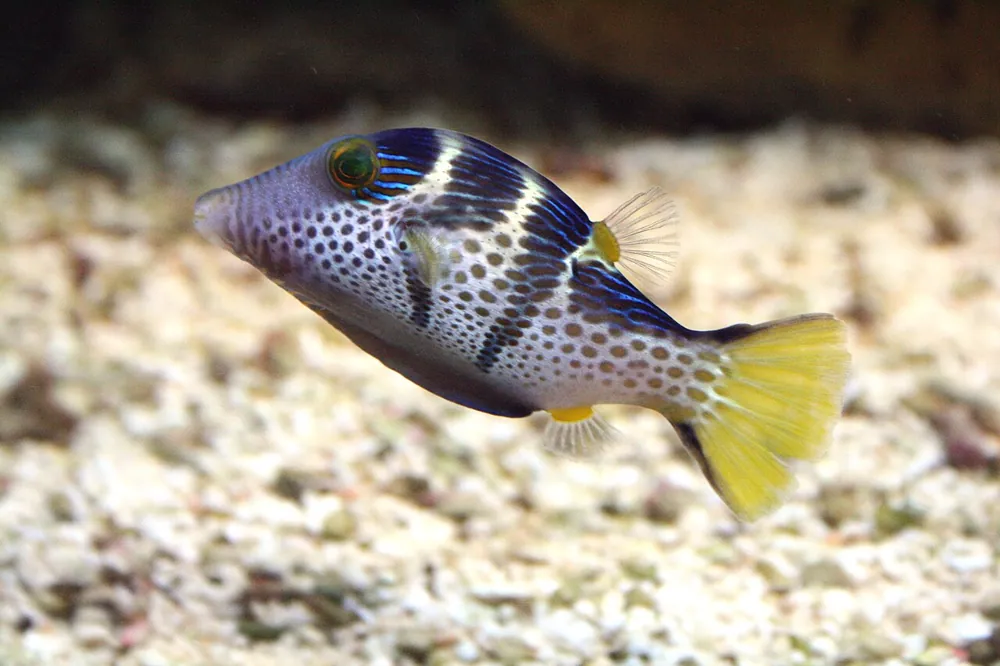
Valentin's sharpnose puffer is a small reef fish with four black stripes across its back. It lives in warm seas across the Indian Ocean, the Red Sea and parts of the Pacific. It is special because its skin holds one of the most potent natural poisons known, which keeps most predators away.1




 Cara mengenalinya
- Four distinct black stripes, called saddles, run across its back.1
- The head is blue-grey.1
- The main body is white, speckled with blue-grey spots.1
- The tail and fins show hints of yellow, and a rainbow streak sits behind the eyes.1
Sering dikelirukan dengan: The filefish Paraluteres prionurus has similar colours and sometimes swims in schools with this puffer. It mimics the puffer's appearance for protection, but it is not toxic.1
Kuasa racun
Ia hanya berbahaya jika ada yang memakannya.
Apa kesan racunnya?
Its skin and other tissues contain tetrodotoxin, a neurotoxin, which attacks the nerves. It is one of the most potent naturally occurring toxins and is lethal to many species of fish. This makes the fish unpalatable to predators.1
Berapa bahaya ia kepada manusia?
Bahaya kepada manusia: SeriusJika seseorang memakannya, jumpa doktor. Kematian sangat jarang berlaku.It is highly poisonous to eat.1
Apa yang ia buat apabila takut?
It gulps water to puff its body up to three or four times its normal volume, and its toxic skin deters predators.1
 Jika seseorang menyentuh atau memakannya
- Jika seseorang memakannya atau ada simptom selepas memakannya: hubungi nombor kecemasan atau pusat racun dengan segera.
Sentiasa hubungi nombor kecemasan dahulu (112, 000, 911). Ini panduan pertolongan cemas umum, bukan nasihat perubatan. Asas pertolongan cemas
 Kekal selamat
- Jangan sesekali sentuh, tangkap atau usik haiwan liar, walaupun yang kecil, dan walaupun ia nampak tidur atau mati.
- Beri ia ruang. Jika kamu terjumpa, bertenang, undur perlahan-lahan dan biarkan ia pergi.
- Jika kamu menyentuh atau memakannya: jangan gosok mata atau mulut, basuh tangan dan dapatkan bantuan perubatan.
Ia bukan mahu memburu kamu. Racunnya ada hanya supaya tiada apa yang memakannya. Lagi tentang keselamatan
Di mana di dunia?
Berapa besar ia?
Berapa panjang ia?
 sepanjang 3 blok binaan mainan disusun sebaris
 boleh berenang sepanjang kolam renang besar (50 m) dalam 45 saat
Berapa besar Valentin's sharpnose puffer berbanding KAMU?
Hanya matematik dalam pelayar kamu. Tiada apa yang disimpan atau dihantar ke mana-mana.
Berapa laju ia?
Fakta
Its tetrodotoxin is one of the most potent naturally occurring toxins, and it is lethal to many fish.1
A non-toxic filefish, Paraluteres prionurus, has evolved to look like this puffer, which helps it avoid predators.1
Its eggs are unpalatable, so predatory fish rarely eat them, and any swallowed eggs are quickly passed out again. This means the parents need not guard them.1
Juveniles of the grouper Plectropomus laevis also mimic its colours.1
Its eggs, at 0.68 to 0.72 mm across, are among the smallest in the puffer family Tetraodontidae.1
Pemecah mitos
Mitos: Pufferfish hold their breath while they puff up.
Hakikat: A 2014 study found that oxygen consumption actually increases while the fish is inflated. Oxygen intake through the gills is almost five times higher than normal.1
Untuk pakar bisa
- Nama saintifik
- Canthigaster valentini
- Kumpulan
- Haiwan beracun lain
- Keluarga
- Tetraodontidae2
- Susunan
- Tetraodontiformes
- Benua-benua
- Lautan Pasifik, Lautan Hindi, Laut Merah, Laut Karang, Laut Filipina, Laut China Selatan, Laut Timor & Laut Arafura, Lautan
- Anak
- Females lay anywhere between fifteen and over 800 eggs at a time, every four to ten days depending on the season.1
- Bahaya kepada manusia
- 3 / 5: Serius3
Dari mana fakta datang
- Valentin's sharpnose puffer (Wikipedia (CC BY-SA 4.0))
- Canthigaster valentini (iNaturalist): nama dan pengelasan.
- Venom Wiki: tahap bahaya, saiz biasa dan anggaran kelajuan adalah penilaian kami sendiri. Lihat cara kami mengiranya: Cara kami menilai bahaya.
Setiap fakta di halaman ini ada nombor yang menunjuk kepada sumbernya. Jika kami tersilap, maaf, kami peminat haiwan, bukan jurnal sains. Beritahu kami di [email protected] dan kami akan betulkan.
 Kala jengking lapar! Venom Wiki ialah projek seorang lelaki: percuma, tanpa iklan dan tanpa penjejak. Sedikit sumbangan membantu memastikannya terus dalam talian.Beri kala jengking makan
Lagi dari kumpulan yang sama: Haiwan beracun lain
 Ikan buntal JepunHaiwan beracun lainMembawa maut
 Hawksbill sea turtleHaiwan beracun lainBoleh membunuh
 Greenland sharkHaiwan beracun lainSakit sahaja
 Silver-cheeked toadfishHaiwan beracun lainMembawa maut
 Blackspotted pufferHaiwan beracun lainBoleh membunuh
 White-spotted pufferHaiwan beracun lainBoleh membunuh
Juga hidup di: Lautan Pasifik
 Obor-obor kotak AustraliaObor-obor & penyengat lautMembawa mautJangan sentuh
 Siput kon geografiSiput kon & sotong kuritaMembawa maut
 Kurita cincin biru besarSiput kon & sotong kuritaMembawa maut
 Kurita cincin biru selatanSiput kon & sotong kuritaMembawa maut
 Irukandji jellyfishObor-obor & penyengat lautBoleh membunuhJangan sentuh
 Reef stonefishIkan berbisaBoleh membunuhJangan sentuh