
 Afrika
 Azië
Azië Europa
 Zuid-Amerika
 Australië & Oceanië
 Antarctica
 Grote Oceaan
 Atlantische Oceaan
 Indische Oceaan
 Noordelijke IJszee
 Middellandse Zee
 Rode Zee
 Caribische Zee
 Koraalzee
 Zuid-Chinese Zee
 Filipijnenzee
 Andamanse Zee
 Noordzee
 Timorzee & Arafurazee
 Golf van Bengalen
 Golf van Californië
Black long-spined urchin
 Giftige stekels
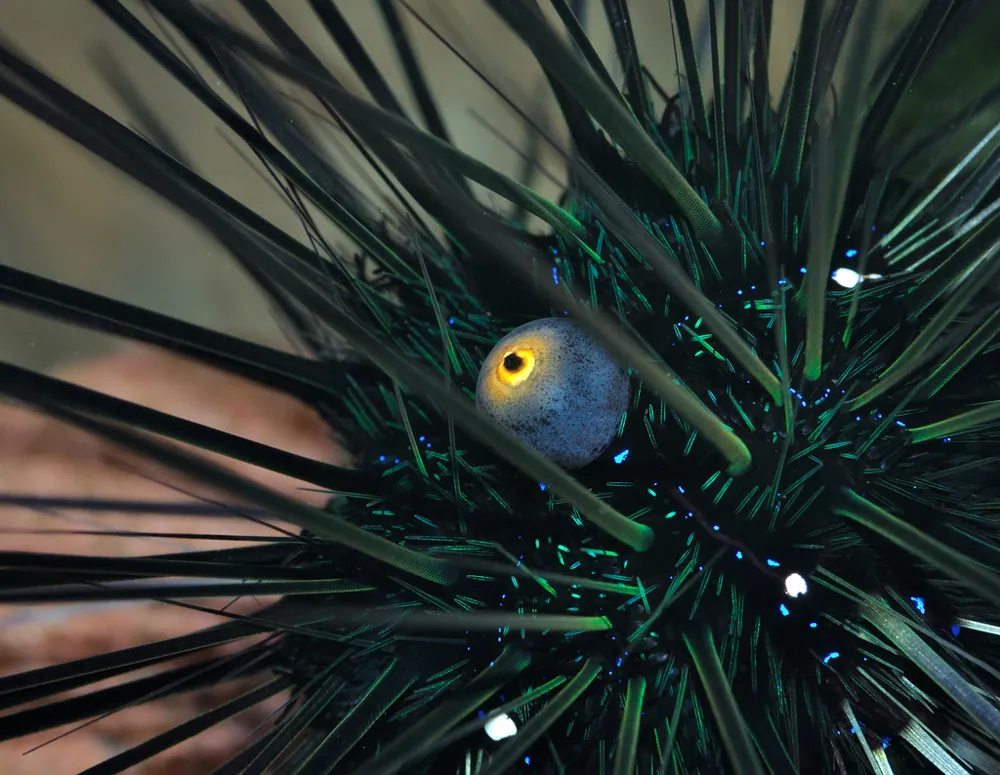
The black long-spined urchin is a sea urchin with very long, hollow spines. It lives on coral reefs, sand flats and seagrass beds across the Indo-Pacific, and it is one of the most widespread sea urchins in that region. Its spines can deliver a mild venom, so it is best to watch where you put your feet.1


 Zo herken je het
- Black, near-spherical body (test) with extremely long, narrow, hollow spines, often black but sometimes brown-banded1
- Five white spots on the body, which separate it from other Diadema species1
- A bright orange ring around the periproctal cone (the 'anal cone'), which is often mistaken for an eye1
- Bluish spots on the genital plates and a line of blue spots along the body1
- Adults are no more than 70 mm across the body and about 40 mm high1
Vaak verward met: Other Diadema species are similar in shape and spines, but they lack the five white spots that mark this species. Its orange ring and blue spots also help to tell it apart.1
Gifkracht
Scherpe stekels bevatten het gif. Erop stappen of het vastpakken doet pijn.
Wat doet zijn gif als het bijt of steekt?
The spines are hollow and contain a mild venom. The toxin mostly causes swelling and pain, which spreads gradually over several hours. The venom is not fatal to humans. The spines themselves are a bigger problem, because they are brittle and needle-like, break off in flesh and are difficult to remove.1
Hoe gevaarlijk is het voor mensen?
Gevaar voor mensen: PijnlijkHet kan echt pijn doen, maar het is bijna nooit ernstig.The venom is only mild, and the species is not considered a serious threat to humans. Stepping on it can cause painful stings.1
Wat doet het als het bang is?
When threatened by a sudden impact or by spines snapping, it rapidly flips its body over and 'runs' on the tips of its longest spines.1
 Als zijn stekels je prikken
- Houd de wond in heet water, zo heet als de persoon kan verdragen zonder zich te verbranden, en haal medische hulp om de stekels te laten verwijderen. Ga er niet zelf naar graven.
Bel altijd eerst je alarmnummer (112, 000, 911). Dit is algemene EHBO-informatie, geen medisch advies. EHBO-basis
 Blijf veilig
- Raak een wild dier nooit aan, vang het niet en pest het niet, ook geen kleintje, en ook niet als het lijkt te slapen of dood lijkt.
- Geef het de ruimte. Kom je er een tegen, blijf rustig, stap langzaam achteruit en laat het zijn eigen weg gaan.
- Als zijn stekels je prikken: blijf rustig, beweeg niet, bel je alarmnummer (112, 000, 911) of ga snel naar een ziekenhuis. Onthoud hoe het eruitzag, een foto helpt.
Het is niet op jou uit. Het gebruikt zijn gif om voedsel te vangen of zichzelf te beschermen, en verstopt zich veel liever. Meer over veilig blijven
Waar ter wereld?
Hoe groot is het?
Hoe lang is het?
Hoe zwaar is het?

 zo lang als 2 speelgoedbouwsteentjes op een rij
 langzamer dan een tuinslak
Hoe groot is Black long-spined urchin vergeleken met JOU?
Alleen rekenwerk in je browser. Er wordt niets opgeslagen of verstuurd.
Hoe snel is het?

Feiten
It can move 760 mm in just 7 seconds by rolling and walking on the tips of its spines.1
It has no eye, but it has a diffuse light-sensing system that lets it detect light levels and the size and colour of objects.1
In 2006, living specimens were found off Turkey, making it the first invasive Erythrean sea urchin recorded in the Mediterranean.1
Goose barnacles of the genus Microlepas are known to live on it as parasites.1
It is considered one of the oldest living species in its genus, Diadema.1
Fabeltjes-checker
Fabel: Black long-spined urchins are deadly and their stings can kill people.
Waarheid: Their venom is mild and is not fatal to humans. The main problems are pain, swelling and spines that break off in the skin.1
Voor gifexperts
- Wetenschappelijke naam
- Diadema setosum
- Groep
- Zee-egels, zeesterren & wormen
- Familie
- Diadematidae2
- Orde
- Diadematoida
- Continenten
- Indische Oceaan, Grote Oceaan, Rode Zee, Koraalzee, Filipijnenzee, Arabische Zee & Perzische Golf, Timorzee & Arafurazee, Golf van Bengalen, De oceanen
- Baby's
- It is a broadcast spawner, releasing eggs and sperm into the water. Spawning happens seasonally or year-round depending on the location, and in some places it follows the full moon.1
- Gevaar voor mensen
- 2 / 5: Pijnlijk3
Waar de feiten vandaan komen
- Diadema setosum (Wikipedia (CC BY-SA 4.0))
- Diadema setosum (iNaturalist): namen en indeling.
- Venom Wiki: het gevarenniveau, de typische grootte en de geschatte snelheid zijn van onszelf. Zo berekenen we ze: Hoe we gevaar beoordelen.
Elk feit op deze pagina heeft een nummer dat naar de bron wijst. Hebben we iets fout? Sorry, we zijn dierenfans, geen wetenschappelijk tijdschrift. Laat het ons weten via [email protected] en we passen het aan.
 De schorpioen heeft honger! Venom Wiki is een eenmansproject: gratis, zonder reclame en zonder trackers. Een kleine fooi helpt om het online te houden.Voer de schorpioen
Meer uit dezelfde groep: Zee-egels, zeesterren & wormen
 Crown-of-thorns starfishZee-egels, zeesterren & wormenMoet naar de dokterNiet aanraken
 Flower urchinZee-egels, zeesterren & wormenKan doden
 Fire urchinZee-egels, zeesterren & wormenMoet naar de dokterNiet aanraken
 Bearded firewormZee-egels, zeesterren & wormenDoet alleen pijnNiet aanraken
 BloodwormZee-egels, zeesterren & wormenDoet alleen pijn
 Bobbit wormZee-egels, zeesterren & wormenDoet alleen pijn
Leeft ook in: Indische Oceaan
 Australische kubuskwalKwallen & netelende zeedierenDodelijkNiet aanraken
 Geografische kegelslakKegelslakken & octopussenDodelijk
 Grote blauwgeringde octopusKegelslakken & octopussenDodelijk
 Zuidelijke blauwgeringde octopusKegelslakken & octopussenDodelijk
 Hawksbill sea turtleAndere passief giftige dierenKan doden
 Irukandji jellyfishKwallen & netelende zeedierenKan dodenNiet aanraken