
 Afrika
 Azië
Azië Europa
 Zuid-Amerika
 Australië & Oceanië
 Antarctica
 Grote Oceaan
 Atlantische Oceaan
 Indische Oceaan
 Noordelijke IJszee
 Middellandse Zee
 Rode Zee
 Caribische Zee
 Koraalzee
 Zuid-Chinese Zee
 Filipijnenzee
 Andamanse Zee
 Noordzee
 Timorzee & Arafurazee
 Golf van Bengalen
 Golf van Californië
East Pacific red octopus
 Beten
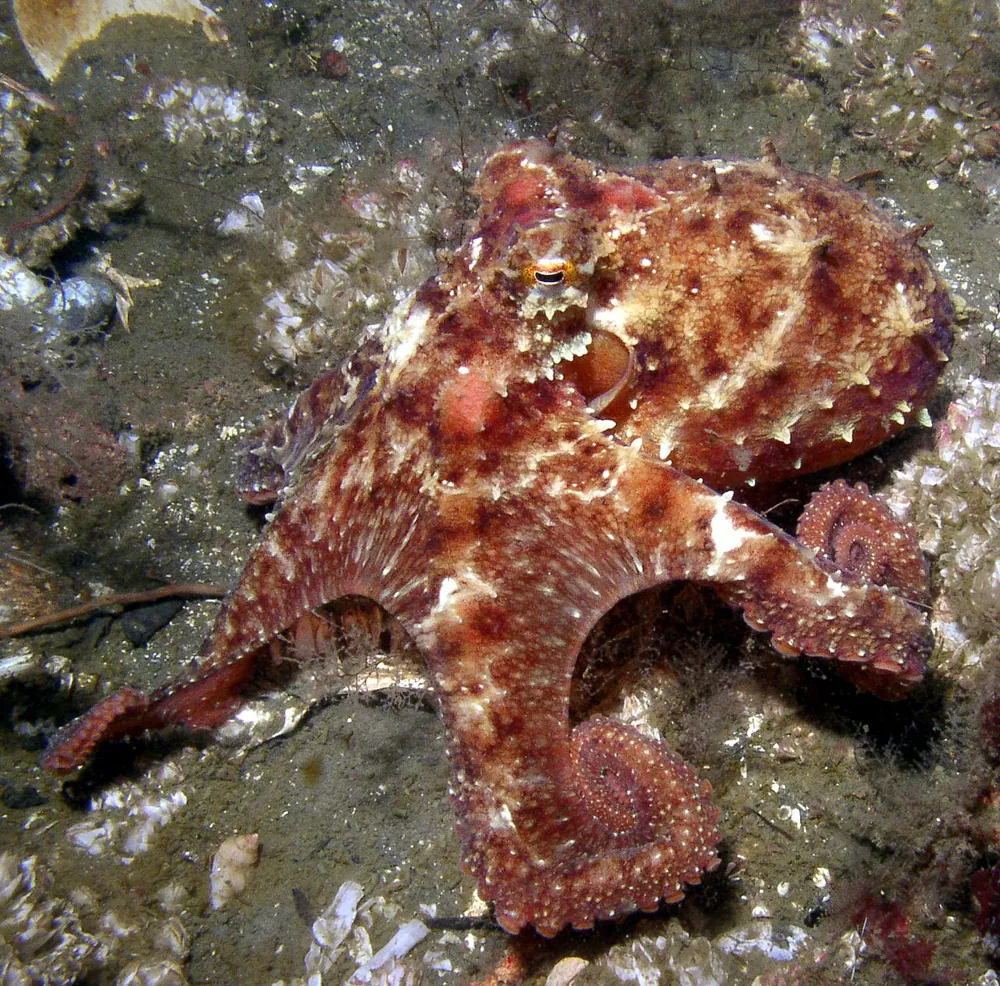
BetenThe East Pacific red octopus is a small octopus that lives along the North American West Coast. It is the most common shallow-water octopus in much of this region and hunts on the seabed. It is special because scientists have shown it has individual personalities, the first invertebrate found to have them.1


 Zo herken je het
- Its colour can vary from deep brick red to brown, to white, or a mottled mixture of these.1
- It can change both its colour and skin texture.1
- It has three eyelash-like papillae (small bumps) below each eye.1
- Adults usually have a mantle (body) length of 8–10 cm, with arms of 30–40 cm.1
Vaak verward met: Small individuals of the giant Pacific octopus (Enteroctopus dofleini) can be mistaken for it in the north of its range. The East Pacific red octopus has three eyelash-like papillae below each eye, which the giant Pacific octopus lacks.1
Gifkracht
Het gif komt naar buiten via de giftanden of tanden als het bijt.
Wat doet zijn gif als het bijt of steekt?
It uses venom to subdue its prey. After catching a bivalve such as a clam, it drills a hole through the shell near the adductor muscles and injects venom through that hole.1
Hoe gevaarlijk is het voor mensen?
Gevaar voor mensen: PijnlijkHet kan echt pijn doen, maar het is bijna nooit ernstig. Als het bijt
- Drukimmobilisatie: wikkel een stevig elastisch verband over de beet en daarna omhoog over de hele arm of het hele been, leg een spalk aan en houd de persoon helemaal stil tot er hulp komt.
- Een blauwgeringde octopus of kegelslak kan iemands ademhaling stilleggen terwijl die nog wakker is: bel om hulp en wees klaar om te beademen tot de ambulance het overneemt.
Bel altijd eerst je alarmnummer (112, 000, 911). Dit is algemene EHBO-informatie, geen medisch advies. EHBO-basis
 Blijf veilig
- Raak een wild dier nooit aan, vang het niet en pest het niet, ook geen kleintje, en ook niet als het lijkt te slapen of dood lijkt.
- Geef het de ruimte. Kom je er een tegen, blijf rustig, stap langzaam achteruit en laat het zijn eigen weg gaan.
- Als er een je bijt: blijf rustig, beweeg niet, bel je alarmnummer (112, 000, 911) of ga snel naar een ziekenhuis. Onthoud hoe het eruitzag, een foto helpt.
Het is niet op jou uit. Het gebruikt zijn gif om voedsel te vangen of zichzelf te beschermen, en verstopt zich veel liever. Meer over veilig blijven
Hoe groot is het?
Hoe lang is het?
Hoe zwaar is het?

 zo lang als 3 speelgoedbouwsteentjes op een rij
 zou de lengte van een groot zwembad (50 m) in 7,2 seconden kunnen zwemmen
Hoe groot is East Pacific red octopus vergeleken met JOU?
Alleen rekenwerk in je browser. Er wordt niets opgeslagen of verstuurd.
Hoe snel is het?


Feiten
It was the first invertebrate in which individual personalities were demonstrated.1
In the 2016 Pixar film Finding Dory, a character named Hank is an East Pacific red octopus. The animators gave him seven arms because they could not fit all eight on his model.1
It drills holes in bivalve shells, often near the adductor muscles, to reach the prey inside.1
A 2011 study suggested it may choose prey based on how easily the fat can be digested rather than on calories.1
It was widely thought to be a young giant Pacific octopus before it was described as a species in 1953.1
Fabeltjes-checker
Fabel: Because captive animals were active at night, many people believed it hunts only at night.
Waarheid: A study in Puget Sound, Washington, found that a local population was likely active during the day (diurnal).1
Waar de feiten vandaan komen
- East Pacific red octopus (Wikipedia (CC BY-SA 4.0))
- Octopus rubescens (iNaturalist): namen en indeling.
- Venom Wiki: het gevarenniveau, de typische grootte en de geschatte snelheid zijn van onszelf. Zo berekenen we ze: Hoe we gevaar beoordelen.
Elk feit op deze pagina heeft een nummer dat naar de bron wijst. Hebben we iets fout? Sorry, we zijn dierenfans, geen wetenschappelijk tijdschrift. Laat het ons weten via [email protected] en we passen het aan.
 De schorpioen heeft honger! Venom Wiki is een eenmansproject: gratis, zonder reclame en zonder trackers. Een kleine fooi helpt om het online te houden.Voer de schorpioen
Meer uit dezelfde groep: Kegelslakken & octopussen
 Geografische kegelslakKegelslakken & octopussenDodelijk
 Grote blauwgeringde octopusKegelslakken & octopussenDodelijk
 Zuidelijke blauwgeringde octopusKegelslakken & octopussenDodelijk
 Blue sea dragonKegelslakken & octopussenDoet alleen pijn
 Common octopusKegelslakken & octopussenOngevaarlijk
 Giant Pacific octopusKegelslakken & octopussenOngevaarlijk
Leeft ook in: Grote Oceaan
 Australische kubuskwalKwallen & netelende zeedierenDodelijkNiet aanraken
 Japanse kogelvisAndere passief giftige dierenDodelijk
 Hawksbill sea turtleAndere passief giftige dierenKan doden
 Irukandji jellyfishKwallen & netelende zeedierenKan dodenNiet aanraken
 Reef stonefishGiftige vissenKan dodenNiet aanraken
 Crown-of-thorns starfishZee-egels, zeesterren & wormenMoet naar de dokterNiet aanraken