
 Afrika
 Azië
Azië Europa
 Zuid-Amerika
 Australië & Oceanië
 Antarctica
 Grote Oceaan
 Atlantische Oceaan
 Indische Oceaan
 Noordelijke IJszee
 Middellandse Zee
 Rode Zee
 Caribische Zee
 Koraalzee
 Zuid-Chinese Zee
 Filipijnenzee
 Andamanse Zee
 Noordzee
 Timorzee & Arafurazee
 Golf van Bengalen
 Golf van Californië
Port Jackson shark
 Giftige stekels
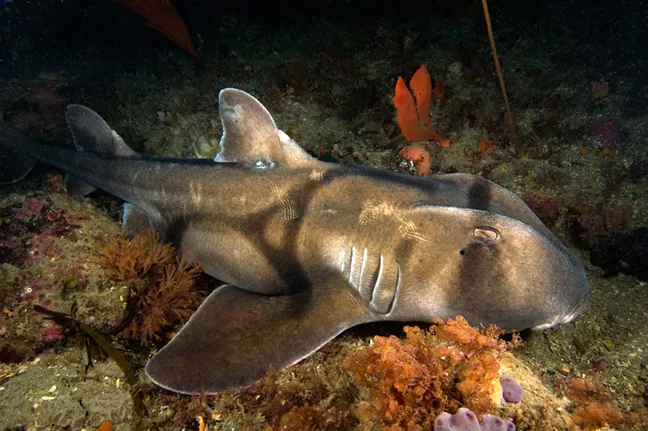
The Port Jackson shark is a bottom-dwelling shark that lives in the cool coastal waters of southern Australia. It is active mostly at night, when it hunts shellfish, sea urchins and fish. It is harmless to people, though its spines have a reputation that is not confirmed.1



 Zo herken je het
- Grey-brown body with dark brown, harness-like bands, including one that runs across the eyes.1
- Large, blunt, flat head with raised ridges above the eyes.1
- A spine at the front edge of each of its two dorsal fins, which are nearly equal in size.1
- Front teeth are small and pointed, while back teeth are flat and blunt.1
- Adults can grow up to 1.65 metres long.1
Gifkracht
Scherpe stekels bevatten het gif. Erop stappen of het vastpakken doet pijn.
Hoe gevaarlijk is het voor mensen?
Gevaar voor mensen: MildZoals een bijensteek of minder. Eigenlijk ongevaarlijk voor mensen.The shark poses no danger to humans. In October 2011, a man was bitten at Elwood Beach near Melbourne, but the bite did not pierce the skin and he was able to swim away while the shark was still attached to his calf.1
 Als zijn stekels je prikken
- Houd de wond in heet water, zo heet als de persoon kan verdragen zonder zich te verbranden (test het met je eigen hand), 30 tot 90 minuten lang. Haal medische hulp, vooral bij steenvissen en pijlstaartroggen.
Bel altijd eerst je alarmnummer (112, 000, 911). Dit is algemene EHBO-informatie, geen medisch advies. EHBO-basis
 Blijf veilig
- Raak een wild dier nooit aan, vang het niet en pest het niet, ook geen kleintje, en ook niet als het lijkt te slapen of dood lijkt.
- Geef het de ruimte. Kom je er een tegen, blijf rustig, stap langzaam achteruit en laat het zijn eigen weg gaan.
- Als zijn stekels je prikken: blijf rustig, beweeg niet, bel je alarmnummer (112, 000, 911) of ga snel naar een ziekenhuis. Onthoud hoe het eruitzag, een foto helpt.
Het is niet op jou uit. Het gebruikt zijn gif om voedsel te vangen of zichzelf te beschermen, en verstopt zich veel liever. Meer over veilig blijven
Waar ter wereld?
Hoe groot is het?
Hoe lang is het?
 zo lang als 3 huiskatten van neus tot staart
 zo lang als 9 bananen achter elkaar
 zou de lengte van een groot zwembad (50 m) in 8,2 seconden kunnen zwemmen
Hoe groot is Port Jackson shark vergeleken met JOU?
Alleen rekenwerk in je browser. Er wordt niets opgeslagen of verstuurd.
Hoe snel is het?


Feiten
It can turn its stomach inside out and spit out unwanted contents.1
It can breathe while lying still on the bottom. It pumps water in through its first gill slit and out through the others, so it does not need to swim with its mouth open.1
Juveniles have individual personalities. Some are bolder than others when exploring new places, and they respond differently to stress.1
Juveniles can learn to link bubbles, lights or sounds with food, and they can learn by watching other sharks.1
Adults are often seen resting together in caves, but juveniles do not seem to be social.1
Each year it migrates south in summer and returns north to breed in winter.1
Fabeltjes-checker
Fabel: Port Jackson sharks are dangerous to people.
Waarheid: The shark poses no danger to humans. Its spines are rumoured to be venomous, but this has not been confirmed.1
Voor gifexperts
- Wetenschappelijke naam
- Heterodontus portusjacksoni
- Groep
- Giftige vissen
- Familie
- Heterodontidae2
- Orde
- Heterodontiformes
- Continenten
- Indische Oceaan, Zuidelijke Oceaan, Antarctica, De oceanen
- Baby's
- It lays eggs rather than giving birth to live young. From late August to mid-November, the female lays pairs of eggs every 8 to 17 days, up to eight pairs in total, and the eggs take 10 to 11 months to hatch.1
- Hoe het in het wild gaat
- Least Concern (IUCN Red List)1
- Gevaar voor mensen
- 1 / 5: Mild3
Waar de feiten vandaan komen
- Port Jackson shark (Wikipedia (CC BY-SA 4.0))
- Heterodontus portusjacksoni (iNaturalist): namen en indeling.
- Venom Wiki: het gevarenniveau, de typische grootte en de geschatte snelheid zijn van onszelf. Zo berekenen we ze: Hoe we gevaar beoordelen.
Elk feit op deze pagina heeft een nummer dat naar de bron wijst. Hebben we iets fout? Sorry, we zijn dierenfans, geen wetenschappelijk tijdschrift. Laat het ons weten via [email protected] en we passen het aan.
 De schorpioen heeft honger! Venom Wiki is een eenmansproject: gratis, zonder reclame en zonder trackers. Een kleine fooi helpt om het online te houden.Voer de schorpioen
Meer uit dezelfde groep: Giftige vissen
 Reef stonefishGiftige vissenKan dodenNiet aanraken
 Red lionfishGiftige vissenMoet naar de dokterNiet aanraken
 Estuarine stonefishGiftige vissenKan dodenNiet aanraken
 Short-tail stingrayGiftige vissenKan doden
 Striped eel catfishGiftige vissenKan dodenNiet aanraken
 Bluespotted ribbontail rayGiftige vissenMoet naar de dokter
Leeft ook in: Indische Oceaan
 Australische kubuskwalKwallen & netelende zeedierenDodelijkNiet aanraken
 Geografische kegelslakKegelslakken & octopussenDodelijk
 Grote blauwgeringde octopusKegelslakken & octopussenDodelijk
 Zuidelijke blauwgeringde octopusKegelslakken & octopussenDodelijk
 Hawksbill sea turtleAndere passief giftige dierenKan doden
 Irukandji jellyfishKwallen & netelende zeedierenKan dodenNiet aanraken