
 Afrika
 Azië
Azië Europa
 Zuid-Amerika
 Australië & Oceanië
 Antarctica
 Grote Oceaan
 Atlantische Oceaan
 Indische Oceaan
 Noordelijke IJszee
 Middellandse Zee
 Rode Zee
 Caribische Zee
 Koraalzee
 Zuid-Chinese Zee
 Filipijnenzee
 Andamanse Zee
 Noordzee
 Timorzee & Arafurazee
 Golf van Bengalen
 Golf van Californië
Textile cone
 Steken
The textile cone is a venomous sea snail. It is a mollusc with a patterned shell, and it hunts other snails at night. It lives in warm seas around Africa, Australia and the Pacific, and it can sting people, so it is important to know it.1

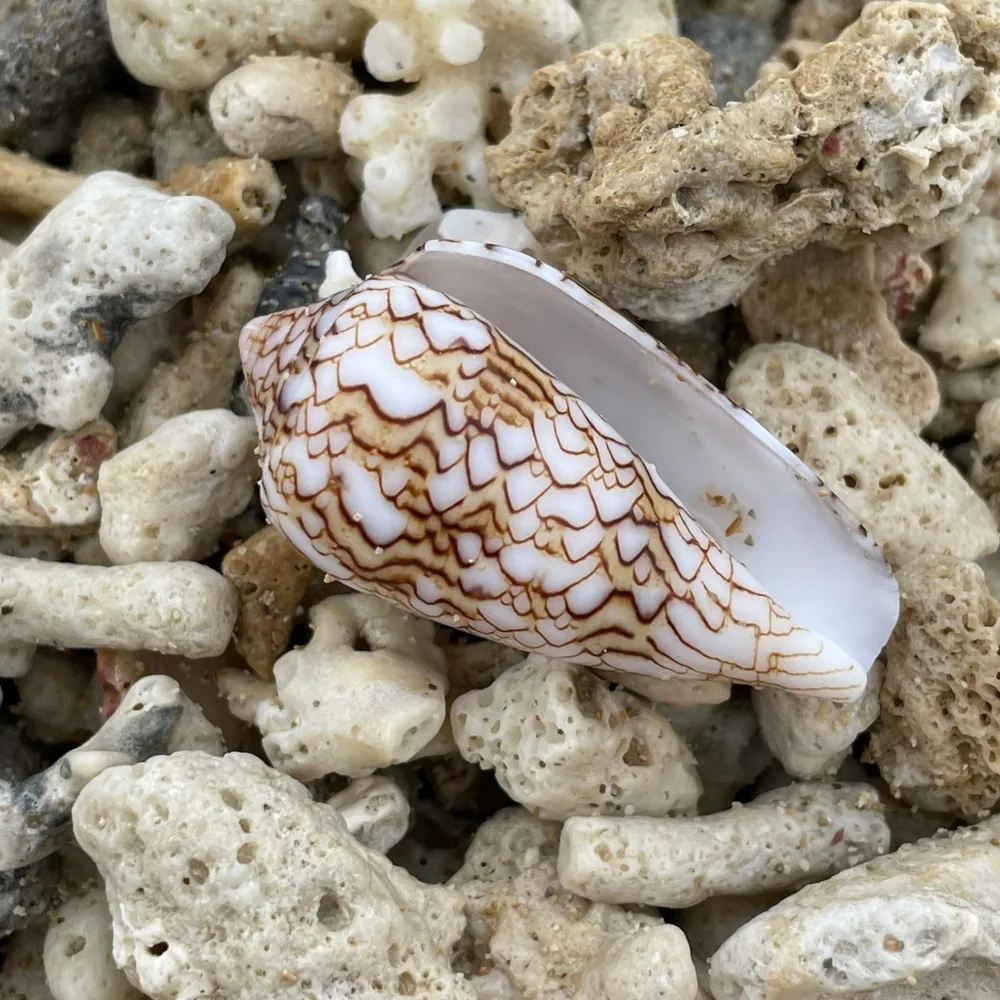
 Zo herken je het
Gifkracht
Het gif komt naar buiten via een angel.
Wat doet zijn gif als het bijt of steekt?
Its venom is a conotoxin, a mix of toxins injected through the harpoon-like radular tooth. The venom contains the neurotoxin RPRFamide, which attacks the nerves.1
Hoe gevaarlijk is het voor mensen?
Gevaar voor mensen: Heel gevaarlijkHet kan iemand doden die geen behandeling krijgt.Several human deaths have been attributed to this species. A 2004 report linked about 30 human deaths to cone snails as a group. Live animals should be handled carefully or not at all, and anyone handling one without protecting exposed skin is at risk.1
 Als het steekt
- Drukimmobilisatie: wikkel een stevig elastisch verband over de beet en daarna omhoog over de hele arm of het hele been, leg een spalk aan en houd de persoon helemaal stil tot er hulp komt.
- Een blauwgeringde octopus of kegelslak kan iemands ademhaling stilleggen terwijl die nog wakker is: bel om hulp en wees klaar om te beademen tot de ambulance het overneemt.
Bel altijd eerst je alarmnummer (112, 000, 911). Dit is algemene EHBO-informatie, geen medisch advies. EHBO-basis
 Blijf veilig
- Raak een wild dier nooit aan, vang het niet en pest het niet, ook geen kleintje, en ook niet als het lijkt te slapen of dood lijkt.
- Geef het de ruimte. Kom je er een tegen, blijf rustig, stap langzaam achteruit en laat het zijn eigen weg gaan.
- Als er een je steekt: blijf rustig, beweeg niet, bel je alarmnummer (112, 000, 911) of ga snel naar een ziekenhuis. Onthoud hoe het eruitzag, een foto helpt.
Het is niet op jou uit. Het gebruikt zijn gif om voedsel te vangen of zichzelf te beschermen, en verstopt zich veel liever. Meer over veilig blijven
Waar ter wereld?
Hoe groot is het?
Hoe lang is het?
 zo lang als 5 speelgoedbouwsteentjes op een rij
 langzamer dan een tuinslak
Hoe groot is Textile cone vergeleken met JOU?
Alleen rekenwerk in je browser. Er wordt niets opgeslagen of verstuurd.
Hoe snel is het?

Feiten
Its shell pattern is made by natural cellular automata, and it resembles Wolfram's rule 30 pattern.1
The pigment cells that make the pattern sit in a narrow band along the shell's lip, and each cell responds to its neighbours.1
Its proboscis can reach any part of its own shell.1
In Australia it is most common in northern Queensland, but sightings are spreading south into New South Wales as ocean temperatures warm with climate change.1
Its larvae drift in the current for about 16 days before settling on the bottom of the sea.1
Voor gifexperts
- Wetenschappelijke naam
- Conus textile
- Groep
- Kegelslakken & octopussen
- Familie
- Conidae2
- Orde
- Neogastropoda
- Continenten
- Indische Oceaan, Grote Oceaan, Koraalzee, Rode Zee, Filipijnenzee, Arabische Zee & Perzische Golf, Timorzee & Arafurazee, Golf van Bengalen, De oceanen
- Baby's
- The female lays several hundred eggs at a time. They hatch after about 16 or 17 days, and the larvae float in the current for about 16 days before settling on the sea floor at about 1.5 mm long.1
- Gevaar voor mensen
- 4 / 5: Heel gevaarlijk3
Waar de feiten vandaan komen
- Conus textile (Wikipedia (CC BY-SA 4.0))
- Conus textile (iNaturalist): namen en indeling.
- Venom Wiki: het gevarenniveau, de typische grootte en de geschatte snelheid zijn van onszelf. Zo berekenen we ze: Hoe we gevaar beoordelen.
Elk feit op deze pagina heeft een nummer dat naar de bron wijst. Hebben we iets fout? Sorry, we zijn dierenfans, geen wetenschappelijk tijdschrift. Laat het ons weten via [email protected] en we passen het aan.
 De schorpioen heeft honger! Venom Wiki is een eenmansproject: gratis, zonder reclame en zonder trackers. Een kleine fooi helpt om het online te houden.Voer de schorpioen
Meer uit dezelfde groep: Kegelslakken & octopussen
 Geography coneKegelslakken & octopussenDodelijk
 Greater blue-ringed octopusKegelslakken & octopussenDodelijk
 Southern blue-ringed octopusKegelslakken & octopussenDodelijk
 Blue sea dragonKegelslakken & octopussenDoet alleen pijn
 Common octopusKegelslakken & octopussenOngevaarlijk
 Giant Pacific octopusKegelslakken & octopussenOngevaarlijk
Leeft ook in: Indische Oceaan
 Australian box jellyfishKwallen & netelende zeedierenDodelijkNiet aanraken
 Hawksbill sea turtleAndere passief giftige dierenKan doden
 Irukandji jellyfishKwallen & netelende zeedierenKan dodenNiet aanraken
 Reef stonefishGiftige vissenKan dodenNiet aanraken
 Crown-of-thorns starfishZee-egels, zeesterren & wormenMoet naar de dokterNiet aanraken
 Portuguese man o' warKwallen & netelende zeedierenMoet naar de dokterNiet aanraken