
 Afrika
 Azië
Azië Europa
 Zuid-Amerika
 Australië & Oceanië
 Antarctica
 Grote Oceaan
 Atlantische Oceaan
 Indische Oceaan
 Noordelijke IJszee
 Middellandse Zee
 Rode Zee
 Caribische Zee
 Koraalzee
 Zuid-Chinese Zee
 Filipijnenzee
 Andamanse Zee
 Noordzee
 Timorzee & Arafurazee
 Golf van Bengalen
 Golf van Californië
Valentin's sharpnose puffer
 Giftig om te eten
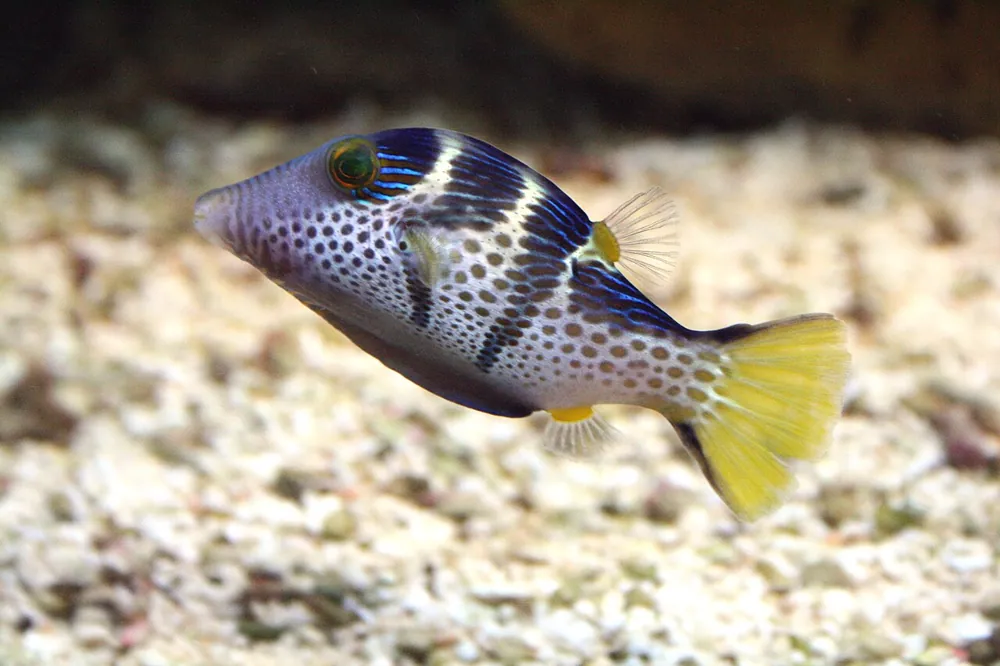
Valentin's sharpnose puffer is a small reef fish with four black stripes across its back. It lives in warm seas across the Indian Ocean, the Red Sea and parts of the Pacific. It is special because its skin holds one of the most potent natural poisons known, which keeps most predators away.1




 Zo herken je het
- Four distinct black stripes, called saddles, run across its back.1
- The head is blue-grey.1
- The main body is white, speckled with blue-grey spots.1
- The tail and fins show hints of yellow, and a rainbow streak sits behind the eyes.1
Vaak verward met: The filefish Paraluteres prionurus has similar colours and sometimes swims in schools with this puffer. It mimics the puffer's appearance for protection, but it is not toxic.1
Gifkracht
Het is alleen schadelijk als iets het opeet.
Wat doet zijn gif als je het aanraakt of opeet?
Its skin and other tissues contain tetrodotoxin, a neurotoxin, which attacks the nerves. It is one of the most potent naturally occurring toxins and is lethal to many species of fish. This makes the fish unpalatable to predators.1
Hoe gevaarlijk is het voor mensen?
Gevaar voor mensen: ErnstigAls iemand het opeet, moet die naar de dokter. Sterfgevallen zijn heel zeldzaam.It is highly poisonous to eat.1
Wat doet het als het bang is?
It gulps water to puff its body up to three or four times its normal volume, and its toxic skin deters predators.1
 Als iemand het heeft aangeraakt of gegeten
- Als iemand het heeft gegeten of klachten heeft na het eten: bel meteen je alarmnummer of het vergiftigingencentrum.
Bel altijd eerst je alarmnummer (112, 000, 911). Dit is algemene EHBO-informatie, geen medisch advies. EHBO-basis
 Blijf veilig
- Raak een wild dier nooit aan, vang het niet en pest het niet, ook geen kleintje, en ook niet als het lijkt te slapen of dood lijkt.
- Geef het de ruimte. Kom je er een tegen, blijf rustig, stap langzaam achteruit en laat het zijn eigen weg gaan.
- Als je het hebt aangeraakt of gegeten: wrijf niet in je ogen of aan je mond, was je handen en haal medische hulp.
Het is niet op jou uit. Zijn gif is er alleen zodat niets het opeet. Meer over veilig blijven
Waar ter wereld?
Hoe groot is het?
Hoe lang is het?
 zo lang als 3 speelgoedbouwsteentjes op een rij
 zou de lengte van een groot zwembad (50 m) in 45 seconden kunnen zwemmen
Hoe groot is Valentin's sharpnose puffer vergeleken met JOU?
Alleen rekenwerk in je browser. Er wordt niets opgeslagen of verstuurd.
Hoe snel is het?
Feiten
Its tetrodotoxin is one of the most potent naturally occurring toxins, and it is lethal to many fish.1
A non-toxic filefish, Paraluteres prionurus, has evolved to look like this puffer, which helps it avoid predators.1
Its eggs are unpalatable, so predatory fish rarely eat them, and any swallowed eggs are quickly passed out again. This means the parents need not guard them.1
Juveniles of the grouper Plectropomus laevis also mimic its colours.1
Its eggs, at 0.68 to 0.72 mm across, are among the smallest in the puffer family Tetraodontidae.1
Fabeltjes-checker
Fabel: Pufferfish hold their breath while they puff up.
Waarheid: A 2014 study found that oxygen consumption actually increases while the fish is inflated. Oxygen intake through the gills is almost five times higher than normal.1
Voor gifexperts
- Wetenschappelijke naam
- Canthigaster valentini
- Groep
- Andere passief giftige dieren
- Familie
- Tetraodontidae2
- Orde
- Tetraodontiformes
- Continenten
- Grote Oceaan, Indische Oceaan, Rode Zee, Koraalzee, Filipijnenzee, Zuid-Chinese Zee, Timorzee & Arafurazee, De oceanen
- Baby's
- Females lay anywhere between fifteen and over 800 eggs at a time, every four to ten days depending on the season.1
- Gevaar voor mensen
- 3 / 5: Ernstig3
Waar de feiten vandaan komen
- Valentin's sharpnose puffer (Wikipedia (CC BY-SA 4.0))
- Canthigaster valentini (iNaturalist): namen en indeling.
- Venom Wiki: het gevarenniveau, de typische grootte en de geschatte snelheid zijn van onszelf. Zo berekenen we ze: Hoe we gevaar beoordelen.
Elk feit op deze pagina heeft een nummer dat naar de bron wijst. Hebben we iets fout? Sorry, we zijn dierenfans, geen wetenschappelijk tijdschrift. Laat het ons weten via [email protected] en we passen het aan.
 De schorpioen heeft honger! Venom Wiki is een eenmansproject: gratis, zonder reclame en zonder trackers. Een kleine fooi helpt om het online te houden.Voer de schorpioen
Meer uit dezelfde groep: Andere passief giftige dieren
 Japanse kogelvisAndere passief giftige dierenDodelijk
 Hawksbill sea turtleAndere passief giftige dierenKan doden
 Greenland sharkAndere passief giftige dierenDoet alleen pijn
 Silver-cheeked toadfishAndere passief giftige dierenDodelijk
 Blackspotted pufferAndere passief giftige dierenKan doden
 White-spotted pufferAndere passief giftige dierenKan doden
Leeft ook in: Grote Oceaan
 Australische kubuskwalKwallen & netelende zeedierenDodelijkNiet aanraken
 Geografische kegelslakKegelslakken & octopussenDodelijk
 Grote blauwgeringde octopusKegelslakken & octopussenDodelijk
 Zuidelijke blauwgeringde octopusKegelslakken & octopussenDodelijk
 Irukandji jellyfishKwallen & netelende zeedierenKan dodenNiet aanraken
 Reef stonefishGiftige vissenKan dodenNiet aanraken