
 Afrika
 Azië
Azië Europa
 Zuid-Amerika
 Australië & Oceanië
 Antarctica
 Grote Oceaan
 Atlantische Oceaan
 Indische Oceaan
 Noordelijke IJszee
 Middellandse Zee
 Rode Zee
 Caribische Zee
 Koraalzee
 Zuid-Chinese Zee
 Filipijnenzee
 Andamanse Zee
 Noordzee
 Timorzee & Arafurazee
 Golf van Bengalen
 Golf van Californië
Yellow boxfish
 Gif in de huid
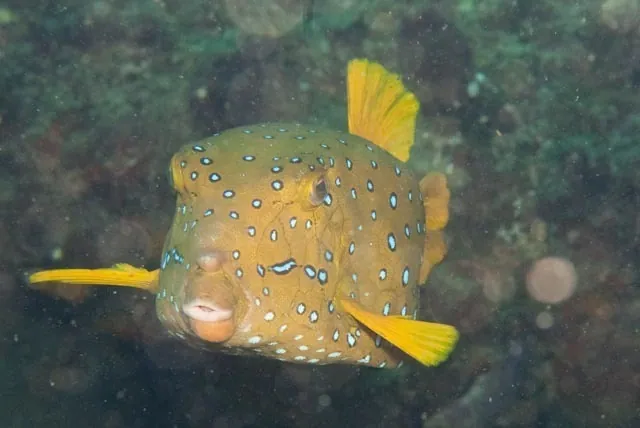
The yellow boxfish is a box-shaped fish with a hard, rigid body and bright yellow skin with black spots. It lives on coral reefs across the Indo-Pacific, from the Red Sea and east Africa to Hawaii and northern New Zealand. It is special because it can release a toxic mucus when stressed, which harms other fish nearby.1


 Zo herken je het
- Box-shaped body covered by a rigid, armoured shell called a carapace1
- Young fish are bright yellow with black spots all over the body1
- As it ages, the yellow fades and very old fish are blue-grey to black with faded yellow1
- Usually found alone, as it is a solitary fish1
Vaak verward met: The spotted boxfish (Ostracion meleagris) has the same box shape and spots. The yellow boxfish is mainly bright yellow with dark spots, while the spotted boxfish is darker with white spots.1
Gifkracht
Zijn huid is giftig. Het is gevaarlijk om aan te raken, te likken of op te eten.
Wat doet zijn gif als je het aanraakt of opeet?
When stressed, it secretes a toxic mucus containing a neurotoxin called ostracitoxin, which attacks the nerves. This toxin is highly harmful to marine fish: it breaks down their red blood cells, which then clump together. Nearby fish may be killed when they are exposed to it.1
Hoe gevaarlijk is het voor mensen?
Gevaar voor mensen: MildZoals een bijensteek of minder. Eigenlijk ongevaarlijk voor mensen.Wat doet het als het bang is?
When threatened, it releases toxic mucus, and its bright yellow and black colours warn predators to stay away.1
 Als iemand het heeft aangeraakt of gegeten
- Als iemand het heeft gegeten of klachten heeft na het eten: bel meteen je alarmnummer of het vergiftigingencentrum.
Bel altijd eerst je alarmnummer (112, 000, 911). Dit is algemene EHBO-informatie, geen medisch advies. EHBO-basis
 Blijf veilig
- Raak een wild dier nooit aan, vang het niet en pest het niet, ook geen kleintje, en ook niet als het lijkt te slapen of dood lijkt.
- Geef het de ruimte. Kom je er een tegen, blijf rustig, stap langzaam achteruit en laat het zijn eigen weg gaan.
- Als je het hebt aangeraakt of gegeten: wrijf niet in je ogen of aan je mond, was je handen en haal medische hulp.
Het is niet op jou uit. Zijn gif is er alleen zodat niets het opeet. Meer over veilig blijven
Waar ter wereld?
Hoe groot is het?
Hoe lang is het?
 zo lang als 2,5 bananen achter elkaar
 zo lang als 14 speelgoedbouwsteentjes op een rij
 zou de lengte van een groot zwembad (50 m) in 45 seconden kunnen zwemmen
Hoe groot is Yellow boxfish vergeleken met JOU?
Alleen rekenwerk in je browser. Er wordt niets opgeslagen of verstuurd.
Hoe snel is het?
Feiten
Engineers have studied boxfish to inspire designs for a concept car, bridge box girders and an airship.1
The carapace was once thought to help stability, but it was found to slightly increase drag and make the fish less stable.1
The fish can make humming and clicking sounds using the muscles of its swim bladder.1
The toxic mucus contains a bacterium, Vibrio parahaemolyticus, which may play a role in the fish's defence.1
Juvenile fish are brighter yellow than adults, and this bright colour is thought to deter predators early in life.1
Boxfish are strong, swift swimmers despite their stiff, box-shaped bodies.1
Fabeltjes-checker
Fabel: Boxfish are weak swimmers because of their boxy shape.
Waarheid: Boxfish are surprisingly strong swimmers. Their shape creates swirling water patterns that help them steer through reefs and make sharp turns.1
Voor gifexperts
- Wetenschappelijke naam
- Ostracion cubicum
- Groep
- Andere passief giftige dieren
- Familie
- Ostraciidae2
- Orde
- Tetraodontiformes
- Continenten
- Grote Oceaan, Indische Oceaan, Rode Zee, Koraalzee, Filipijnenzee, Zuid-Chinese Zee, Timorzee & Arafurazee, Golf van Bengalen, De oceanen
- Hoe het in het wild gaat
- Least Concern1
- Gevaar voor mensen
- 1 / 5: Mild3
Waar de feiten vandaan komen
- Yellow boxfish (Wikipedia (CC BY-SA 4.0))
- Ostracion cubicum (iNaturalist): namen en indeling.
- Venom Wiki: het gevarenniveau, de typische grootte en de geschatte snelheid zijn van onszelf. Zo berekenen we ze: Hoe we gevaar beoordelen.
Elk feit op deze pagina heeft een nummer dat naar de bron wijst. Hebben we iets fout? Sorry, we zijn dierenfans, geen wetenschappelijk tijdschrift. Laat het ons weten via [email protected] en we passen het aan.
 De schorpioen heeft honger! Venom Wiki is een eenmansproject: gratis, zonder reclame en zonder trackers. Een kleine fooi helpt om het online te houden.Voer de schorpioen
Meer uit dezelfde groep: Andere passief giftige dieren
 Japanese pufferfishAndere passief giftige dierenDodelijk
 Hawksbill sea turtleAndere passief giftige dierenKan doden
 Greenland sharkAndere passief giftige dierenDoet alleen pijn
 Silver-cheeked toadfishAndere passief giftige dierenDodelijk
 Blackspotted pufferAndere passief giftige dierenKan doden
 White-spotted pufferAndere passief giftige dierenKan doden
Leeft ook in: Grote Oceaan
 Australian box jellyfishKwallen & netelende zeedierenDodelijkNiet aanraken
 Geography coneKegelslakken & octopussenDodelijk
 Greater blue-ringed octopusKegelslakken & octopussenDodelijk
 Southern blue-ringed octopusKegelslakken & octopussenDodelijk
 Irukandji jellyfishKwallen & netelende zeedierenKan dodenNiet aanraken
 Reef stonefishGiftige vissenKan dodenNiet aanraken