
 Afrikaa
 Eeshiyaa
 Awurooppaa
 Ameerikaa Kibbaa
 Awustiraaliyaa fi Oshiyaaniyaa
 Antaarkitikaa
 Garba Paasifikii
 Garba Atlaantikii
 Garba Hindii
 Garba Arkitikii
 Galaana Meditiraaniyaa
 Galaana Diimaa
 Galaana Kaariibiyaan
 Galaana Kooraal
 Galaana Chaayinaa Kibbaa
 Galaana Filippiinsii
 Galaana Andamaan
 Galaana Kaabaa
 Galaana Timoor fi Araafuuraa
 Galaana Bengaal
 Galaana Kaaliforniyaa
Desert night snake
 Ciniinnaa
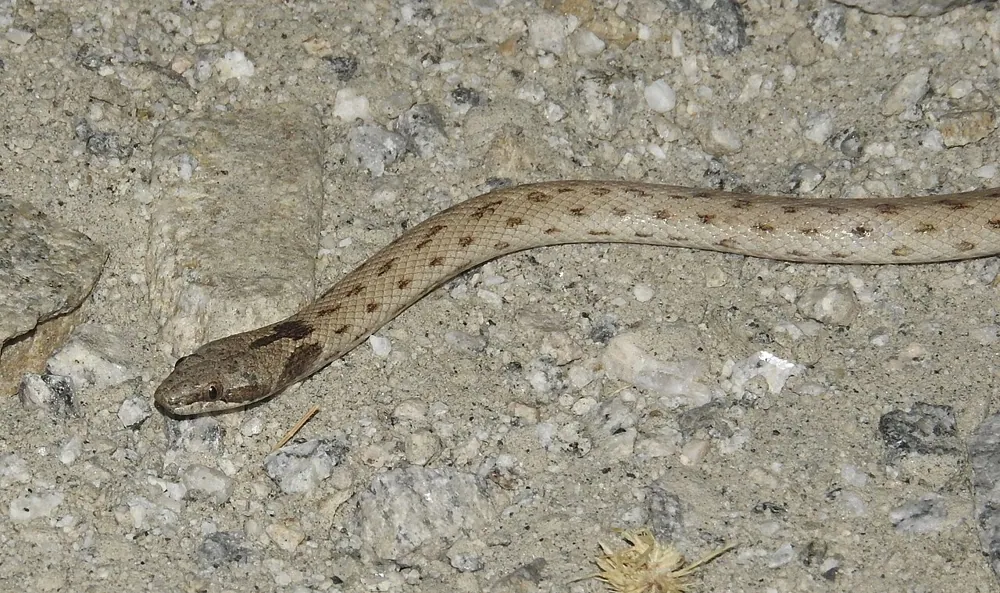
The desert nightsnake is a small, slender snake that hunts at night and spends the day hidden. It lives in dry parts of western North America, from the southwestern United States into northwestern Mexico. It is mildly venomous, but it poses no danger to people.1



 Akkaataa itti beekamu
- Small and slender, usually 30 to 66 cm long in total.1
- Base colour is beige, yellowish or grey, with dark grey-brown blotches that usually form offset pairs down the back.1
- Three long dark blotches on the neck and one behind each eye.1
- Triangular head with vertical pupils.1
- Smooth scales on the back and no rattle at the tail.1
Yeroo baay'ee kan itti wal fakkeessan: It is often mistaken for a juvenile rattlesnake because of its triangular head, vertical pupils and blotched pattern. Unlike a rattlesnake, it has no rattle and its back scales are smooth.1
Humna summii
Summiin yeroo ciniinu ilkaan summii ykn ilkaan isaa keessaan ba'a.
Summiin isaa (ciniinnaa ykn iddiin) maal godha?
It is mildly venomous and uses its venom to subdue prey. It has rear fangs, which are grooved teeth at the back of the upper jaw.1
Namootaaf hammam balaa qaba?
Balaa namootaaf: SalphaaAkka iddii kanniisaa ykn sanaa gadi. Namootaaf gonkumaa jechuun ni danda'ama miidhaa hin qabu.It is mildly venomous and poses no danger to humans.1
 Yoo ciniine
- Bakka ciniiname dhiqi, namicha tasgabbeessi, gargaarsa yaalaas argadhu. Gosoonni tokko tokko (akka boomslang) sa'aatii booda nama ajjeesuu danda'u.
Yeroo hunda dursa lakkoofsa balaa tasaa kee bilbili (112, 000, 911). Kun qajeelfama gargaarsa jalqabaa waliigalaa ti, gorsa yaalaa miti. Bu'uura gargaarsa jalqabaa
 Nageenyaan turi
- Bineensa bosonaa gonkumaa hin tuqin, hin qabin, hin tuttuqin, xiqqaa ta'us, rafe ykn du'e fakkaatus.
- Iddoo itti kenni. Yoo tokko wajjin wal argite, tasgabbaa'i, suuta duubatti deebi'iitii karaa isaa akka deemu dhiisi.
- Yoo tokko si ciniine: tasgabbaa'i, sochii malee turi, lakkoofsa balaa tasaa kee (112, 000, 911) bilbili ykn dafii hospitaala ga'i. Maal akka fakkaatu yaadadhu, suuraan ni gargaara.
Si miidhuuf si hin barbaadu. Summii isaa nyaata qabachuuf ykn of eeguuf fayyadama, dhokachuu immoo baay'ee filata. Waa'ee nageenyaa dabalataan
Addunyaa keessaa eessatti?
Hammam guddaa dha?
Dheerinni isaa hammam?
 akka muuzii 4 walitti aananii tarreeffamanii dheerata
 meetira 100 sekoondii 80 keessatti fiiguu danda'a (namni hundaa caalaa ariifatu 9,6 barbaada)
Desert night snake SI wajjin yoo wal bira qabamu hammam guddaa dha?
Herrega qofa barsiisaa kee keessatti. Homtuu hin olkaa'amu, eessayyuu hin ergamu.
Hammam ariifata?


Dhugaawwan
It is a rear-fanged snake, with enlarged grooved teeth at the back of the upper jaw that help it subdue prey.1
In Canada, it is federally listed as Endangered, because its small population is threatened by habitat loss.1
Females are generally longer and heavier than males.1
It is mainly active at night and at dusk, which is why it has the name nightsnake.1
Soba diigaa
Soba: It is a juvenile rattlesnake.
Dhugaa: It is a separate species. It has no rattle and its back scales are smooth.1
Ogeeyyii summiitiif
- Maqaa saayinsii
- Hypsiglena chlorophaea
- Garee
- Bofoota ilkaan summii duubaan qaban
- Maatii
- Colubridae2
- Tartiiba
- Squamata
- Ardiiwwan
- Ameerikaa Kaabaa
- Ilmoolee
- It lays eggs. Females lay a single clutch of 2 to 9 eggs, usually around 4, between April and July, hidden in rock crevices or abandoned burrows. The eggs hatch in late summer, and the hatchlings are about 17 cm long.1
- Bosona keessatti haala akkamii keessa jira
- Least Concern globally (IUCN); Endangered in Canada (COSEWIC)1
- Balaa namootaaf
- 1 / 5: Salphaa3
Dhugaawwan eessaa dhufu
- Hypsiglena chlorophaea (Wikipedia (CC BY-SA 4.0))
- Hypsiglena chlorophaea (iNaturalist): maqaa fi ramaddii.
- Venom Wiki: sadarkaan balaa, guddinni idilee fi tilmaamni ariitii kan keenya. Akkamitti akka hojjennu ilaali: Balaa akkamitti madaalla.
Dhugaan fuula kana irra jiru hundi lakkoofsa madda isaatti si qajeelchu qaba. Yoo waan tokko dogoggorre, dhiifama, nuti jaallattoota bineensotaa ti malee joornaalii saayinsii miti. [email protected] irratti nutti himi, ni sirreessina.
 Iskoorpiyooniin beela'eera! Venom Wiki pirojektii nama tokkoo ti: bilisa, beeksisa fi hordoftuu malee. Gumaachi xiqqaan interneetii irratti akka turu gargaara.Iskoorpiyoonii nyaachisi
Garee wal fakkaataa irraa dabalataan: Bofoota ilkaan summii duubaan qaban
 Western hognose snakeBofoota ilkaan summii duubaan qabanMiidhaa hin qabu
 Brown vine snakeBofoota ilkaan summii duubaan qabanMiidhaa hin qabu
 Eastern hognose snakeBofoota ilkaan summii duubaan qabanMiidhaa hin qabu
 Green vine snakeBofoota ilkaan summii duubaan qabanMiidhaa hin qabu
 Night snakeBofoota ilkaan summii duubaan qabanMiidhaa hin qabu
 Sonoran lyre snakeBofoota ilkaan summii duubaan qabanMiidhaa hin qabu
Akkasumas kan jiraatu: Ameerikaa Kaabaa
 TerciopeloBofoota pit viperNama ajjeesa
 Eastern coral snakeBofa kooraalNi ajjeesuu danda'a
 Eastern diamondback rattlesnakeBofoota rattlesnakeNi ajjeesuu danda'a
 Eyelash viperBofoota pit viperNi ajjeesuu danda'a
 Timber rattlesnakeBofoota rattlesnakeNi ajjeesuu danda'a
 Western diamondback rattlesnakeBofoota rattlesnakeNi ajjeesuu danda'a