
 Africa
 Asia
Asia Europa
 America dal Sid
 Australia ed Oceania
 Antarctica
 Ocean Pacific
 Ocean Atlantic
 Ocean Indic
 Ocean Arctic
 Mar Mediterran
 Mar Cotschen
 Mar Caribic
 Mar da Coral
 Mar da la China dal Sid
 Mar da las Filippinas
 Mar d'Andaman
 Mar dal Nord
 Mar da Timor e d'Arafura
 Golf dal Bengal
 Golf da California
Flower urchin
 Piztgadas
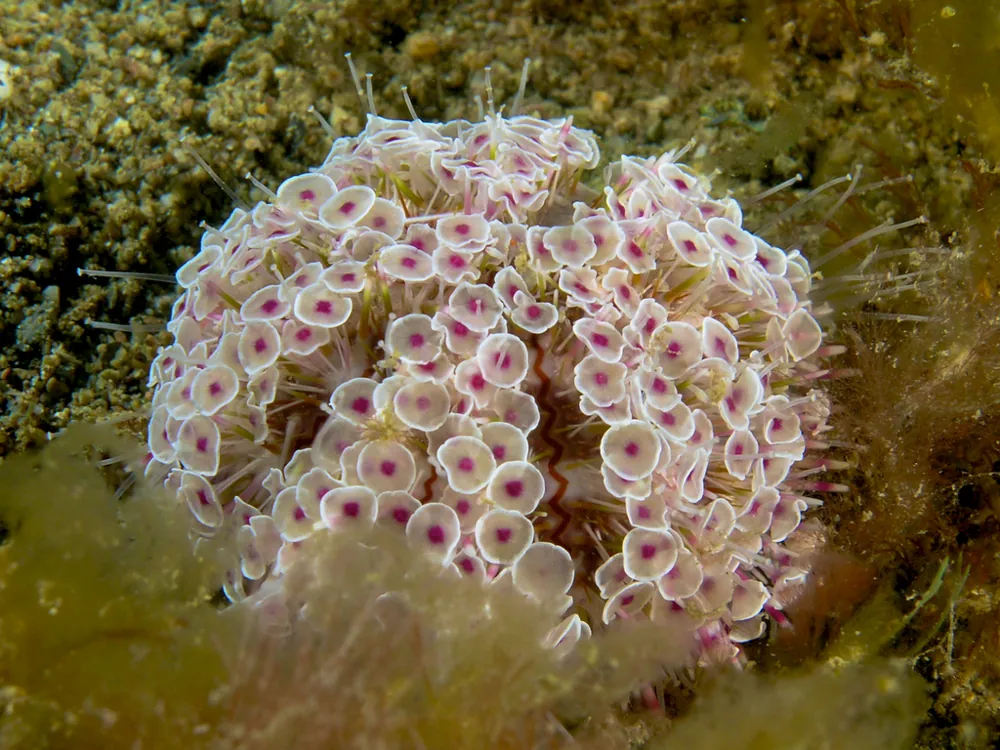
The flower urchin is a sea urchin with flower-shaped claws that can sting. It lives on coral reefs, in seagrass beds and on rocky or sandy sea floors across the Indo-West Pacific. It is one of the sea urchins most likely to cause a painful and medically significant sting.1
 Co renconuscher el
- Flower-like claws (globiferous pedicellariae) that are pinkish-white to yellowish-white, with a central purple dot and a bright white rim1
- A rigid shell (test) that is deep red and grey, with a purple zigzag pattern along each of the five ambulacral segments; rarely it is greenish or pale purple1
- Short, blunt spines, usually hidden beneath the flower-like claws1
- A body diameter of about 15 to 20 cm1
Savens confundì cun: Other Toxopneustes urchins look similar. Toxopneustes roseus has a uniform pink, brown or purple test and lives only in the eastern Pacific. Toxopneustes elegans, found only around Japan, has a dark stripe just below the tips of its spines. Toxopneustes maculatus is very rare, known from Réunion, Christmas Island and Palmyra Atoll, and has bright violet on its underside and a violet band around its middle.1
Forza dal tissi
Il tissi vegn or tras in aguigl.
Tge fa ses tissi?
Its venom is made in glands at the base of the flower-like claws, not in the spines. The claws have sharp fang-like tips that can penetrate human skin, and when touched they snap shut and inject venom. The sting is described as extremely painful and medically significant.1
Quant privlus è el per umans?
Privel per umans: Fitg privlusEl po mazzar ina persuna che na survegn nagin tractament.It is considered highly dangerous to people. Its stings are extremely painful and medically significant. Larger individuals with bigger claws are thought to be more dangerous, because the strength of the venom is linked to claw size.1
Tge fa el, cura ch'el ha tema?
When touched or brushed against, its flower-like claws snap shut and inject venom. The claws can break off and stay attached to the skin, continuing to inject venom for several hours.1
 Sch'el piztga
- Metta la plaja en aua chauda, uschè chauda sco che la persuna po supportar senza sa brischar, e tschertga agid medicinal per allontanar las spinas. N'emprova betg da las chavar ora sez.
Clama adina l'emprim tes numer d'urgenza (112, 000, 911). Quai è in cussegl general d'emprim agid, betg in cussegl medicinal. Basa da l'emprim agid
 Resta en segirezza
- Na tutga, na piglia e na tizza mai in animal selvadi, gnanc in pitschen, ed era sch'el para da durmir u d'esser mort.
- Dà spazi a l'animal. Sche ti scuntras in, resta calm, va plaun enavos e lascha ir el per sia via.
- Sch'in tal animal ta piztga: resta calm, na ta mova betg, clama tes numer d'urgenza (112, 000, 911) u va spert en in ospital. Ta regorda co ch'el veseva or, ina foto gida.
El n'ha betg quai sin tai. El dovra ses tissi per pigliar nutriment u per sa defender, e sa zuppa bler pli gugent. Dapli davart la segirezza
Nua sin il mund?
Quant grond è el?
Quant lung è el?
 uschè lung sco 6 bluccs da construcziun in suenter l'auter
 pli plaun ch'ina lindorna da curtin
Quant grond è Flower urchin cumpareglià cun TAI?
Mo matematica en tes navigatur. Nagut na vegn memorisà u tramess.
Quant svelt è el?

Fatgs
Unlike most venomous sea urchins, it does not sting through its spines. Its venom is delivered through the claws.1
A zebra crab, Zebrida adamsii, often lives attached to its shell. The crab is thought to be immune to its venom.1
Its flower-like claws are the source of its common name and are its most striking feature.1
Tiny shrimp, Athanas areteformis, sometimes live among its spines.1
In the seashell trade, its empty shells are called "mushroom urchins" because they look like mushroom caps.1
Destructur da mits
Mit: Sea urchins sting with their spines.
Vardad: Flower urchins do not deliver venom through their spines. Their venom comes from the flower-like claws, which snap shut and inject it.1
Per experts da tissi
- Num scientific
- Toxopneustes pileolus
- Gruppa
- Ritschs, stailas e verms
- Famiglia
- Toxopneustidae2
- Urden
- Camarodonta
- Continents
- Ocean Indic, Ocean Pacific, Mar Cotschen, Mar da Coral, Mar da las Filippinas, Mar da Timor e d'Arafura, Golf dal Bengal, Ils oceans
- Poppins
- Eggs and sperm are released into the water during mass spawning events, and fertilisation happens outside the body.1
- Privel per umans
- 4 / 5: Fitg privlus3
Da nua che vegnan ils fatgs
- Toxopneustes pileolus (Wikipedia (CC BY-SA 4.0))
- Toxopneustes pileolus (iNaturalist): nums e classificaziun.
- Venom Wiki: il stgalim da privel, la grondezza tipica e la stima da la sveltezza èn noss agens. Guarda co che nus als calculain: Co che nus valitain il privel.
Mintga fatg sin questa pagina ha in numer che renvia a sia funtauna. Sche nus avain fatg in sbagl, perstgisa, nus essan fans d'animals, betg ina revista scientifica. Scriva a nus a [email protected] e nus curregin.
 Il scorpiun ha fom! Venom Wiki è in project d'ina suletta persuna: gratuit, senza reclama e senza trackers. In pitschen bunamaun gida a tegnair el online.Pavlar il scorpiun
Dapli da la medema gruppa: Ritschs, stailas e verms
 Crown-of-thorns starfishRitschs, stailas e vermsDovra in mediBetg tutgar
 Fire urchinRitschs, stailas e vermsDovra in mediBetg tutgar
 Bearded firewormRitschs, stailas e vermsFa mo malBetg tutgar
 Black long-spined urchinRitschs, stailas e vermsFa mo malBetg tutgar
 BloodwormRitschs, stailas e vermsFa mo mal
 Bobbit wormRitschs, stailas e vermsFa mo mal
Viva era en: Ocean Indic
 Australian box jellyfishMedusas ed autras creaturas da mar che piztganMortalBetg tutgar
 Geography coneLindornas conicas e polipsMortal
 Greater blue-ringed octopusLindornas conicas e polipsMortal
 Southern blue-ringed octopusLindornas conicas e polipsMortal
 Hawksbill sea turtleAuters animals tossicsPo mazzar
 Irukandji jellyfishMedusas ed autras creaturas da mar che piztganPo mazzarBetg tutgar