
 Africa
 Asia
Asia Europa
 America dal Sid
 Australia ed Oceania
 Antarctica
 Ocean Pacific
 Ocean Atlantic
 Ocean Indic
 Ocean Arctic
 Mar Mediterran
 Mar Cotschen
 Mar Caribic
 Mar da Coral
 Mar da la China dal Sid
 Mar da las Filippinas
 Mar d'Andaman
 Mar dal Nord
 Mar da Timor e d'Arafura
 Golf dal Bengal
 Golf da California
Horseshoe pit viper
 Morsas
The horseshoe pit viper is a venomous snake that lives only in the Western Ghats mountains of southern India. It has a pale horseshoe-shaped mark on the back of its neck, which gives it its common name. It is special because its natural range is very small, possibly the smallest of any pit viper confirmed from India.1



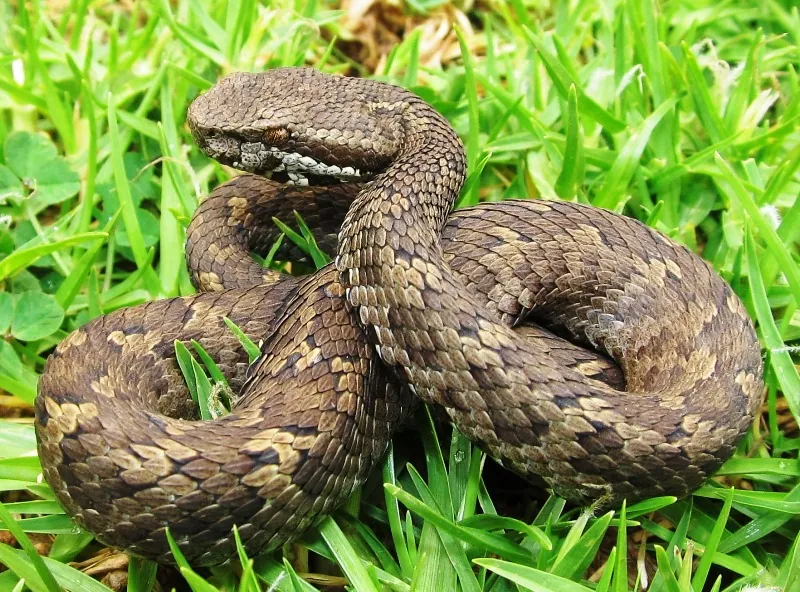
 Co renconuscher el
- A pale buff, horseshoe-shaped (inverted "U") mark on the nape of the neck.1
- Pale brownish or buff body with darker grey blotches and some white streaks.1
- Small internasal scales on the snout.1
- 21 rows of smooth or weakly keeled scales along the middle of the body.1
Savens confundì cun: It is often grouped with other pit vipers of peninsular India. It can be told apart by its small internasal scales, the second upper lip scale touching the loreal pit (the heat-sensing pit between eye and nostril), 21 rows of dorsal scales at midbody, and a single row of scales between the lip scales and the eye scales.1
Forza dal tissi
Il tissi vegn or tras ses dents da tissi u ses dents, cura ch'el morda.
Quant privlus è el per umans?
Privel per umans: GravIna morsa sto vegnir tractada dad in medi. Cas da mort èn fitg rars. Sch'el morda
- Tegna la persuna immobila e quieta, tegna il member mors a l'autezza dal cor, prenda giu anels e chaussas strenschidas e va spert en in ospital.
Clama adina l'emprim tes numer d'urgenza (112, 000, 911). Quai è in cussegl general d'emprim agid, betg in cussegl medicinal. Basa da l'emprim agid
 Resta en segirezza
- Na tutga, na piglia e na tizza mai in animal selvadi, gnanc in pitschen, ed era sch'el para da durmir u d'esser mort.
- Dà spazi a l'animal. Sche ti scuntras in, resta calm, va plaun enavos e lascha ir el per sia via.
- Sch'in tal animal ta morda: resta calm, na ta mova betg, clama tes numer d'urgenza (112, 000, 911) u va spert en in ospital. Ta regorda co ch'el veseva or, ina foto gida.
El n'ha betg quai sin tai. El dovra ses tissi per pigliar nutriment u per sa defender, e sa zuppa bler pli gugent. Dapli davart la segirezza
Quant grond è el?
Quant lung è el?
 uschè lung sco 2 bananas ina suenter l'autra
 uschè lung sco 12 bluccs da construcziun in suenter l'auter
 pudess currer 100 meters en 110 secundas (l'uman il pli svelt dovra 9,6)
Quant grond è Horseshoe pit viper cumpareglià cun TAI?
Mo matematica en tes navigatur. Nagut na vegn memorisà u tramess.
Quant svelt è el?


Fatgs
Destructur da mits
Mit: The horseshoe pit viper is found across a wide area, including parts of the Eastern Ghats.
Vardad: Early reports from outside the Western Ghats were misidentifications. The species is endemic to the Western Ghats, in Karnataka, Tamil Nadu and Kerala.1
Da nua che vegnan ils fatgs
- Craspedocephalus strigatus (Wikipedia (CC BY-SA 4.0))
- Craspedocephalus strigatus (iNaturalist): nums e classificaziun.
- Venom Wiki: il stgalim da privel, la grondezza tipica e la stima da la sveltezza èn noss agens. Guarda co che nus als calculain: Co che nus valitain il privel.
Mintga fatg sin questa pagina ha in numer che renvia a sia funtauna. Sche nus avain fatg in sbagl, perstgisa, nus essan fans d'animals, betg ina revista scientifica. Scriva a nus a [email protected] e nus curregin.
 Il scorpiun ha fom! Venom Wiki è in project d'ina suletta persuna: gratuit, senza reclama e senza trackers. In pitschen bunamaun gida a tegnair el online.Pavlar il scorpiun
 Brown spotted pit viper
 Habu
Habu Hump-nosed viper
 Hundred-pace viper
 Malayan pit viper
 Mamushi
 Deathstalker
 Indian cobra
 Indian saw-scaled viper
 King cobra
 Puff adder
 Russell's viper