
 Africa
 Asia
Asia Europa
 America dal Sid
 Australia ed Oceania
 Antarctica
 Ocean Pacific
 Ocean Atlantic
 Ocean Indic
 Ocean Arctic
 Mar Mediterran
 Mar Cotschen
 Mar Caribic
 Mar da Coral
 Mar da la China dal Sid
 Mar da las Filippinas
 Mar d'Andaman
 Mar dal Nord
 Mar da Timor e d'Arafura
 Golf dal Bengal
 Golf da California
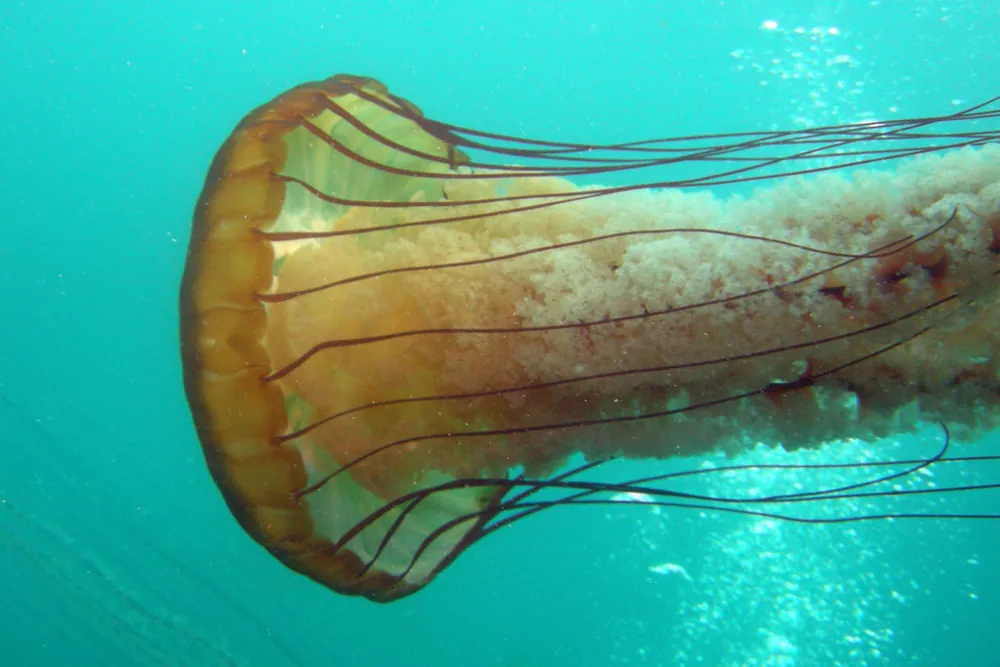
Pacific sea nettle
 Tentaclas che piztgan
The Pacific sea nettle is a large jellyfish with a golden-brown bell and long, trailing tentacles. It lives in the cool and temperate coastal waters of the northeastern Pacific Ocean, from southern British Columbia down to Mexico. Its sting is irritating, but it is rarely dangerous to people.1



 Co renconuscher el
Forza dal tissi
Millis da pitschnas cellas urticantas sajettan, cura ch'insatge las tutga.
Tge fa ses tissi?
When prey touches the tentacles, thousands of stinging cells (nematocysts) fire barbed stingers that inject venom. The venom contains proteins, including proteases and pore-forming toxins, which can disrupt cell membranes and tissues. The venom is effective against prey and humans, but is typically not lethal to people.1
Quant privlus è el per umans?
Privel per umans: DolurusQuai po far propi mal, ma i n'è bunamain mai grav.Its sting is often irritating and possibly mildly painful to people, but it is rarely dangerous. It is typically nonlethal to humans.1
Tge fa el, cura ch'el ha tema?
Its stinging tentacles are its main defence, although some animals, such as leatherback turtles, are not bothered by the sting.1
 Sch'el piztga
- Va or da l'aua e prenda davent las tentaclas (cun manetschas u cun in tschop).
- Tar medusas cubicas tropicalas: versa aschieu sin las piztgadas durant almain 30 secundas, clama agid e sajas pront da far ina reanimaziun. Tar galeras portugaisas e las bleras autras: lava cun aua da mar, lura cun aua chauda cunter las dolurs.
Clama adina l'emprim tes numer d'urgenza (112, 000, 911). Quai è in cussegl general d'emprim agid, betg in cussegl medicinal. Basa da l'emprim agid
 Resta en segirezza
- Na tutga, na piglia e na tizza mai in animal selvadi, gnanc in pitschen, ed era sch'el para da durmir u d'esser mort.
- Dà spazi a l'animal. Sche ti scuntras in, resta calm, va plaun enavos e lascha ir el per sia via.
- Sch'in tal animal ta piztga: resta calm, na ta mova betg, clama tes numer d'urgenza (112, 000, 911) u va spert en in ospital. Ta regorda co ch'el veseva or, ina foto gida.
El n'ha betg quai sin tai. El dovra ses tissi per pigliar nutriment u per sa defender, e sa zuppa bler pli gugent. Dapli davart la segirezza
Quant grond è el?
Quant lung è el?
 uschè lung sco 2 giats da chasa dal nas fin a la cua
 uschè lung sco 6 bananas ina suenter l'autra
Quant grond è Pacific sea nettle cumpareglià cun TAI?
Mo matematica en tes navigatur. Nagut na vegn memorisà u tramess.
Quant svelt è el?


Fatgs
Small fish and crabs sometimes hide inside its bell, where they may feed on it.1
It uses light-sensing organs called ocelli to migrate from deep water up to the surface.1
It swims by jet propulsion, squeezing its bell to push water out, though it mostly floats.1
Its population may be growing because of nutrient pollution from human sources, which feeds algal blooms and the wider food chain.1
It is kept in many aquariums because of its bright colours and very long tentacles, and it is low-maintenance in captivity.1
Per experts da tissi
- Num scientific
- Chrysaora fuscescens
- Gruppa
- Medusas ed autras creaturas da mar che piztgan
- Famiglia
- Pelagiidae2
- Urden
- Semaeostomeae
- Continents
- Ocean Pacific, Ils oceans
- Poppins
- Females hold fertilised eggs on their oral arms, where they grow into free-swimming larvae. The larvae settle, become polyps, and bud new polyps before developing into jellyfish. No number is given.1
- Privel per umans
- 2 / 5: Dolurus3
Da nua che vegnan ils fatgs
- Chrysaora fuscescens (Wikipedia (CC BY-SA 4.0))
- Chrysaora fuscescens (iNaturalist): nums e classificaziun.
- Venom Wiki: il stgalim da privel, la grondezza tipica e la stima da la sveltezza èn noss agens. Guarda co che nus als calculain: Co che nus valitain il privel.
Mintga fatg sin questa pagina ha in numer che renvia a sia funtauna. Sche nus avain fatg in sbagl, perstgisa, nus essan fans d'animals, betg ina revista scientifica. Scriva a nus a [email protected] e nus curregin.
 Il scorpiun ha fom! Venom Wiki è in project d'ina suletta persuna: gratuit, senza reclama e senza trackers. In pitschen bunamaun gida a tegnair el online.Pavlar il scorpiun
Dapli da la medema gruppa: Medusas ed autras creaturas da mar che piztgan
 Australian box jellyfishMedusas ed autras creaturas da mar che piztganMortalBetg tutgar
 Irukandji jellyfishMedusas ed autras creaturas da mar che piztganPo mazzarBetg tutgar
 Portuguese man o' warMedusas ed autras creaturas da mar che piztganDovra in mediBetg tutgar
 Lion's mane jellyfishMedusas ed autras creaturas da mar che piztganFa mo malBetg tutgar
 Moon jellyfishMedusas ed autras creaturas da mar che piztganNunprivlus
 Common kingslayerMedusas ed autras creaturas da mar che piztganPo mazzarBetg tutgar
Viva era en: Ocean Pacific
 Geography coneLindornas conicas e polipsMortal
 Greater blue-ringed octopusLindornas conicas e polipsMortal
 Japanese pufferfishAuters animals tossicsMortal
 Southern blue-ringed octopusLindornas conicas e polipsMortal
 Hawksbill sea turtleAuters animals tossicsPo mazzar
 Reef stonefishPeschs tissientadsPo mazzarBetg tutgar