
 Afurika
 Aziya
Aziya Uburayi
 Amerika y'Amajyepfo
 Ositaraliya na Oseyaniya
 Antaragitika
 Inyanja ya Pasifika
 Inyanja ya Atalantika
 Inyanja y'Abahinde
 Inyanja ya Arigitika
 Inyanja ya Mediterane
 Inyanja Itukura
 Inyanja ya Karayibe
 Inyanja ya Korali
 Inyanja y'Amajyepfo y'u Bushinwa
 Inyanja ya Filipine
 Inyanja ya Andamani
 Inyanja y'Amajyaruguru
 Inyanja ya Timor na Arafura
 Ikigobe cya Bengali
 Ikigobe cya Kaliforuniya
European purseweb spider
 Iraruma
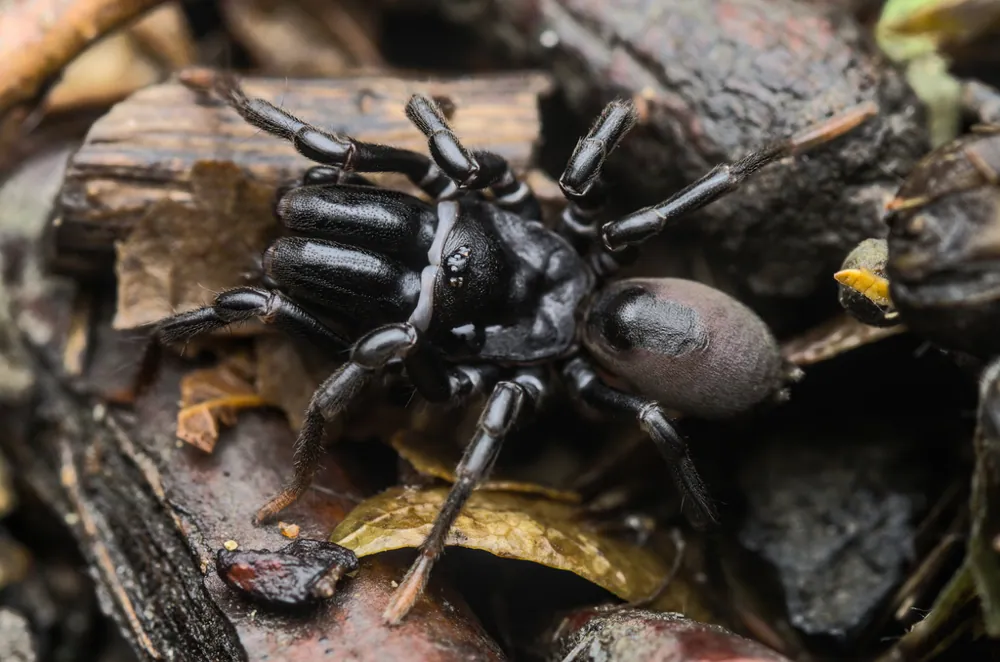
The European purseweb spider is a small, hidden spider that lives in the ground. It is found in mainland Europe, Great Britain and North Africa, and it is the only mygalomorph spider found in the Nordic countries and the United Kingdom. It is special because it builds a silk tube partly under the ground and catches insects that walk onto it.1

 Uko wayimenya
- Black or brownish in colour1
- Not particularly large: males are 7–9 mm and females are 10–15 mm long1
- Builds a silk tube that is partly underground, with the part above ground covered in leaves and other debris1
- Usually stays inside its web and does not leave except to mate1
- Young spiderlings are often very lightly coloured1
Ikunze kwitiranywa na: It looks much like Atypus piceus. Spiderlings of the European purseweb spider are often very lightly coloured, and its three-part posterior spinnerets do not have a light blot, which helps tell them apart.1
Imbaraga z'ubumara
Ubumara busohokera mu menyo yayo y'ubumara cyangwa mu yandi menyo iyo iriye.
Iteje akaga kangana iki ku bantu?
Akaga ku bantu: YorohejeNko guterwa urubori n'uruyuki cyangwa munsi yaho. Mu by'ukuri ntacyo itwaye abantu. Niba iruma
- Oza aho yarumye kandi uhakonjeshe. Shaka ubufasha bwa muganga niba ububabare bukabije cyangwa umuntu yumva atameze neza.
Buri gihe banza uhamagare nimero y'ubutabazi (112, 000, 911). Izi ni inama rusange z'ubutabazi bw'ibanze, si inama za muganga. Ibanze by'ubutabazi bw'ibanze
 Irinde akaga
- Ntuzigere ukora, ufata cyangwa ushotora inyamaswa yo mu gasozi, nubwo yaba ntoya, kandi nubwo yasa n'isinziriye cyangwa yapfuye.
- Yihe umwanya. Niba uhuye n'imwe, tuza, usubire inyuma buhoro buhoro kandi uyireke yigendere.
- Niba imwe ikurumye: tuza, ntunyeganyege, hamagara nimero y'ubutabazi (112, 000, 911) cyangwa ujye ku bitaro vuba. Ibuka uko yasaga, ifoto irafasha.
Ntigushakisha ngo ikugirire nabi. Ikoresha ubumara bwayo kugira ngo ifate ibyo kurya cyangwa yirinde, kandi ikunda cyane kwihisha. Ibindi ku kwirinda
Ingana gute?
Ireshya ite?
 ngufi kurusha agahera kawe
 yakwiruka metero 100 mu masegonda 330 (umuntu wihuta kurusha abandi akenera 9,6)
European purseweb spider ingana ite ugereranyije NAWE?
Ni imibare gusa ikorerwa muri mudasobwa yawe. Nta kintu kibikwa cyangwa cyoherezwa ahandi.
Yihuta gute?


Ibintu by'ukuri
Its fangs point straight down rather than crossing, as in other mygalomorph spiders.1
Autumn is its mating season. The male enters the female's burrow, where they live together until the male dies soon after mating.1
It is a mygalomorph spider, and it is the only mygalomorph spider found in the Nordic countries and the United Kingdom.1
It becomes sexually mature at about 4 years old.1
Usenya ibinyoma
Ikinyoma: The European purseweb spider lives in Ireland.
Ukuri: It was once listed for Ireland, based on a single silk tube found in 1896. This is now thought to be most likely from a plant nursery import, and the species is no longer recognised as living on the island.1
Ku bahanga mu by'ubumara
- Izina rya siyansi
- Atypus affinis
- Itsinda
- Tarantula na funnel-web
- Umuryango
- Atypidae2
- Itsinda rinini (order)
- Araneae
- Imigabane
- Uburayi
- Abana bato
- The female lays her egg sac inside the tube. The spiderlings hatch the following summer and stay with their mother for nearly another year.1
- Akaga ku bantu
- 1 / 5: Yoroheje3
Aho ibintu bivugwa bituruka
- Atypus affinis (Wikipedia (CC BY-SA 4.0))
- Atypus affinis (iNaturalist): amazina n'ibyiciro.
- Venom Wiki: urwego rw'akaga, ingano isanzwe n'ikigereranyo cy'umuvuduko ni ibyacu bwite. Reba uko tubibara: Uko tugena akaga.
Buri kintu kivugwa kuri iyi paji gifite nimero yerekana aho cyavuye. Niba twibeshye, tubabarire, turi abakunzi b'inyamaswa, ntituri ikinyamakuru cya siyansi. Tubwire kuri [email protected] tuzabikosora.
 Sikorupiyo irashonje! Venom Wiki ni umushinga w'umuntu umwe: ni ubuntu, nta matangazo kandi nta bikurikirana abantu. Impano ntoya ifasha kugira ngo ikomeze kuboneka kuri interineti.Gaburira sikorupiyo
Izindi zo mu itsinda rimwe: Tarantula na funnel-web
 Gibraltar funnel-web spiderTarantula na funnel-webIrababaza gusa
 Andalusian tarantulaTarantula na funnel-webNtacyo itwaye
 Sydney funnel-web spiderTarantula na funnel-webYica
 Goliath birdeaterTarantula na funnel-webIrababaza gusa
 Mexican redknee tarantulaTarantula na funnel-webNtacyo itwaye
 Northern tree-dwelling funnel-web spiderTarantula na funnel-webYica
Iba kandi muri: Uburayi
 Common European adderVipera na adderBisaba muganga
 Spanish flyIzindi nyamaswa zifite uburoziBisaba mugangaNtukayikoreho
 Common waspInzuki, amavubi n'amavubi maniniIrababaza gusa
 European hornetInzuki, amavubi n'amavubi maniniIrababaza gusa
 Fire salamanderIbikeri by'uburozi, ibikeri binini na newtIrababaza gusaNtukayikoreho
 Western honey beeInzuki, amavubi n'amavubi maniniIrababaza gusa