
 Afurika
 Aziya
Aziya Uburayi
 Amerika y'Amajyepfo
 Ositaraliya na Oseyaniya
 Antaragitika
 Inyanja ya Pasifika
 Inyanja ya Atalantika
 Inyanja y'Abahinde
 Inyanja ya Arigitika
 Inyanja ya Mediterane
 Inyanja Itukura
 Inyanja ya Karayibe
 Inyanja ya Korali
 Inyanja y'Amajyepfo y'u Bushinwa
 Inyanja ya Filipine
 Inyanja ya Andamani
 Inyanja y'Amajyaruguru
 Inyanja ya Timor na Arafura
 Ikigobe cya Bengali
 Ikigobe cya Kaliforuniya
Tarantula hawk
 Itera urubori
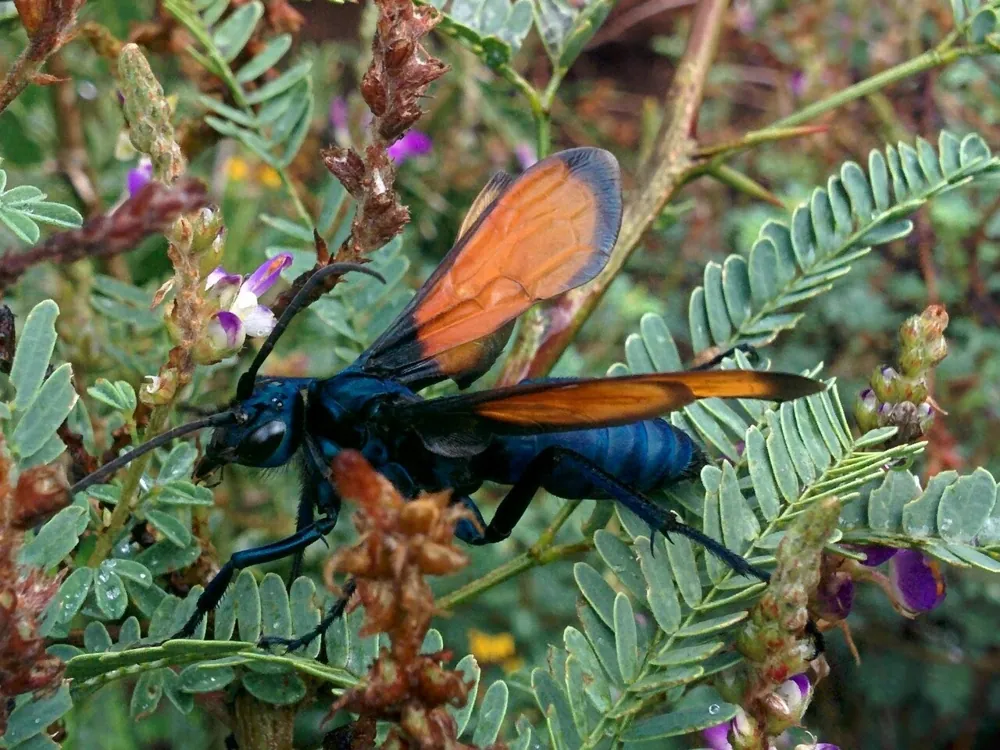
The tarantula hawk is a very large wasp that hunts tarantulas, which are big hairy spiders. It lives from the southern United States through Mexico and Central America to northern South America, and also on the Caribbean islands. Its sting is among the most painful of any insect.1
 Uko wayimenya
- Black and orange colours, with several colour forms: an orange-winged form, a black-winged form, and in northern South America a form with a dark wing base, dark amber patches and a pale wing tip1
- Females are 30–51 mm long; males are 24–40 mm long1
- Jerky movements and a strong odour1
- Males have 12 antennal segments, which separates them from other Pepsis species, which have 131
Ikunze kwitiranywa na: The black-winged form is hard to tell apart from Pepsis mexicana, but that species is always noticeably smaller. The robber fly Wyliea mydas copies the tarantula hawk's black body and bright orange wings, and makes stinging movements, but it cannot sting.1
Imbaraga z'ubumara
Ubumara busohokera mu rubori.
Ubumara bwayo bukora iki?
Tarantula hawks produce large amounts of venom. A sting causes immediate, intense pain that is short-lived, and it is among the greatest pain recorded for any stinging insect. The venom itself is not very toxic, so its defence works almost entirely through pain.1
Iteje akaga kangana iki ku bantu?
Akaga ku bantu: IrababazaIshobora kubabaza cyane, ariko hafi ya buri gihe nta kibazo gikomeye biteza.Only females can sting. The sting is considered the second most painful of any insect sting, scoring 4.0 on the Schmidt sting pain index, compared with 4.0+ for the bullet ant.1
Ikora iki iyo ifite ubwoba?
Its black and orange colours, jerky behaviour and strong odour warn predators that it can sting.1
 Niba itera urubori
- Kuramo urubori rw'uruyuki uruharura, kandi ukonjeshe aho rwateye.
- Niba umuntu ahumeka bimugoye, akabyimba mu maso cyangwa mu muhogo, cyangwa akumva agiye guta ubwenge, ni ikibazo cyihutirwa cya aleriji: hamagara nimero y'ubutabazi kandi ukoreshe urushinge rwe rwa adrenaline (adrenaline pen) niba arufite.
Buri gihe banza uhamagare nimero y'ubutabazi (112, 000, 911). Izi ni inama rusange z'ubutabazi bw'ibanze, si inama za muganga. Ibanze by'ubutabazi bw'ibanze
 Irinde akaga
- Ntuzigere ukora, ufata cyangwa ushotora inyamaswa yo mu gasozi, nubwo yaba ntoya, kandi nubwo yasa n'isinziriye cyangwa yapfuye.
- Yihe umwanya. Niba uhuye n'imwe, tuza, usubire inyuma buhoro buhoro kandi uyireke yigendere.
- Niba imwe igutereye urubori: tuza, ntunyeganyege, hamagara nimero y'ubutabazi (112, 000, 911) cyangwa ujye ku bitaro vuba. Ibuka uko yasaga, ifoto irafasha.
Ntigushakisha ngo ikugirire nabi. Ikoresha ubumara bwayo kugira ngo ifate ibyo kurya cyangwa yirinde, kandi ikunda cyane kwihisha. Ibindi ku kwirinda
Ingana gute?
Ireshya ite?
 ngufi kurusha agahera kawe
 yaguruka ikambuka ikibuga cyose cy'umupira w'amaguru mu masegonda 8,4
Tarantula hawk ingana ite ugereranyije NAWE?
Ni imibare gusa ikorerwa muri mudasobwa yawe. Nta kintu kibikwa cyangwa cyoherezwa ahandi.
Yihuta gute?


Ibintu by'ukuri
The female chooses the spider's size and sex for her eggs. Fertilised eggs go on large spiders and become females, and unfertilised eggs go on male spiders and become males.1
Roadrunners sometimes steal the tarantula from a wasp and leave the wasp unharmed. Others beat the wasp against the ground before eating it.1
The tarantula hawk is the state insect of New Mexico. Almost 10,000 schoolchildren voted for it, and it was made official by a law signed in 1989.1
Wasps of the genus Pepsis are important pollinators of milkweeds, which are poisonous to grazing livestock.1
Usenya ibinyoma
Ikinyoma: The tarantula hawk's sting is dangerous mainly because its venom is strongly poisonous.
Ukuri: The venom itself is not very toxic. Its main defence is the intense pain of the sting.1
Ku bahanga mu by'ubumara
- Izina rya siyansi
- Pepsis grossa
- Itsinda
- Inzuki, amavubi n'amavubi manini
- Umuryango
- Pompilidae2
- Itsinda rinini (order)
- Hymenoptera
- Imigabane
- Amerika y'Amajyaruguru, Amerika y'Amajyepfo
- Abana bato
- The female lays a single egg on a paralysed spider and seals it in a chamber, and the larva eats the spider.1
- Akaga ku bantu
- 2 / 5: Irababaza3
Aho ibintu bivugwa bituruka
- Pepsis grossa (Wikipedia (CC BY-SA 4.0))
- Pepsis grossa (iNaturalist): amazina n'ibyiciro.
- Venom Wiki: urwego rw'akaga, ingano isanzwe n'ikigereranyo cy'umuvuduko ni ibyacu bwite. Reba uko tubibara: Uko tugena akaga.
Buri kintu kivugwa kuri iyi paji gifite nimero yerekana aho cyavuye. Niba twibeshye, tubabarire, turi abakunzi b'inyamaswa, ntituri ikinyamakuru cya siyansi. Tubwire kuri [email protected] tuzabikosora.
 Sikorupiyo irashonje! Venom Wiki ni umushinga w'umuntu umwe: ni ubuntu, nta matangazo kandi nta bikurikirana abantu. Impano ntoya ifasha kugira ngo ikomeze kuboneka kuri interineti.Gaburira sikorupiyo
Izindi zo mu itsinda rimwe: Inzuki, amavubi n'amavubi manini
 Executioner waspInzuki, amavubi n'amavubi maniniBisaba muganga
 Warrior waspInzuki, amavubi n'amavubi maniniBisaba muganga
 Bald-faced hornetInzuki, amavubi n'amavubi maniniIrababaza gusa
 Cow killer velvet antInzuki, amavubi n'amavubi maniniIrababaza gusa
 Eastern cicada killerInzuki, amavubi n'amavubi maniniNtacyo itwaye
 Armadillo waspInzuki, amavubi n'amavubi maniniBisaba muganga
 Terciopelo
 Eastern coral snake
 Eastern diamondback rattlesnake
 Eyelash viper
 Timber rattlesnake
 Western diamondback rattlesnake
.jpg)