
 Afrika
 Asia
Asia Yuropu
 Amerika yeKumaodzanyemba
 Australia neOceania
 Antarctica
 Gungwa rePacific
 Gungwa reAtlantic
 Gungwa reIndia
 Gungwa reArctic
 Gungwa reMediterranean
 Gungwa Dzvuku
 Gungwa reCaribbean
 Gungwa reCoral
 Gungwa reChina yeKumaodzanyemba
 Gungwa rePhilippines
 Gungwa reAndaman
 Gungwa reKuchamhembe
 Gungwa reTimor neArafura
 Gungwa reBengal
 Gulf yeCalifornia
Crown-of-thorns starfish
 Mazonzwa ane uturu
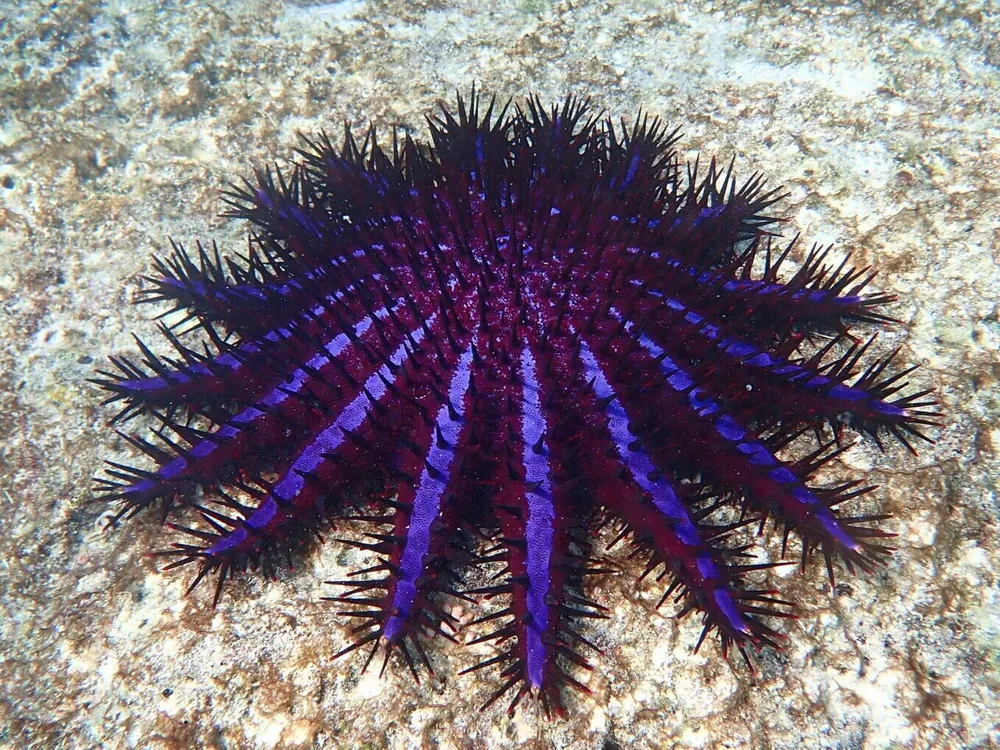
The crown-of-thorns starfish is a large starfish with long, sharp spines that look like a crown of thorns. It lives on coral reefs across the Indo-Pacific, from the Red Sea to the west coast of Central America, and it is most common around Australia. It feeds on hard coral, so it can change the reefs it lives on.1

 Maziviro ayo
- Adults are normally 25 to 35 cm across.1
- Up to 21 arms, with long, stiff, very sharp spines that are 4 to 5 cm long on the top and sides of the arms.1
- Colour varies with diet or region: purple, purple-blue, reddish grey or brown with red spine tips, or green with yellow spine tips.1
- The body is flexible and can bend and twist around coral surfaces.1
Inowanzovhiringidzwa ne: A close relative, Acanthaster brevispinus, lives on soft sea floors at moderate depths rather than on coral reefs. The two are considered sibling species.1
Simba reuturu
Mazonzwa akapinza ndiwo anotakura uturu. Kuitsika kana kuibata kunorwadza.
Uturu hwayo hunoitei?
The spines do not inject venom. When they pierce skin, tissue containing saponins (detergent-like chemicals) is left in the wound. In humans this causes a sharp, stinging pain that can last several hours, persistent bleeding, and nausea and swelling that may last a week or more.1
Ine ngozi yakadii kuvanhu?
Ngozi kuvanhu: YakakombaKana minzwa yayo ikakubaya, enda kuna chiremba. Kufa hakuwanzoitiki zvachose.The spines can cause sharp pain, long-lasting bleeding, nausea and swelling. Brittle spines can break off and stay in the tissue.1
 Kana minzwa yayo ikakubaya
- Spines that become embedded in the tissue must be removed surgically.1
- Isa ronda mumvura inopisa, inopisa sezvinokwanisa munhu asina kutsva, uye wana rubatsiro rwechiremba kuti mazonzwa abviswe. Usaachera iwe pachako.
Gara uchitanga wafonera nhamba yechimbichimbi (112, 000, 911). Iri izano rakajairika rerubatsiro rwekutanga, kwete zano rechiremba. Zvakakosha zverubatsiro rwekutanga
 Gara wakachengeteka
- Usambobata mhuka yesango, kuedza kuitora kana kuinetsa, kunyange iri diki, uye kunyange ichiita seyakarara kana yakafa.
- Ipa nzvimbo. Kana ukasangana nayo, dzikama, dzokera shure zvishoma nezvishoma uirege iende nenzira yayo.
- Kana minzwa yayo ikakubaya: dzikama, gara wakanyarara, fonera nhamba yechimbichimbi (112, 000, 911) kana kuti enda kuchipatara nokukurumidza. Rangarira kuti yaitaridzika sei, mufananidzo unobatsira.
Haisi kukutsvaga. Inoshandisa uturu hwayo kubata chikafu kana kuzvidzivirira, uye inotonyanya kuda kuhwanda. Zvimwe pamusoro pekugara wakachengeteka
Kupi pasi rose?
Yakakura sei?
Yakareba zvakadii?
 yakareba sezvidhinha zvematoyi 11 zvakateedzana
 inononoka kupfuura hozhwa yemugadheni
Crown-of-thorns starfish yakakura sei kana yaenzaniswa NEWE?
Masvomhu chete mubrowser yako. Hapana chinochengetwa kana kutumirwa kupi zvako.
Inomhanya zvakadii?

.jpg)
Chokwadi
An individual starfish can consume up to 6 square metres of living coral reef per year.1
When taken out of water, its soft body ruptures and collapses, but its spines can recover their shape if it is put back in the water while still alive.1
Its body contains detergent-like saponins, so keeping starfish in small volumes of water with aeration produces large amounts of foam.1
It is one of the largest starfish in the world.1
It has lost the usual five-fold symmetry of starfish as it grew more arms, although it begins life with five-fold symmetry.1
Kuputsa ngano
Ngano: Its spines inject venom like a snake or stinging animal.
Chokwadi: It has no mechanism for injecting toxin. Its spines pierce skin and leave saponin-containing tissue in the wound.1
Kune nyanzvi dzeuturu
- Zita resainzi
- Acanthaster planci
- Boka
- Masea urchin, nyeredzi dzegungwa nemakonye egungwa
- Mhuri
- Acanthasteridae2
- Odha
- Valvatida
- Makondinendi
- Gungwa reIndia, Gungwa rePacific, Gungwa Dzvuku, Gungwa reCoral, Gungwa rePhilippines, Gungwa reChina yeKumaodzanyemba, Gungwa reAndaman, Gungwa reArabia neGulf yePersia, Gungwa reTimor neArafura, Gungwa reBengal, Makungwa makuru
- Vacheche
- It releases vast amounts of eggs and sperm (gametes) during mass spawning events in summer, and the eggs contain saponins similar to those in adults.1
- Ngozi kuvanhu
- 3 / 5: Yakakomba3
Kwakabva chokwadi
- Crown-of-thorns starfish (Wikipedia (CC BY-SA 4.0))
- Acanthaster planci (iNaturalist): mazita nekurongwa kwemhuka.
- Venom Wiki: danho rengozi, saizi yakajairika nekufungidzira kwekumhanya ndezvedu. Ona kuti tinozviwana sei: Matinoyera ngozi.
Chokwadi chimwe nechimwe pane peji rino chine nhamba inoratidza kwachakabva. Kana takakanganisa, ruregerero, tiri vanoda mhuka, kwete magazini yesainzi. Tiudze pa[email protected] tichazvigadzirisa.
 Chinyavada chine nzara! Venom Wiki iprojekiti yemunhu mumwe: yemahara, isina kushambadza uye isina zvinokuteedzera. Chipo chidiki chinobatsira kuti irambe iri paindaneti.Fudza chinyavada
Zvimwe kubva muboka rimwe chete: Masea urchin, nyeredzi dzegungwa nemakonye egungwa
 Flower urchinMasea urchin, nyeredzi dzegungwa nemakonye egungwaInogona kuuraya
 Fire urchinMasea urchin, nyeredzi dzegungwa nemakonye egungwaInoda chirembaUsabata
 Bearded firewormMasea urchin, nyeredzi dzegungwa nemakonye egungwaInongorwadzaUsabata
 Black long-spined urchinMasea urchin, nyeredzi dzegungwa nemakonye egungwaInongorwadzaUsabata
 BloodwormMasea urchin, nyeredzi dzegungwa nemakonye egungwaInongorwadza
 Bobbit wormMasea urchin, nyeredzi dzegungwa nemakonye egungwaInongorwadza
Inogarawo mu: Gungwa reIndia
 Australian box jellyfishMajellyfish nezvimwe zvinobaya zvegungwaInourayaUsabata
 Geography coneHozhwa dzecone nemaoctopusInouraya
 Greater blue-ringed octopusHozhwa dzecone nemaoctopusInouraya
 Southern blue-ringed octopusHozhwa dzecone nemaoctopusInouraya
 Hawksbill sea turtleDzimwe mhuka dzine chepfuInogona kuuraya
 Irukandji jellyfishMajellyfish nezvimwe zvinobaya zvegungwaInogona kuurayaUsabata