
 Afrika
 Asia
Asia Yuropa
 Amerika Borwa
 Australia le Oceania
 Antarctica
 Lewatle la Pacific
 Lewatle la Atlantic
 Lewatle la India
 Lewatle la Arctic
 Lewatle la Mediterranean
 Lewatle le Lefubedu
 Lewatle la Caribbean
 Lewatle la Coral
 Lewatle la China Borwa
 Lewatle la Philippine
 Lewatle la Andaman
 Lewatle la Leboya
 Lewatle la Timor le Arafura
 Kgwohlo ya Bengal
 Kgwohlo ya California
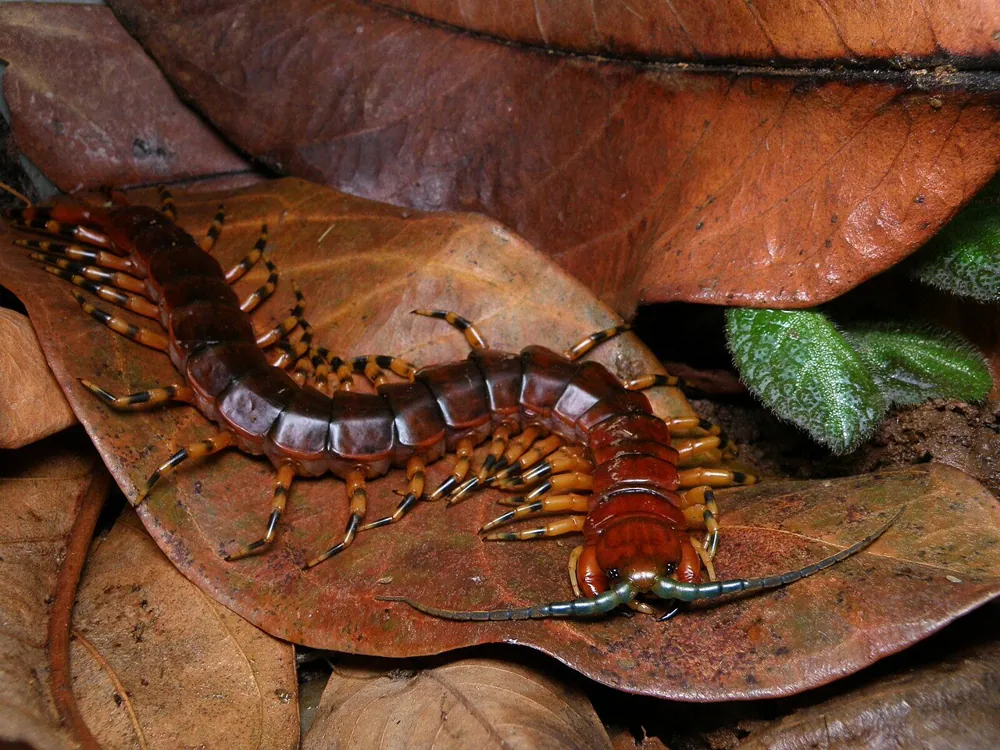
Amazonian giant green-horned centipede
 Ho loma
The Amazonian giant green-horned centipede is a large, fast hunting centipede that lives in the Amazon rainforest. It is a predator that uses venom to subdue its prey, and it is known in parts of Brazil for its use in folk medicine.1



 Ho e tseba jwang
Matla a chefo
Chefo e tswa ka meno a yona a chefo (fangs) kapa ka meno a mang ha e loma.
E kotsi hakae ho batho?
Kotsi ho batho: E tebilengHo longwa ho hloka ngaka. Lefu le etsahala ka seoelo haholo.E etsang ha e tshohile?
When disturbed by a predator, it runs away quickly. If pursued, it raises its terminal legs to draw an attack to its hind end, then grips the attacker, spins round and bites before fleeing.1
 Haeba e loma
- Hlatswa moo e lomileng teng, o pholise kapa o ho kenye metsing a futhumetseng bakeng sa bohloko, mme o fumane thuso ya bongaka haeba ho mpefala.
Kamehla letsetsa nomoro ya tshohanyetso pele (112, 000, 911). Ena ke tataiso e akaretsang ya thuso ya pele, hase keletso ya bongaka. Metheo ya thuso ya pele
 Dula o bolokehile
- O se ke wa ama, wa tshwara kapa wa tena phoofolo ya naheng, leha e le e nyenyane, le leha e shebahala e robetse kapa e shwele.
- E fe sebaka. Ha o kopana le yona, dula o kgutsitse, kgutlela morao butle mme o e tlohele e tsamaye ka tsela ya yona.
- Haeba e nngwe e o loma: dula o kgutsitse, o se ke wa sisinyeha, letsetsa nomoro ya tshohanyetso (112, 000, 911) kapa o ye sepetlele kapele. Hopola hore e ne e shebahala jwang, foto e a thusa.
Ha e o batle. E sebedisa chefo ya yona ho tshwara dijo kapa ho itshireletsa, mme e kgetha ho ipata. Ho eketsehileng ka ho dula o bolokehile
Hokae lefatsheng?
E kgolo hakae?
E telele hakae?
 e telele jwaloka diboloko tsa ho bapala tse 7 moleng
 e ka matha metara e 100 ka metsotswana e 170 (motho ya potlakang ka ho fetisisa o hloka 9,6)
Amazonian giant green-horned centipede e kgolo hakae ha e bapiswa le WENA?
Ke dipalo feela ka hara sebatli sa hao. Ha ho letho le bolokwang kapa le romelwang kae kapa kae.
E potlaka hakae?


Dintlha
Despite its size, it can eat small vertebrates such as rodents, frogs, snakes and lizards.1
When a predator touches its raised rear legs, it grips the attacker and spins round to bite.1
A peptide called lacrain, found in its body, has strong effects against Gram-negative bacteria. It is the first peptide with antimicrobial activity described from a myriapod's body extract.1
Lacrain shows little toxicity to human red blood cells, which makes it promising for future uses.1
In northeast Brazil, it is used in regional folk medicine as a painkiller (analgesic).1
Moo dintlha di tswang teng
- Scolopendra viridicornis (Wikipedia (CC BY-SA 4.0))
- Scolopendra viridicornis (iNaturalist): mabitso le tlhophiso.
- Venom Wiki: boemo ba kotsi, boholo bo tlwaelehileng le kakanyo ya lebelo ke tsa rona. Bona kamoo re di balang ka teng: Kamoo re lekanyang kotsi ka teng.
Taba e nngwe le e nngwe leqepheng lena e na le nomoro e bontshang mohlodi wa yona. Haeba re entse phoso, re kopa tshwarelo, re barati ba diphoofolo, hase makasine wa saense. Re bolelle ho [email protected] mme re tla e lokisa.
 Phepheng e lapile! Venom Wiki ke projeke ya motho a le mong: ke mahala, ha e na dipapatso ebile ha e na di-tracker. Thuso e nyenyane ya tjhelete e e boloka e ntse e le inthaneteng.Fepa phepheng
Tse ding tsa sehlopha se le seng: Di-centipede
 Peruvian giant centipedeDi-centipedeE hloka ngaka
 Galapagos centipedeDi-centipedeE hloka ngaka
 Chinese red-headed centipedeDi-centipedeE hloka ngaka
 Giant Australian centipedeDi-centipedeE utlwisa bohloko feela
 Giant desert centipedeDi-centipedeE utlwisa bohloko feela
 Mediterranean banded centipedeDi-centipedeE utlwisa bohloko feela
 Golden poison frog
 Terciopelo
 Brazilian wandering spider
 Eyelash viper
 Golden lancehead
 South American bushmaster