
 Afrika
 Asia
Asia Yuropa
 Amerika Borwa
 Australia le Oceania
 Antarctica
 Lewatle la Pacific
 Lewatle la Atlantic
 Lewatle la India
 Lewatle la Arctic
 Lewatle la Mediterranean
 Lewatle le Lefubedu
 Lewatle la Caribbean
 Lewatle la Coral
 Lewatle la China Borwa
 Lewatle la Philippine
 Lewatle la Andaman
 Lewatle la Leboya
 Lewatle la Timor le Arafura
 Kgwohlo ya Bengal
 Kgwohlo ya California
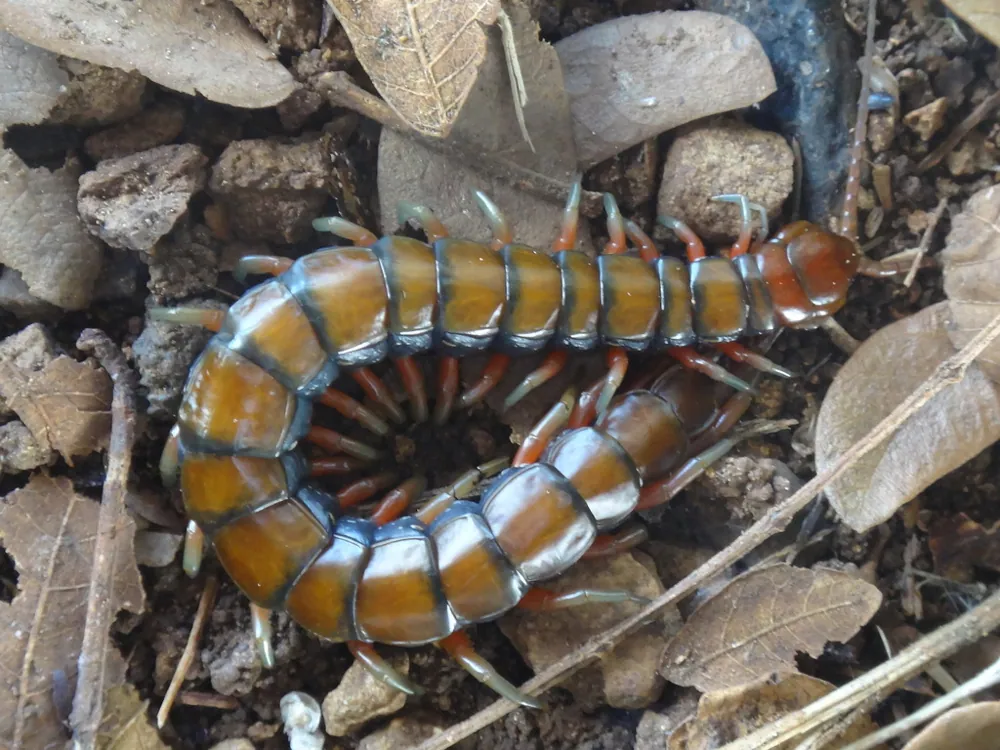
Chinese red-headed centipede
 Ho loma
The Chinese red-headed centipede is one of the largest centipedes in the world. It lives across much of southeastern Asia and on many islands and continents, often through human introduction. It is an active hunter with a venomous bite, so it is best seen from a safe distance.1



 Ho e tseba jwang
Matla a chefo
Chefo e tswa ka meno a yona a chefo (fangs) kapa ka meno a mang ha e loma.
Chefo ya yona (eo e e kenyang ka ho loma kapa ho hlaba) e etsang?
Its venom normally causes extreme pain, among other symptoms. A fatal case was reported in the Philippines, where a 7-year-old girl was bitten on the head and died 29 hours later.1
E kotsi hakae ho batho?
Kotsi ho batho: E tebilengHo longwa ho hloka ngaka. Lefu le etsahala ka seoelo haholo.Its bite causes extreme pain, and a child has died after being bitten in the Philippines. Bites per year and other risk details are not recorded.1
E etsang ha e tshohile?
It is aggressive and nervous, ready to strike if disturbed, and when defending itself it coils its whole body around the attacker while using its toxicognaths.1
 Haeba e loma
- Hlatswa moo e lomileng teng, o pholise kapa o ho kenye metsing a futhumetseng bakeng sa bohloko, mme o fumane thuso ya bongaka haeba ho mpefala.
Kamehla letsetsa nomoro ya tshohanyetso pele (112, 000, 911). Ena ke tataiso e akaretsang ya thuso ya pele, hase keletso ya bongaka. Metheo ya thuso ya pele
 Dula o bolokehile
- O se ke wa ama, wa tshwara kapa wa tena phoofolo ya naheng, leha e le e nyenyane, le leha e shebahala e robetse kapa e shwele.
- E fe sebaka. Ha o kopana le yona, dula o kgutsitse, kgutlela morao butle mme o e tlohele e tsamaye ka tsela ya yona.
- Haeba e nngwe e o loma: dula o kgutsitse, o se ke wa sisinyeha, letsetsa nomoro ya tshohanyetso (112, 000, 911) kapa o ye sepetlele kapele. Hopola hore e ne e shebahala jwang, foto e a thusa.
Ha e o batle. E sebedisa chefo ya yona ho tshwara dijo kapa ho itshireletsa, mme e kgetha ho ipata. Ho eketsehileng ka ho dula o bolokehile
Hokae lefatsheng?
E kgolo hakae?
E telele hakae?
 e telele jwaloka diboloko tsa ho bapala tse 6 moleng
 e ka matha metara e 100 ka metsotswana e 190 (motho ya potlakang ka ho fetisisa o hloka 9,6)
Chinese red-headed centipede e kgolo hakae ha e bapiswa le WENA?
Ke dipalo feela ka hara sebatli sa hao. Ha ho letho le bolokwang kapa le romelwang kae kapa kae.
E potlaka hakae?


Dintlha
It is among the largest centipedes in the world, with a normal maximum length of 20 cm.1
The centipede was a traditional food source for Aboriginal Australians.1
Adults molt once every year and may live for 10 years or more.1
It is a popular pet among arthropod hobbyists.1
Young centipedes molt once a year and take 3 to 4 years to reach full adult size.1
Bakeng sa ditsebi tsa chefo
- Lebitso la saense
- Scolopendra subspinipes
- Sehlopha
- Di-centipede
- Lelapa
- Scolopendridae2
- Tatelano
- Scolopendromorpha
- Dikontinente
- Asia
- Masea
- The female lays 50 to 80 eggs in a dark, protected place, guards them until they hatch, and wraps around her young if danger is detected.1
- Nako ya bophelo
- e ka bang dilemo tse 101
- Kotsi ho batho
- 3 / 5: E tebileng3
Moo dintlha di tswang teng
- Scolopendra subspinipes (Wikipedia (CC BY-SA 4.0))
- Scolopendra subspinipes (iNaturalist): mabitso le tlhophiso.
- Venom Wiki: boemo ba kotsi, boholo bo tlwaelehileng le kakanyo ya lebelo ke tsa rona. Bona kamoo re di balang ka teng: Kamoo re lekanyang kotsi ka teng.
Taba e nngwe le e nngwe leqepheng lena e na le nomoro e bontshang mohlodi wa yona. Haeba re entse phoso, re kopa tshwarelo, re barati ba diphoofolo, hase makasine wa saense. Re bolelle ho [email protected] mme re tla e lokisa.
 Phepheng e lapile! Venom Wiki ke projeke ya motho a le mong: ke mahala, ha e na dipapatso ebile ha e na di-tracker. Thuso e nyenyane ya tjhelete e e boloka e ntse e le inthaneteng.Fepa phepheng
Tse ding tsa sehlopha se le seng: Di-centipede
 Giant Australian centipedeDi-centipedeE utlwisa bohloko feela
 Mediterranean banded centipedeDi-centipedeE utlwisa bohloko feela
 House centipedeDi-centipedeHa e na kotsi
 Vietnamese giant centipedeDi-centipedeE hloka ngaka
 Indian tiger centipedeDi-centipedeE utlwisa bohloko feela
 Japanese giant centipedeDi-centipedeE utlwisa bohloko feela
 Deathstalker
 Indian cobra
 Indian saw-scaled viper
 King cobra
 Puff adder
 Noha ea Russell