
 Afrika
 Asia
Asia Yuropa
 Amerika Borwa
 Australia le Oceania
 Antarctica
 Lewatle la Pacific
 Lewatle la Atlantic
 Lewatle la India
 Lewatle la Arctic
 Lewatle la Mediterranean
 Lewatle le Lefubedu
 Lewatle la Caribbean
 Lewatle la Coral
 Lewatle la China Borwa
 Lewatle la Philippine
 Lewatle la Andaman
 Lewatle la Leboya
 Lewatle la Timor le Arafura
 Kgwohlo ya Bengal
 Kgwohlo ya California
Baja California bark scorpion
 Ho hlaba
The Baja California bark scorpion is a slender scorpion with a long tail. It lives in the western deserts and wet places of North America, mainly in Baja California. It matters because it is closely related to the Arizona bark scorpion, and scientists only confirmed in 2004 that the two are separate species.1


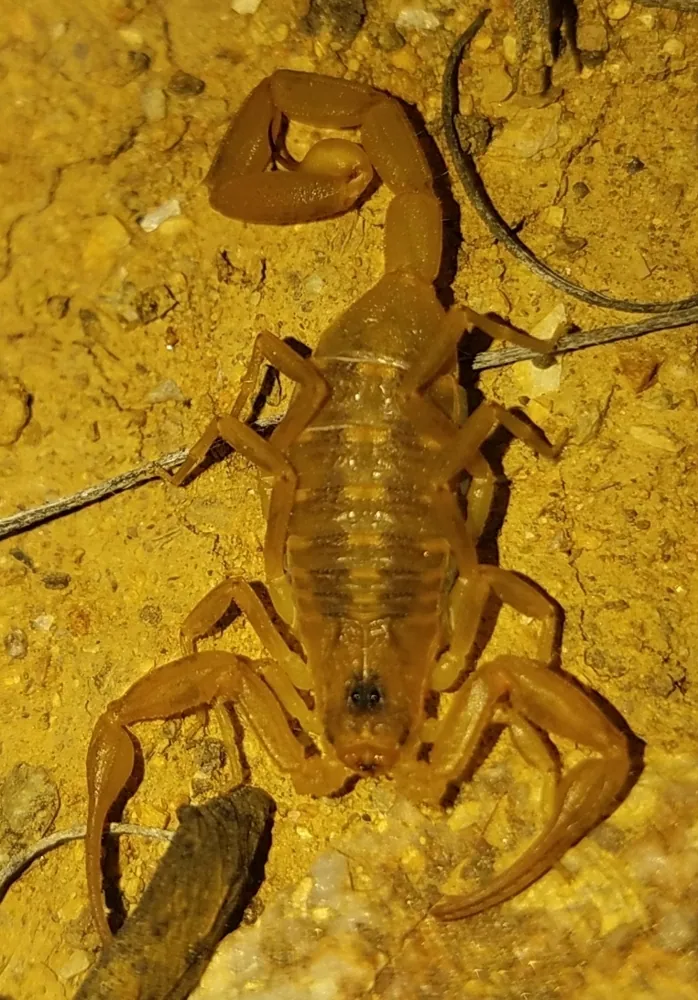
 Ho e tseba jwang
- Slender body with a long tail1
- Typically sand-coloured, though it can appear darker1
- Exoskeleton can be yellow, light brown or gold1
- Body length of about 3.8 to 7.6 cm1
- Rests its tail on the ground, unlike other scorpions that hold it arched over the back. It also has a subaculear tooth at the tip of its stinger1
Hangata e ferekanngwa le: It is closely related to the Arizona bark scorpion, and their body shapes can be almost impossible to tell apart. Differences in venom and DNA are used to separate the two species. The subaculear tooth at the tip of the stinger and the way the tail rests on the ground are the main features that set it apart from other scorpions.1
Matla a chefo
Chefo e tswa ka lemao le hlabang.
Chefo ya yona (eo e e kenyang ka ho loma kapa ho hlaba) e etsang?
It uses venom to hunt, injecting it into prey to immobilise or kill it. Each scorpion species has a unique venom profile, which is used to tell species apart. In humans, its venom may cause difficulty breathing or muscle spasms.1
E kotsi hakae ho batho?
Kotsi ho batho: E bohlokoE ka utlwisa bohloko haholo, empa hoo e batlang e le kamehla ha e kotsi haholo.Its venom has the potential to be fatal to humans, but the chances of this happening are low. It is not considered dangerous, and it is less of a medical threat than its close relative, the Arizona bark scorpion.1
 Haeba e hlaba
- Pholisa moo e hlabileng teng ka pakete ya leqhwa mme o boloke motho a sa sisinyehe. Fumana thuso ya bongaka kapele, haholoholo bakeng sa bana: diphepheng tse ding di bolaya bana.
Kamehla letsetsa nomoro ya tshohanyetso pele (112, 000, 911). Ena ke tataiso e akaretsang ya thuso ya pele, hase keletso ya bongaka. Metheo ya thuso ya pele
 Dula o bolokehile
- O se ke wa ama, wa tshwara kapa wa tena phoofolo ya naheng, leha e le e nyenyane, le leha e shebahala e robetse kapa e shwele.
- E fe sebaka. Ha o kopana le yona, dula o kgutsitse, kgutlela morao butle mme o e tlohele e tsamaye ka tsela ya yona.
- Haeba e nngwe e o hlaba: dula o kgutsitse, o se ke wa sisinyeha, letsetsa nomoro ya tshohanyetso (112, 000, 911) kapa o ye sepetlele kapele. Hopola hore e ne e shebahala jwang, foto e a thusa.
Ha e o batle. E sebedisa chefo ya yona ho tshwara dijo kapa ho itshireletsa, mme e kgetha ho ipata. Ho eketsehileng ka ho dula o bolokehile
Hokae lefatsheng?
E kgolo hakae?
E telele hakae?
 e telele jwaloka diboloko tsa ho bapala tse 2,5 moleng
 e ka matha metara e 100 ka metsotswana e 260 (motho ya potlakang ka ho fetisisa o hloka 9,6)
Baja California bark scorpion e kgolo hakae ha e bapiswa le WENA?
Ke dipalo feela ka hara sebatli sa hao. Ha ho letho le bolokwang kapa le romelwang kae kapa kae.
E potlaka hakae?


Dintlha
Ho senya ditshomo
Tshomo: It is the same species as the Arizona bark scorpion.
Nnete: The two were grouped as one species in 1980, but differences in venom toxicity and DNA analysis in 2004 showed they are separate species.1
Moo dintlha di tswang teng
- Centruroides exilicauda (Wikipedia (CC BY-SA 4.0))
- Centruroides exilicauda (iNaturalist): mabitso le tlhophiso.
- Venom Wiki: boemo ba kotsi, boholo bo tlwaelehileng le kakanyo ya lebelo ke tsa rona. Bona kamoo re di balang ka teng: Kamoo re lekanyang kotsi ka teng.
Taba e nngwe le e nngwe leqepheng lena e na le nomoro e bontshang mohlodi wa yona. Haeba re entse phoso, re kopa tshwarelo, re barati ba diphoofolo, hase makasine wa saense. Re bolelle ho [email protected] mme re tla e lokisa.
 Phepheng e lapile! Venom Wiki ke projeke ya motho a le mong: ke mahala, ha e na dipapatso ebile ha e na di-tracker. Thuso e nyenyane ya tjhelete e e boloka e ntse e le inthaneteng.Fepa phepheng
 Arizona bark scorpion
 Cuban blue scorpion
 Striped bark scorpion
 Giant desert hairy scorpion
 Colima scorpion
 Durango scorpion
 Terciopelo
 Eastern coral snake
 Eastern diamondback rattlesnake
 Eyelash viper
 Timber rattlesnake
 Western diamondback rattlesnake
.jpg)