
 Afrika
 Asia
Asia Yuropa
 Amerika Borwa
 Australia le Oceania
 Antarctica
 Lewatle la Pacific
 Lewatle la Atlantic
 Lewatle la India
 Lewatle la Arctic
 Lewatle la Mediterranean
 Lewatle le Lefubedu
 Lewatle la Caribbean
 Lewatle la Coral
 Lewatle la China Borwa
 Lewatle la Philippine
 Lewatle la Andaman
 Lewatle la Leboya
 Lewatle la Timor le Arafura
 Kgwohlo ya Bengal
 Kgwohlo ya California
Baron's green racer
 Ho loma
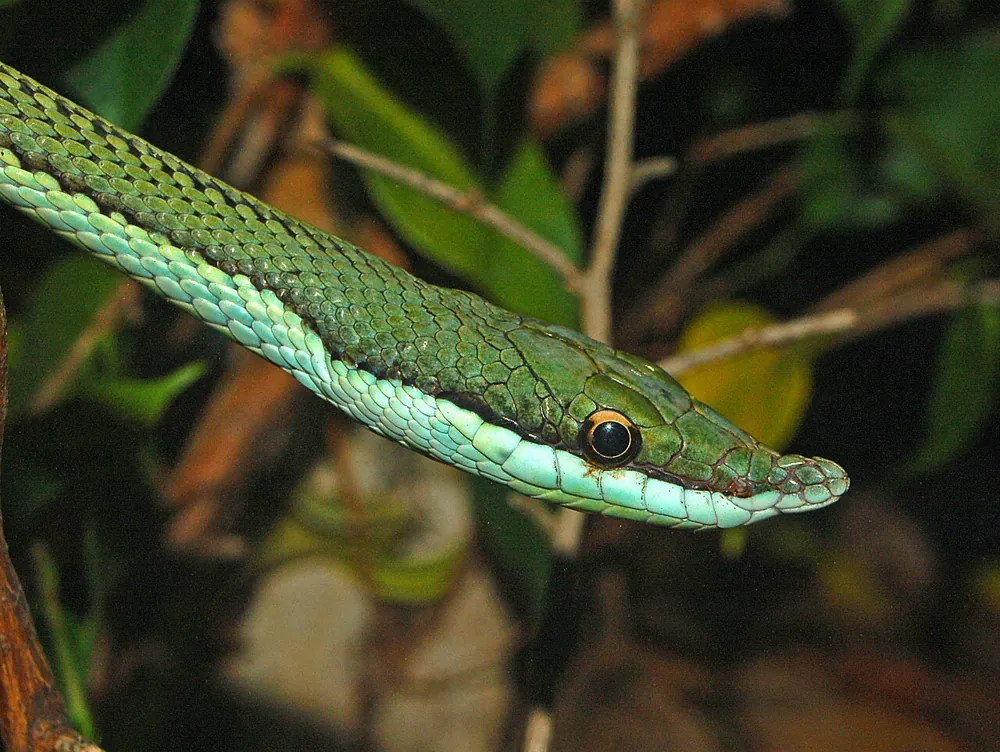
Baron's green racer is a long, green tree snake that lives in South America. It has rear fangs at the back of its mouth and its venom can harm people, so it should be treated with caution. It is one of the longest snakes in its genus, Philodryas.1



 Ho e tseba jwang
- Usually green, but some individuals are blue or brown.1
- The body is either plain or has black stripes running along the back and sides, on the front third of the body.1
- The underside under the black side lines is white or yellowish-white, sometimes with green or blue shades.1
- The head is small and elongated, with a small, flexible nasal point that is more developed in males.1
- Adults can reach 150 to 180 cm, and the tail makes up about 30% of the total length.1
Matla a chefo
Chefo e tswa ka meno a yona a chefo (fangs) kapa ka meno a mang ha e loma.
Chefo ya yona (eo e e kenyang ka ho loma kapa ho hlaba) e etsang?
It is rear-fanged, which means its fangs sit at the back of the mouth. Its venom has proteolytic activity, meaning it breaks down proteins, and it can stop blood platelets from clumping together, which affects clotting. Local effects include bleeding, muscle death, swelling and inflammation of the tissue.1
E kotsi hakae ho batho?
Kotsi ho batho: E bohlokoE ka utlwisa bohloko haholo, empa hoo e batlang e le kamehla ha e kotsi haholo.It is considered dangerous to humans and should be treated with caution. No bite numbers or deaths are recorded.1
E etsang ha e tshohile?
When frightened, it releases a foul-smelling substance from its cloaca, which is the common opening for its digestive, urinary and reproductive systems. It is generally non-aggressive.1
 Haeba e loma
- Hlatswa moo e lomileng teng, boloka motho a kgutsitse mme o fumane thuso ya bongaka. Mefuta e meng (jwaloka boomslang) e ka bolaya dihora hamorao.
Kamehla letsetsa nomoro ya tshohanyetso pele (112, 000, 911). Ena ke tataiso e akaretsang ya thuso ya pele, hase keletso ya bongaka. Metheo ya thuso ya pele
 Dula o bolokehile
- O se ke wa ama, wa tshwara kapa wa tena phoofolo ya naheng, leha e le e nyenyane, le leha e shebahala e robetse kapa e shwele.
- E fe sebaka. Ha o kopana le yona, dula o kgutsitse, kgutlela morao butle mme o e tlohele e tsamaye ka tsela ya yona.
- Haeba e nngwe e o loma: dula o kgutsitse, o se ke wa sisinyeha, letsetsa nomoro ya tshohanyetso (112, 000, 911) kapa o ye sepetlele kapele. Hopola hore e ne e shebahala jwang, foto e a thusa.
Ha e o batle. E sebedisa chefo ya yona ho tshwara dijo kapa ho itshireletsa, mme e kgetha ho ipata. Ho eketsehileng ka ho dula o bolokehile
Hokae lefatsheng?
E kgolo hakae?
E telele hakae?
 e telele jwaloka dikatse tsa lapeng tse 4 ho tloha nkong ho isa mohatleng
 e telele jwaloka dibanana tse 10 tse latellanang
 e ka matha metara e 100 ka metsotswana e 60 (motho ya potlakang ka ho fetisisa o hloka 9,6)
Baron's green racer e kgolo hakae ha e bapiswa le WENA?
Ke dipalo feela ka hara sebatli sa hao. Ha ho letho le bolokwang kapa le romelwang kae kapa kae.
E potlaka hakae?


Dintlha
When frightened, it gives off a foul-smelling liquid from its cloaca.1
Larger members of its species have been reported eating immature individuals.1
Its colour varies, with green being most common but blue and brown individuals also found.1
It is the longest known species in the genus Philodryas.1
Its tail makes up about 30% of its total body length.1
Moo dintlha di tswang teng
- Philodryas baroni (Wikipedia (CC BY-SA 4.0))
- Philodryas baroni (iNaturalist): mabitso le tlhophiso.
- Venom Wiki: boemo ba kotsi, boholo bo tlwaelehileng le kakanyo ya lebelo ke tsa rona. Bona kamoo re di balang ka teng: Kamoo re lekanyang kotsi ka teng.
Taba e nngwe le e nngwe leqepheng lena e na le nomoro e bontshang mohlodi wa yona. Haeba re entse phoso, re kopa tshwarelo, re barati ba diphoofolo, hase makasine wa saense. Re bolelle ho [email protected] mme re tla e lokisa.
 Phepheng e lapile! Venom Wiki ke projeke ya motho a le mong: ke mahala, ha e na dipapatso ebile ha e na di-tracker. Thuso e nyenyane ya tjhelete e e boloka e ntse e le inthaneteng.Fepa phepheng
Tse ding tsa sehlopha se le seng: Dinoha tse meno a ka morao
 False water cobraDinoha tse meno a ka moraoE utlwisa bohloko feela
 Brown vine snakeDinoha tse meno a ka moraoHa e na kotsi
 Green vine snakeDinoha tse meno a ka moraoHa e na kotsi
 Lichtenstein's green racerDinoha tse meno a ka moraoE hloka ngaka
 Peruvian slender snakeDinoha tse meno a ka moraoE hloka ngaka
 Chilean green racerDinoha tse meno a ka moraoE utlwisa bohloko feela
 Golden poison frog
 Terciopelo
 Brazilian wandering spider
 Eyelash viper
 Golden lancehead
 South American bushmaster