
 Afrika
 Asia
Asia Yuropa
 Amerika Borwa
 Australia le Oceania
 Antarctica
 Lewatle la Pacific
 Lewatle la Atlantic
 Lewatle la India
 Lewatle la Arctic
 Lewatle la Mediterranean
 Lewatle le Lefubedu
 Lewatle la Caribbean
 Lewatle la Coral
 Lewatle la China Borwa
 Lewatle la Philippine
 Lewatle la Andaman
 Lewatle la Leboya
 Lewatle la Timor le Arafura
 Kgwohlo ya Bengal
 Kgwohlo ya California
False water cobra
 Ho loma
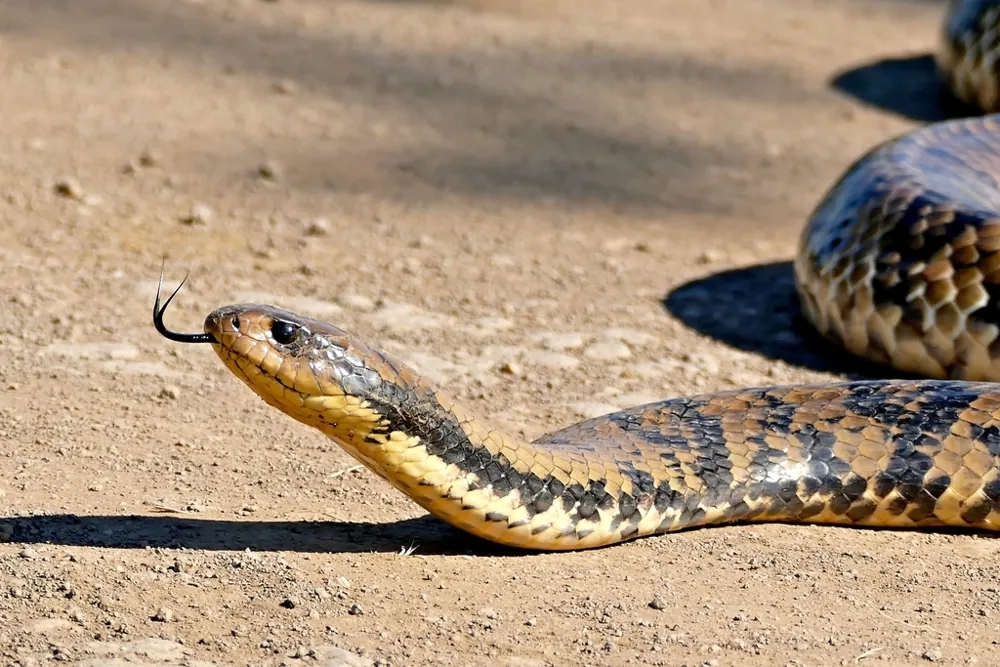
The false water cobra is a large snake that lives in South America. It is named after true cobras because it flattens its neck to look bigger when threatened, but it is not a true cobra. It is mildly venomous, and its bites rarely cause serious harm to people.1



 Ho e tseba jwang
- Background colour is olive green or brown, with dark spots and bands over much of the body.1
- Bands and colour grow darker towards the tail.1
- Large eyes with round pupils. The tongue is black.1
- Belly is yellow or brown with dark flecks, which form three dotted lines. Males tend to be yellow underneath and females brown.1
- Hatchlings and juveniles are much darker and lack the dark eyes of adults.1
Hangata e ferekanngwa le: Its pattern and colouring look somewhat like those of true water cobras (Boulengerina). The easiest difference to see is the hood: when threatened, the false water cobra stays horizontal, while a true cobra rears up.1
Matla a chefo
Chefo e tswa ka meno a yona a chefo (fangs) kapa ka meno a mang ha e loma.
Chefo ya yona (eo e e kenyang ka ho loma kapa ho hlaba) e etsang?
This snake has enlarged rear teeth that are not grooved, and they are linked to a gland that produces oral secretions with proteolytic activity, meaning they break down proteins. In the few serious cases, symptoms included severe swelling, bruising, numbness, itching and dizziness. Most bites cause only mild pain and minor swelling.1
E kotsi hakae ho batho?
Kotsi ho batho: E bohlokoE ka utlwisa bohloko haholo, empa hoo e batlang e le kamehla ha e kotsi haholo.Many bites have been recorded, but only four cases of significant reaction in humans are reported for this species. It is considered mildly venomous.1
E etsang ha e tshohile?
When threatened, it flattens its neck like a cobra, and can flatten lower parts of its body too, to look larger and more intimidating.1
 Haeba e loma
- Hlatswa moo e lomileng teng, boloka motho a kgutsitse mme o fumane thuso ya bongaka. Mefuta e meng (jwaloka boomslang) e ka bolaya dihora hamorao.
Kamehla letsetsa nomoro ya tshohanyetso pele (112, 000, 911). Ena ke tataiso e akaretsang ya thuso ya pele, hase keletso ya bongaka. Metheo ya thuso ya pele
 Dula o bolokehile
- O se ke wa ama, wa tshwara kapa wa tena phoofolo ya naheng, leha e le e nyenyane, le leha e shebahala e robetse kapa e shwele.
- E fe sebaka. Ha o kopana le yona, dula o kgutsitse, kgutlela morao butle mme o e tlohele e tsamaye ka tsela ya yona.
- Haeba e nngwe e o loma: dula o kgutsitse, o se ke wa sisinyeha, letsetsa nomoro ya tshohanyetso (112, 000, 911) kapa o ye sepetlele kapele. Hopola hore e ne e shebahala jwang, foto e a thusa.
Ha e o batle. E sebedisa chefo ya yona ho tshwara dijo kapa ho itshireletsa, mme e kgetha ho ipata. Ho eketsehileng ka ho dula o bolokehile
Hokae lefatsheng?
E kgolo hakae?
E telele hakae?
E boima hakae?
 e telele jwaloka dintja tse 3 ho tloha nkong ho isa mohatleng
 e telele jwaloka dibanana tse 17 tse latellanang
 e boima jwaloka katse ya lapeng
 e ka matha metara e 100 ka metsotswana e 54 (motho ya potlakang ka ho fetisisa o hloka 9,6)
False water cobra e kgolo hakae ha e bapiswa le WENA?
Ke dipalo feela ka hara sebatli sa hao. Ha ho letho le bolokwang kapa le romelwang kae kapa kae.
E potlaka hakae?


Dintlha
Captive-bred individuals can become quite tame and trusting, and many show a high level of intelligence.1
Temperaments vary a lot: some individuals are docile, while others are defensive or even aggressive.1
Males are much smaller than females, a difference called sexual dimorphism.1
It is mainly active during the day, which gives it good daytime vision thanks to its large eyes.1
Ho senya ditshomo
Tshomo: It is a true cobra.
Nnete: It is not a true cobra. It hoods in a similar way, but stays horizontal instead of rearing up.1
Moo dintlha di tswang teng
- Hydrodynastes gigas (Wikipedia (CC BY-SA 4.0))
- Hydrodynastes gigas (iNaturalist): mabitso le tlhophiso.
- Venom Wiki: boemo ba kotsi, boholo bo tlwaelehileng le kakanyo ya lebelo ke tsa rona. Bona kamoo re di balang ka teng: Kamoo re lekanyang kotsi ka teng.
Taba e nngwe le e nngwe leqepheng lena e na le nomoro e bontshang mohlodi wa yona. Haeba re entse phoso, re kopa tshwarelo, re barati ba diphoofolo, hase makasine wa saense. Re bolelle ho [email protected] mme re tla e lokisa.
 Phepheng e lapile! Venom Wiki ke projeke ya motho a le mong: ke mahala, ha e na dipapatso ebile ha e na di-tracker. Thuso e nyenyane ya tjhelete e e boloka e ntse e le inthaneteng.Fepa phepheng
Tse ding tsa sehlopha se le seng: Dinoha tse meno a ka morao
 Baron's green racerDinoha tse meno a ka moraoE utlwisa bohloko feela
 Brown vine snakeDinoha tse meno a ka moraoHa e na kotsi
 Green vine snakeDinoha tse meno a ka moraoHa e na kotsi
 Lichtenstein's green racerDinoha tse meno a ka moraoE hloka ngaka
 Peruvian slender snakeDinoha tse meno a ka moraoE hloka ngaka
 Chilean green racerDinoha tse meno a ka moraoE utlwisa bohloko feela
 Golden poison frog
 Terciopelo
 Brazilian wandering spider
 Eyelash viper
 Golden lancehead
 South American bushmaster