
 Afrika
 Asia
Asia Yuropa
 Amerika Borwa
 Australia le Oceania
 Antarctica
 Lewatle la Pacific
 Lewatle la Atlantic
 Lewatle la India
 Lewatle la Arctic
 Lewatle la Mediterranean
 Lewatle le Lefubedu
 Lewatle la Caribbean
 Lewatle la Coral
 Lewatle la China Borwa
 Lewatle la Philippine
 Lewatle la Andaman
 Lewatle la Leboya
 Lewatle la Timor le Arafura
 Kgwohlo ya Bengal
 Kgwohlo ya California
Brazilian brown spider
 Ho loma
The Brazilian brown recluse spider is a small spider that is highly venomous. It lives in parts of Brazil and Argentina, and it is one of the species linked to deaths from spider bites in South America. Its bite can seem mild at first, so it matters to know what it looks like.1


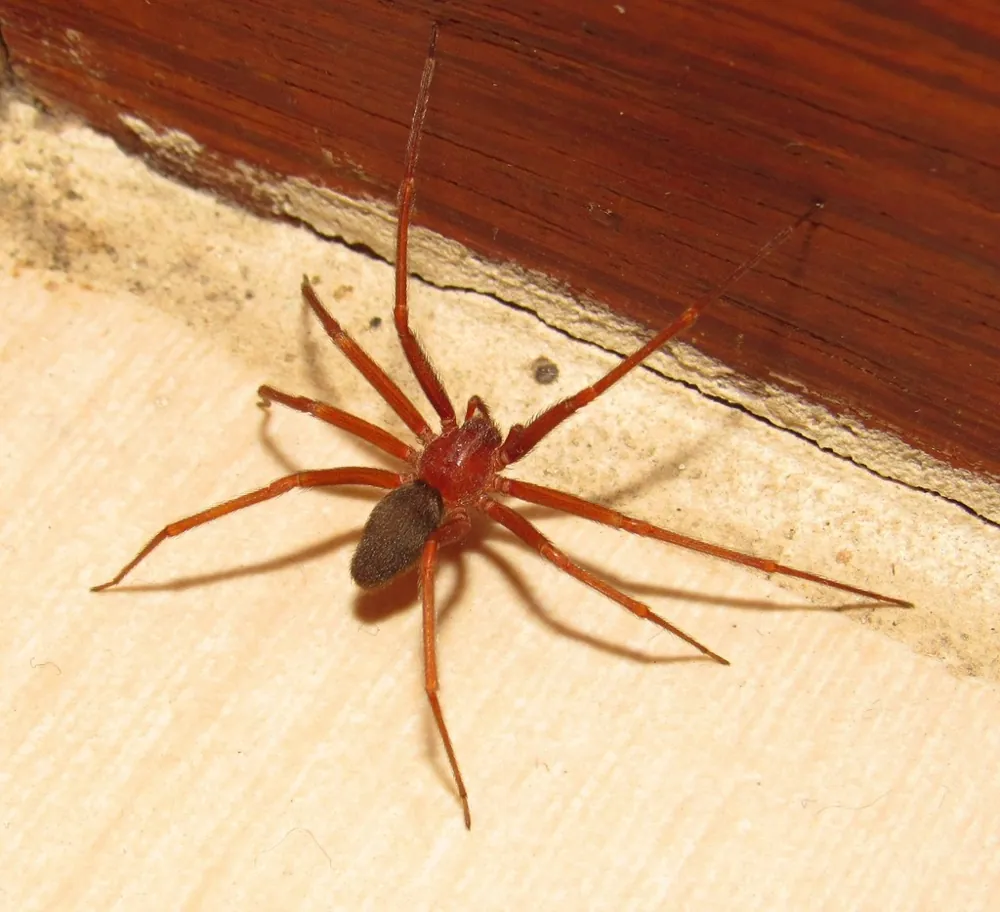
 Ho e tseba jwang
- Carapace (the front body shield) is dull yellow to orange-brown, with a dark, U-shaped marking on the head area that contrasts with the yellowish thorax.1
- Legs are orange-brown to reddish-brown.1
- Abdomen is grey or blackened, and darker on top than underneath.1
- Small spider: the female is about 8.5 mm long, and the male is smaller.1
- Active at night and very shy, usually found in dark places.1
Matla a chefo
Chefo e tswa ka meno a yona a chefo (fangs) kapa ka meno a mang ha e loma.
Chefo ya yona (eo e e kenyang ka ho loma kapa ho hlaba) e etsang?
Its venom contains a high concentration of the enzyme sphingomyelinase D, which causes both local and whole-body effects. Symptoms usually take hours to appear. The bite starts with severe pain, redness, swelling and blisters, and in more severe cases the skin tissue can die. Whole-body effects can include damage to red blood cells, heart problems, low blood pressure, kidney failure and severe bleeding.1
E kotsi hakae ho batho?
Kotsi ho batho: E tebilengHo longwa ho hloka ngaka. Lefu le etsahala ka seoelo haholo.It is one of the main species linked to deaths from spider bites in South America. Whole-body effects occur frequently after its bite. Because symptoms are delayed, a victim may think the bite was mild.1
E etsang ha e tshohile?
It is a very shy spider that keeps to dark places, so it is rarely seen.1
 Haeba e loma
- Hlatswa moo e lomileng teng mme o bee pakete ya leqhwa hodima teng bakeng sa bohloko. Fumana thuso ya bongaka haeba bohloko bo le matla, bo phatlalla kapa motho a ikutlwa a kula.
Kamehla letsetsa nomoro ya tshohanyetso pele (112, 000, 911). Ena ke tataiso e akaretsang ya thuso ya pele, hase keletso ya bongaka. Metheo ya thuso ya pele
 Dula o bolokehile
- O se ke wa ama, wa tshwara kapa wa tena phoofolo ya naheng, leha e le e nyenyane, le leha e shebahala e robetse kapa e shwele.
- E fe sebaka. Ha o kopana le yona, dula o kgutsitse, kgutlela morao butle mme o e tlohele e tsamaye ka tsela ya yona.
- Haeba e nngwe e o loma: dula o kgutsitse, o se ke wa sisinyeha, letsetsa nomoro ya tshohanyetso (112, 000, 911) kapa o ye sepetlele kapele. Hopola hore e ne e shebahala jwang, foto e a thusa.
Ha e o batle. E sebedisa chefo ya yona ho tshwara dijo kapa ho itshireletsa, mme e kgetha ho ipata. Ho eketsehileng ka ho dula o bolokehile
Hokae lefatsheng?
E kgolo hakae?
E telele hakae?
 e nyenyane hoo e ka dulang lenalong la hao
Brazilian brown spider e kgolo hakae ha e bapiswa le WENA?
Ke dipalo feela ka hara sebatli sa hao. Ha ho letho le bolokwang kapa le romelwang kae kapa kae.
E potlaka hakae?


Dintlha
The minimum dose that causes skin tissue death is 2.4 μg per kg of body weight.1
An average bite injects about 40 μg of venom proteins.1
It produces about 5.6 mg of venom, and the male produces less, around 2.43 mg.1
Males have much longer legs than females, although the female has the larger body.1
Its webs are irregular and built under fallen tree trunks and debris, usually in dark places.1
Bakeng sa ditsebi tsa chefo
Moo dintlha di tswang teng
- Loxosceles intermedia (Wikipedia (CC BY-SA 4.0))
- Loxosceles intermedia (iNaturalist): mabitso le tlhophiso.
- Venom Wiki: boemo ba kotsi, boholo bo tlwaelehileng le kakanyo ya lebelo ke tsa rona. Bona kamoo re di balang ka teng: Kamoo re lekanyang kotsi ka teng.
Taba e nngwe le e nngwe leqepheng lena e na le nomoro e bontshang mohlodi wa yona. Haeba re entse phoso, re kopa tshwarelo, re barati ba diphoofolo, hase makasine wa saense. Re bolelle ho [email protected] mme re tla e lokisa.
 Phepheng e lapile! Venom Wiki ke projeke ya motho a le mong: ke mahala, ha e na dipapatso ebile ha e na di-tracker. Thuso e nyenyane ya tjhelete e e boloka e ntse e le inthaneteng.Fepa phepheng
Tse ding tsa sehlopha se le seng: Dikgo
 Brazilian wandering spider
 Amazon wandering spider
 Chilean recluse
 Golden silk orb-weaver
 Keyserling's wandering spider
 Argentine black widow
E boetse e phela: Amerika Borwa
 Golden poison frogDihoho tse chefang, mampotsana le di-newtE a bolayaO se ke wa ama
 TerciopeloDi-pit viperE a bolaya
 Eyelash viperDi-pit viperE ka bolaya
 Golden lanceheadDi-pit viperE ka bolaya
 South American bushmasterDi-pit viperE ka bolaya
 Cane toadDihoho tse chefang, mampotsana le di-newtE hloka ngakaO se ke wa ama