
 Afrika
 Asia
Asia Yuropa
 Amerika Borwa
 Australia le Oceania
 Antarctica
 Lewatle la Pacific
 Lewatle la Atlantic
 Lewatle la India
 Lewatle la Arctic
 Lewatle la Mediterranean
 Lewatle le Lefubedu
 Lewatle la Caribbean
 Lewatle la Coral
 Lewatle la China Borwa
 Lewatle la Philippine
 Lewatle la Andaman
 Lewatle la Leboya
 Lewatle la Timor le Arafura
 Kgwohlo ya Bengal
 Kgwohlo ya California
Broad-banded copperhead
 Ho loma
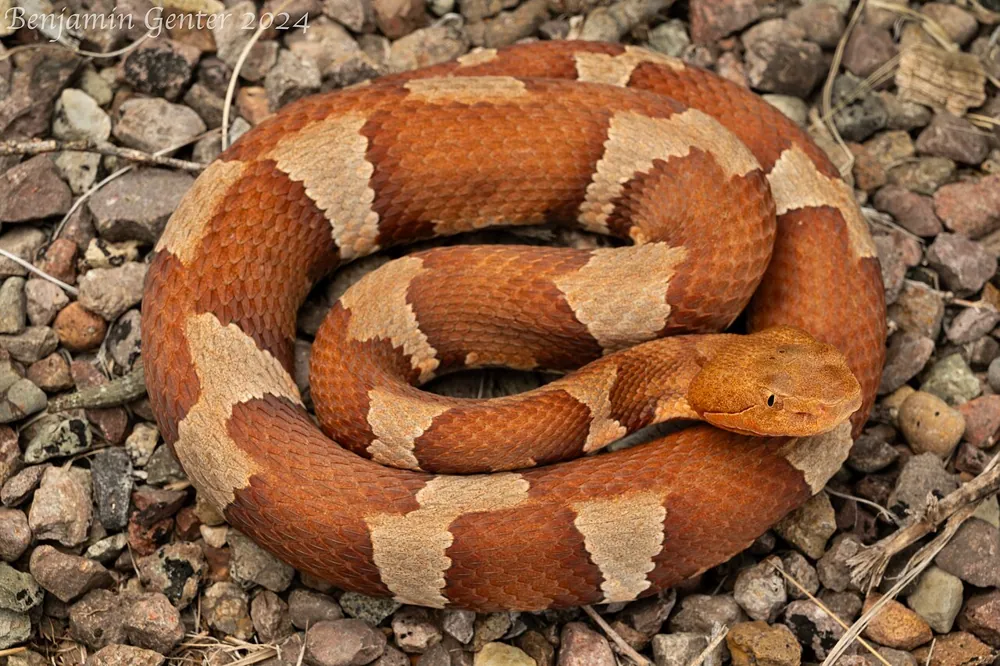
The broad-banded copperhead is a venomous pit viper, a type of snake that uses heat-sensing pits between its eyes and nostrils to find prey. It lives in the central United States, mainly Oklahoma and central Texas, and in parts of northern Mexico. For a long time it was thought to be a form of the eastern copperhead, but it is now treated as its own species.1


 Ho e tseba jwang
- Typically light tan with wide, darker brown crossbands, which give it its common name.1
- Colour varies by location, from red-brown to grey-brown.1
- The bands stay even in width. The eastern copperhead's bands narrow at the spine to form hourglass shapes.1
- Young snakes have a bright green-yellow tail tip that fades to grey or brown at about one year old.1
Hangata e ferekanngwa le: The eastern copperhead overlaps with this species in the south of its range, and the two can be hard to tell apart there. Look at the bands: the broad-banded copperhead has even bands, while the eastern copperhead's bands narrow at the spine.1
Matla a chefo
Chefo e tswa ka meno a yona a chefo (fangs) kapa ka meno a mang ha e loma.
Chefo ya yona (eo e e kenyang ka ho loma kapa ho hlaba) e etsang?
Its venom is hemotoxic, meaning it mainly damages blood and tissue. It is injected through hinged, hollow fangs in a single quick strike. The bite can cause localised swelling, necrosis (death of tissue at the bite site) and severe pain.1
E kotsi hakae ho batho?
Kotsi ho batho: E tebilengHo longwa ho hloka ngaka. Lefu le etsahala ka seoelo haholo.Copperhead venom is not considered life-threatening to an otherwise healthy adult. Any bite from a venomous snake should still be treated as serious.1
 Ditaba tse monate: dingaka di na le moriana (antivenom) kapa kalafo bakeng sa sena.1
 Haeba e loma
- Any bite from a venomous snake should be treated as serious, and medical treatment should be sought. Doctors may use CroFab in severe cases, which is made using cottonmouth venom because no antivenin is made specifically for copperheads.1
- Boloka motho a sa sisinyehe ebile a kgutsitse, boloka setho se lomilweng se lekana le bophahamo ba pelo, tlosa mesale le dintho tse tiileng, mme o mo ise sepetlele kapele.
Kamehla letsetsa nomoro ya tshohanyetso pele (112, 000, 911). Ena ke tataiso e akaretsang ya thuso ya pele, hase keletso ya bongaka. Metheo ya thuso ya pele
 Dula o bolokehile
- O se ke wa ama, wa tshwara kapa wa tena phoofolo ya naheng, leha e le e nyenyane, le leha e shebahala e robetse kapa e shwele.
- E fe sebaka. Ha o kopana le yona, dula o kgutsitse, kgutlela morao butle mme o e tlohele e tsamaye ka tsela ya yona.
- Haeba e nngwe e o loma: dula o kgutsitse, o se ke wa sisinyeha, letsetsa nomoro ya tshohanyetso (112, 000, 911) kapa o ye sepetlele kapele. Hopola hore e ne e shebahala jwang, foto e a thusa.
Ha e o batle. E sebedisa chefo ya yona ho tshwara dijo kapa ho itshireletsa, mme e kgetha ho ipata. Ho eketsehileng ka ho dula o bolokehile
Hokae lefatsheng?
E kgolo hakae?
E telele hakae?
 e telele jwaloka dibanana tse 4 tse latellanang
 e ka matha metara e 100 ka metsotswana e 110 (motho ya potlakang ka ho fetisisa o hloka 9,6)
Broad-banded copperhead e kgolo hakae ha e bapiswa le WENA?
Ke dipalo feela ka hara sebatli sa hao. Ha ho letho le bolokwang kapa le romelwang kae kapa kae.
E potlaka hakae?


Dintlha
It can swim across large bodies of water and has been found swimming more than a quarter of a mile from shore in Lake Texoma, Texas.1
In one radio tracking study, a snake was found with a Texas horned lizard inside it. The snake later passed the tracking device without harm.1
Although it is not tree-dwelling, it can climb and has been seen coiled and resting in trees about 2 metres above the ground.1
Some copperheads in Kansas are hybrids of the eastern and broad-banded copperheads. Genetic studies in that state found no genetically pure broad-banded copperheads.1
It is known by colourful local names, including thunder snake, rattlesnake pilot and red eye.1
Ho senya ditshomo
Tshomo: Copperhead bites are harmless.
Nnete: A bite is not life-threatening to a healthy adult, but it can cause swelling, tissue death and severe pain. Any bite should be treated seriously and medical care sought.1
Bakeng sa ditsebi tsa chefo
Moo dintlha di tswang teng
- Agkistrodon laticinctus (Wikipedia (CC BY-SA 4.0))
- Agkistrodon laticinctus (iNaturalist): mabitso le tlhophiso.
- Venom Wiki: boemo ba kotsi, boholo bo tlwaelehileng le kakanyo ya lebelo ke tsa rona. Bona kamoo re di balang ka teng: Kamoo re lekanyang kotsi ka teng.
Taba e nngwe le e nngwe leqepheng lena e na le nomoro e bontshang mohlodi wa yona. Haeba re entse phoso, re kopa tshwarelo, re barati ba diphoofolo, hase makasine wa saense. Re bolelle ho [email protected] mme re tla e lokisa.
 Phepheng e lapile! Venom Wiki ke projeke ya motho a le mong: ke mahala, ha e na dipapatso ebile ha e na di-tracker. Thuso e nyenyane ya tjhelete e e boloka e ntse e le inthaneteng.Fepa phepheng
 Terciopelo
 Eyelash viper
 Cottonmouth
 Eastern copperhead
 Cantil
 Central American bushmaster
 Eastern coral snake
 Eastern diamondback rattlesnake
 Timber rattlesnake
 Western diamondback rattlesnake
 Arizona bark scorpion
 Brown recluse
.jpg)