
 Afrika
 Asia
Asia Yuropa
 Amerika Borwa
 Australia le Oceania
 Antarctica
 Lewatle la Pacific
 Lewatle la Atlantic
 Lewatle la India
 Lewatle la Arctic
 Lewatle la Mediterranean
 Lewatle le Lefubedu
 Lewatle la Caribbean
 Lewatle la Coral
 Lewatle la China Borwa
 Lewatle la Philippine
 Lewatle la Andaman
 Lewatle la Leboya
 Lewatle la Timor le Arafura
 Kgwohlo ya Bengal
 Kgwohlo ya California
Chilean six-eyed sand spider
 Ho loma
The Chilean six-eyed sand spider is a small spider that lives in the deserts of northern and central Chile. It hides under rocks and comes out at night. Its venom has effects similar to those of the Chilean recluse spider, which is why it matters to people who live nearby.1


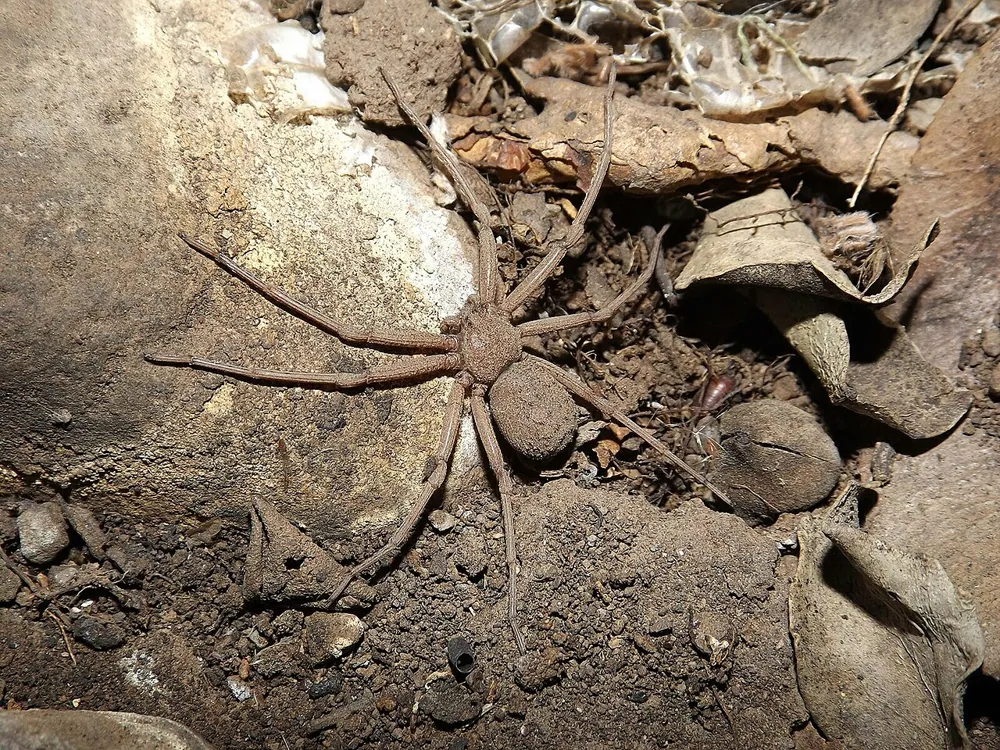
 Ho e tseba jwang
- Body length of 12 to 20 mm1
- Active at night, with nocturnal habits1
- Shelters under rocks on sandy ground1
- Very common in urban areas with household waste1
Hangata e ferekanngwa le: Older records under the name Sicarius terrosus may actually describe other species, such as Sicarius levii. Names in older books can therefore be unreliable.1
Matla a chefo
Chefo e tswa ka meno a yona a chefo (fangs) kapa ka meno a mang ha e loma.
Chefo ya yona (eo e e kenyang ka ho loma kapa ho hlaba) e etsang?
Its venom contains an enzyme called sphingomyelinase D, which has effects similar to those of the Chilean recluse spider. In laboratory tests the venom broke down red blood cells (haemolysis) and damaged skin cells, and 50 μg was enough to cause dermonecrosis, or the death of skin tissue. The venom also broke down fibrinogen, a protein needed for blood to clot.1
E kotsi hakae ho batho?
Kotsi ho batho: E bohlokoE ka utlwisa bohloko haholo, empa hoo e batlang e le kamehla ha e kotsi haholo.Laboratory work shows that the venom can damage human tissue. Adult spiders carry up to eight times the amount of venom tested, so bites from adults could cause more serious lesions.1
 Haeba e loma
- Hlatswa moo e lomileng teng mme o bee pakete ya leqhwa hodima teng bakeng sa bohloko. Fumana thuso ya bongaka haeba bohloko bo le matla, bo phatlalla kapa motho a ikutlwa a kula.
Kamehla letsetsa nomoro ya tshohanyetso pele (112, 000, 911). Ena ke tataiso e akaretsang ya thuso ya pele, hase keletso ya bongaka. Metheo ya thuso ya pele
 Dula o bolokehile
- O se ke wa ama, wa tshwara kapa wa tena phoofolo ya naheng, leha e le e nyenyane, le leha e shebahala e robetse kapa e shwele.
- E fe sebaka. Ha o kopana le yona, dula o kgutsitse, kgutlela morao butle mme o e tlohele e tsamaye ka tsela ya yona.
- Haeba e nngwe e o loma: dula o kgutsitse, o se ke wa sisinyeha, letsetsa nomoro ya tshohanyetso (112, 000, 911) kapa o ye sepetlele kapele. Hopola hore e ne e shebahala jwang, foto e a thusa.
Ha e o batle. E sebedisa chefo ya yona ho tshwara dijo kapa ho itshireletsa, mme e kgetha ho ipata. Ho eketsehileng ka ho dula o bolokehile
Hokae lefatsheng?
E kgolo hakae?
E telele hakae?
 e telele jwaloka klipi ya pampiri
 e ka matha metara e 100 ka metsotswana e 330 (motho ya potlakang ka ho fetisisa o hloka 9,6)
Chilean six-eyed sand spider e kgolo hakae ha e bapiswa le WENA?
Ke dipalo feela ka hara sebatli sa hao. Ha ho letho le bolokwang kapa le romelwang kae kapa kae.
E potlaka hakae?


Dintlha
In 2020 a 20 mm spider was recorded preying on a 28 mm gecko, which is larger than the spider itself.1
Its venom breaks down fibrinogen, a clotting protein, faster than the venom of the Loxosceles species it was compared with.1
Scientists found that 50 μg of its venom was enough to cause dermonecrosis in laboratory tests.1
It is extremely common in Chilean cities where household waste is plentiful.1
Ho senya ditshomo
Tshomo: The species is known as Sicarius terrosus.
Nnete: The correct name is Sicarius thomisoides. The name terrosus was used for this species for a long time, but it was often used wrongly for other species too.1
Moo dintlha di tswang teng
- Sicarius thomisoides (Wikipedia (CC BY-SA 4.0))
- Sicarius thomisoides (iNaturalist): mabitso le tlhophiso.
- Venom Wiki: boemo ba kotsi, boholo bo tlwaelehileng le kakanyo ya lebelo ke tsa rona. Bona kamoo re di balang ka teng: Kamoo re lekanyang kotsi ka teng.
Taba e nngwe le e nngwe leqepheng lena e na le nomoro e bontshang mohlodi wa yona. Haeba re entse phoso, re kopa tshwarelo, re barati ba diphoofolo, hase makasine wa saense. Re bolelle ho [email protected] mme re tla e lokisa.
 Phepheng e lapile! Venom Wiki ke projeke ya motho a le mong: ke mahala, ha e na dipapatso ebile ha e na di-tracker. Thuso e nyenyane ya tjhelete e e boloka e ntse e le inthaneteng.Fepa phepheng
Tse ding tsa sehlopha se le seng: Dikgo
 Brazilian wandering spider
 Amazon wandering spider
 Chilean recluse
 Golden silk orb-weaver
 Keyserling's wandering spider
 Argentine black widow
E boetse e phela: Amerika Borwa
 Golden poison frogDihoho tse chefang, mampotsana le di-newtE a bolayaO se ke wa ama
 TerciopeloDi-pit viperE a bolaya
 Eyelash viperDi-pit viperE ka bolaya
 Golden lanceheadDi-pit viperE ka bolaya
 South American bushmasterDi-pit viperE ka bolaya
 Cane toadDihoho tse chefang, mampotsana le di-newtE hloka ngakaO se ke wa ama