
 Afrika
 Asia
Asia Yuropa
 Amerika Borwa
 Australia le Oceania
 Antarctica
 Lewatle la Pacific
 Lewatle la Atlantic
 Lewatle la India
 Lewatle la Arctic
 Lewatle la Mediterranean
 Lewatle le Lefubedu
 Lewatle la Caribbean
 Lewatle la Coral
 Lewatle la China Borwa
 Lewatle la Philippine
 Lewatle la Andaman
 Lewatle la Leboya
 Lewatle la Timor le Arafura
 Kgwohlo ya Bengal
 Kgwohlo ya California
Crown-of-thorns starfish
 Meutlwa e nang le chefo
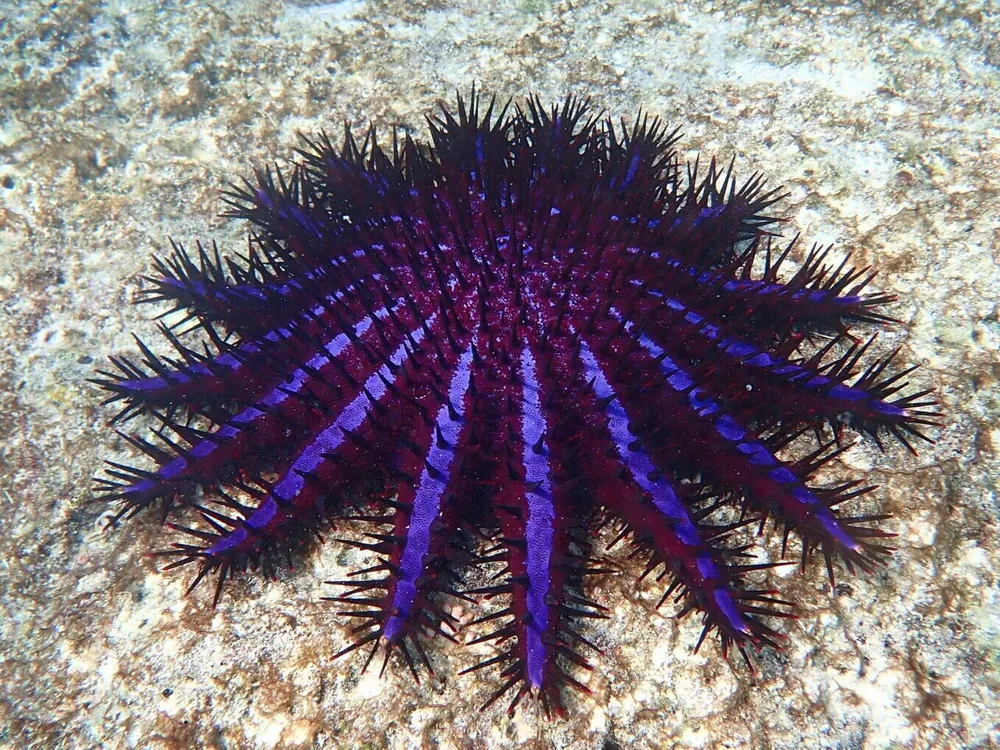
The crown-of-thorns starfish is a large starfish with long, sharp spines that look like a crown of thorns. It lives on coral reefs across the Indo-Pacific, from the Red Sea to the west coast of Central America, and it is most common around Australia. It feeds on hard coral, so it can change the reefs it lives on.1

 Ho e tseba jwang
- Adults are normally 25 to 35 cm across.1
- Up to 21 arms, with long, stiff, very sharp spines that are 4 to 5 cm long on the top and sides of the arms.1
- Colour varies with diet or region: purple, purple-blue, reddish grey or brown with red spine tips, or green with yellow spine tips.1
- The body is flexible and can bend and twist around coral surfaces.1
Hangata e ferekanngwa le: A close relative, Acanthaster brevispinus, lives on soft sea floors at moderate depths rather than on coral reefs. The two are considered sibling species.1
Matla a chefo
Meutlwa e bohale e nka chefo. Ho e hata kapa ho e tshwara ho bohloko.
Chefo ya yona (eo e e kenyang ka ho loma kapa ho hlaba) e etsang?
The spines do not inject venom. When they pierce skin, tissue containing saponins (detergent-like chemicals) is left in the wound. In humans this causes a sharp, stinging pain that can last several hours, persistent bleeding, and nausea and swelling that may last a week or more.1
E kotsi hakae ho batho?
Kotsi ho batho: E tebilengHaeba meutlwa ya yona e o hlaba, eya ho ngaka. Lefu le etsahala ka seoelo haholo.The spines can cause sharp pain, long-lasting bleeding, nausea and swelling. Brittle spines can break off and stay in the tissue.1
 Haeba meutlwa ya yona e o hlaba
- Spines that become embedded in the tissue must be removed surgically.1
- Kenya leqeba metsing a tjhesang, a tjhesang hoo motho a ka a mamellang ntle le ho tjha, mme o fumane thuso ya bongaka ho ntsha meutlwa. O se ke wa e cheka ka bowena.
Kamehla letsetsa nomoro ya tshohanyetso pele (112, 000, 911). Ena ke tataiso e akaretsang ya thuso ya pele, hase keletso ya bongaka. Metheo ya thuso ya pele
 Dula o bolokehile
- O se ke wa ama, wa tshwara kapa wa tena phoofolo ya naheng, leha e le e nyenyane, le leha e shebahala e robetse kapa e shwele.
- E fe sebaka. Ha o kopana le yona, dula o kgutsitse, kgutlela morao butle mme o e tlohele e tsamaye ka tsela ya yona.
- Haeba meutlwa ya yona e o hlaba: dula o kgutsitse, o se ke wa sisinyeha, letsetsa nomoro ya tshohanyetso (112, 000, 911) kapa o ye sepetlele kapele. Hopola hore e ne e shebahala jwang, foto e a thusa.
Ha e o batle. E sebedisa chefo ya yona ho tshwara dijo kapa ho itshireletsa, mme e kgetha ho ipata. Ho eketsehileng ka ho dula o bolokehile
Hokae lefatsheng?
E kgolo hakae?
E telele hakae?
 e telele jwaloka diboloko tsa ho bapala tse 11 moleng
 e dieha ho feta kgofu ya serapeng
Crown-of-thorns starfish e kgolo hakae ha e bapiswa le WENA?
Ke dipalo feela ka hara sebatli sa hao. Ha ho letho le bolokwang kapa le romelwang kae kapa kae.
E potlaka hakae?

.jpg)
Dintlha
An individual starfish can consume up to 6 square metres of living coral reef per year.1
When taken out of water, its soft body ruptures and collapses, but its spines can recover their shape if it is put back in the water while still alive.1
Its body contains detergent-like saponins, so keeping starfish in small volumes of water with aeration produces large amounts of foam.1
It is one of the largest starfish in the world.1
It has lost the usual five-fold symmetry of starfish as it grew more arms, although it begins life with five-fold symmetry.1
Ho senya ditshomo
Tshomo: Its spines inject venom like a snake or stinging animal.
Nnete: It has no mechanism for injecting toxin. Its spines pierce skin and leave saponin-containing tissue in the wound.1
Bakeng sa ditsebi tsa chefo
- Lebitso la saense
- Acanthaster planci
- Sehlopha
- Di-sea urchin, dinaledi tsa lewatle le diboko
- Lelapa
- Acanthasteridae2
- Tatelano
- Valvatida
- Dikontinente
- Lewatle la India, Lewatle la Pacific, Lewatle le Lefubedu, Lewatle la Coral, Lewatle la Philippine, Lewatle la China Borwa, Lewatle la Andaman, Lewatle la Arabia le Kgwohlo ya Persia, Lewatle la Timor le Arafura, Kgwohlo ya Bengal, Mawatle
- Masea
- It releases vast amounts of eggs and sperm (gametes) during mass spawning events in summer, and the eggs contain saponins similar to those in adults.1
- Kotsi ho batho
- 3 / 5: E tebileng3
Moo dintlha di tswang teng
- Crown-of-thorns starfish (Wikipedia (CC BY-SA 4.0))
- Acanthaster planci (iNaturalist): mabitso le tlhophiso.
- Venom Wiki: boemo ba kotsi, boholo bo tlwaelehileng le kakanyo ya lebelo ke tsa rona. Bona kamoo re di balang ka teng: Kamoo re lekanyang kotsi ka teng.
Taba e nngwe le e nngwe leqepheng lena e na le nomoro e bontshang mohlodi wa yona. Haeba re entse phoso, re kopa tshwarelo, re barati ba diphoofolo, hase makasine wa saense. Re bolelle ho [email protected] mme re tla e lokisa.
 Phepheng e lapile! Venom Wiki ke projeke ya motho a le mong: ke mahala, ha e na dipapatso ebile ha e na di-tracker. Thuso e nyenyane ya tjhelete e e boloka e ntse e le inthaneteng.Fepa phepheng
Tse ding tsa sehlopha se le seng: Di-sea urchin, dinaledi tsa lewatle le diboko
 Flower urchinDi-sea urchin, dinaledi tsa lewatle le dibokoE ka bolaya
 Fire urchinDi-sea urchin, dinaledi tsa lewatle le dibokoE hloka ngakaO se ke wa ama
 Bearded firewormDi-sea urchin, dinaledi tsa lewatle le dibokoE utlwisa bohloko feelaO se ke wa ama
 Black long-spined urchinDi-sea urchin, dinaledi tsa lewatle le dibokoE utlwisa bohloko feelaO se ke wa ama
 BloodwormDi-sea urchin, dinaledi tsa lewatle le dibokoE utlwisa bohloko feela
 Bobbit wormDi-sea urchin, dinaledi tsa lewatle le dibokoE utlwisa bohloko feela
E boetse e phela: Lewatle la India
 Australian box jellyfishDi-jellyfish le diphoofolo tsa lewatle tse hlabangE a bolayaO se ke wa ama
 Geography coneDikgofu tsa cone le di-octopusE a bolaya
 Greater blue-ringed octopusDikgofu tsa cone le di-octopusE a bolaya
 Southern blue-ringed octopusDikgofu tsa cone le di-octopusE a bolaya
 Hawksbill sea turtleDiphoofolo tse ding tse chefangE ka bolaya
 Irukandji jellyfishDi-jellyfish le diphoofolo tsa lewatle tse hlabangE ka bolayaO se ke wa ama