
 Afrika
 Asia
Asia Yuropa
 Amerika Borwa
 Australia le Oceania
 Antarctica
 Lewatle la Pacific
 Lewatle la Atlantic
 Lewatle la India
 Lewatle la Arctic
 Lewatle la Mediterranean
 Lewatle le Lefubedu
 Lewatle la Caribbean
 Lewatle la Coral
 Lewatle la China Borwa
 Lewatle la Philippine
 Lewatle la Andaman
 Lewatle la Leboya
 Lewatle la Timor le Arafura
 Kgwohlo ya Bengal
 Kgwohlo ya California
Cupboard spider
 Ho loma
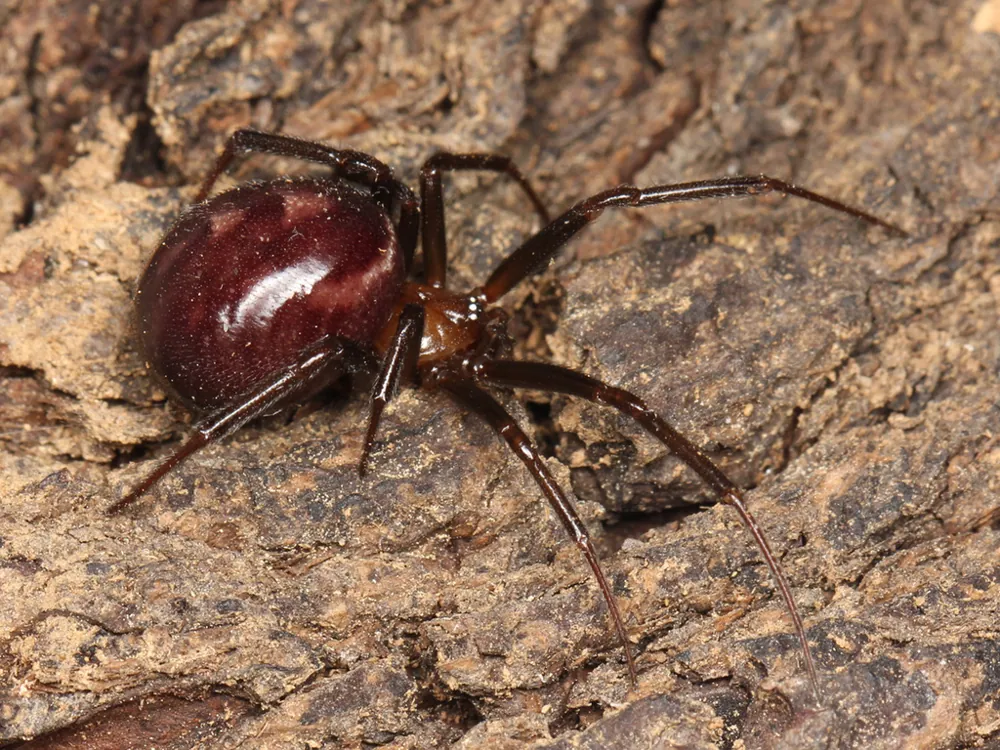
The cupboard spider is a common house spider that lives in dark corners and builds messy, three-dimensional webs. It is often mistaken for the dangerous black widow, but its bite is usually minor. Its name shows that it is found in many parts of the world, including Europe, temperate Asia and areas where it has been introduced.1

 Ho e tseba jwang
- Adult females are 6 to 10.5 mm long, dark coloured and round-bodied, with a bulbous abdomen.1
- Typical colour ranges from purplish brown to black, with light-coloured markings.1
- It has no bright red hourglass pattern or other bright, distinctive markings.1
- Males are thinner and can be nearly as long as females, at 4.1 to 10 mm.1
- Sexually mature males have lighter, more reddish legs than females.1
Hangata e ferekanngwa le: It is often confused with black widows and redbacks (Latrodectus species), which have a bright red hourglass pattern that this spider lacks. Steatoda borealis is similar in shape but slightly smaller and found in colder climates. It has coloured markings on the top of the abdomen rather than the underside.1
Matla a chefo
Chefo e tswa ka meno a yona a chefo (fangs) kapa ka meno a mang ha e loma.
Chefo ya yona (eo e e kenyang ka ho loma kapa ho hlaba) e etsang?
The bite is minor in humans and has no long-lasting effects. Symptoms can include blistering at the bite site and pain. A few cases have included fever, nausea, sweating and a general feeling of being unwell that lasted several days.1
E kotsi hakae ho batho?
Kotsi ho batho: E bobebeJwaloka ho hlajwa ke notshi kapa ho fetang moo. Ha e na kotsi ho batho.The spider is not aggressive. Most injuries to people happen when a spider is accidentally squeezed or pinched and bites in defence. It is possible that a spider may bite a finger pushed into its web by mistake.1
 Ditaba tse monate: dingaka di na le moriana (antivenom) kapa kalafo bakeng sa sena.1
E etsang ha e tshohile?
It usually flees when a large creature comes near, and it bites when it is squeezed or pinched.1
 Haeba e loma
- Hlatswa moo e lomileng teng mme o bee pakete ya leqhwa hodima teng bakeng sa bohloko. Fumana thuso ya bongaka haeba bohloko bo le matla, bo phatlalla kapa motho a ikutlwa a kula.
Kamehla letsetsa nomoro ya tshohanyetso pele (112, 000, 911). Ena ke tataiso e akaretsang ya thuso ya pele, hase keletso ya bongaka. Metheo ya thuso ya pele
 Dula o bolokehile
- O se ke wa ama, wa tshwara kapa wa tena phoofolo ya naheng, leha e le e nyenyane, le leha e shebahala e robetse kapa e shwele.
- E fe sebaka. Ha o kopana le yona, dula o kgutsitse, kgutlela morao butle mme o e tlohele e tsamaye ka tsela ya yona.
- Haeba e nngwe e o loma: dula o kgutsitse, o se ke wa sisinyeha, letsetsa nomoro ya tshohanyetso (112, 000, 911) kapa o ye sepetlele kapele. Hopola hore e ne e shebahala jwang, foto e a thusa.
Ha e o batle. E sebedisa chefo ya yona ho tshwara dijo kapa ho itshireletsa, mme e kgetha ho ipata. Ho eketsehileng ka ho dula o bolokehile
Hokae lefatsheng?
E kgolo hakae?
E telele hakae?
 e nyenyane hoo e ka dulang lenalong la hao
Cupboard spider e kgolo hakae ha e bapiswa le WENA?
Ke dipalo feela ka hara sebatli sa hao. Ha ho letho le bolokwang kapa le romelwang kae kapa kae.
E potlaka hakae?


Dintlha
Director Sam Raimi chose this spider to play the radioactive spider that bites Peter Parker in the 2002 film Spider-Man. The filming spider was painted with red and blue makeup.1
The spider reportedly preys on black widows, which can make it useful to have around.1
It can go several months without feeding, as long as it has access to water.1
Females can live up to six years, while males typically live 1 to 1.5 years and often die shortly after mating.1
Ho senya ditshomo
Tshomo: It is a dangerous widow spider, just like the black widow.
Nnete: Its bite is minor in humans and has no long-lasting effects, although it can cause pain, blistering and, in a few cases, several days of feeling unwell.1
Bakeng sa ditsebi tsa chefo
- Lebitso la saense
- Steatoda grossa
- Sehlopha
- Dikgo
- Lelapa
- Theridiidae2
- Tatelano
- Araneae
- Dikontinente
- Yuropa
- Masea
- A well-fed female can lay three or more egg sacs each year, with 40 to 100 eggs in each sac. The eggs usually hatch within a month at normal household temperature and humidity, and the spiderlings are independent from the moment they hatch.1
- Nako ya bophelo
- e ka bang dilemo tse 61
- Kotsi ho batho
- 1 / 5: E bobebe3
Moo dintlha di tswang teng
- Steatoda grossa (Wikipedia (CC BY-SA 4.0))
- Steatoda grossa (iNaturalist): mabitso le tlhophiso.
- Venom Wiki: boemo ba kotsi, boholo bo tlwaelehileng le kakanyo ya lebelo ke tsa rona. Bona kamoo re di balang ka teng: Kamoo re lekanyang kotsi ka teng.
Taba e nngwe le e nngwe leqepheng lena e na le nomoro e bontshang mohlodi wa yona. Haeba re entse phoso, re kopa tshwarelo, re barati ba diphoofolo, hase makasine wa saense. Re bolelle ho [email protected] mme re tla e lokisa.
 Phepheng e lapile! Venom Wiki ke projeke ya motho a le mong: ke mahala, ha e na dipapatso ebile ha e na di-tracker. Thuso e nyenyane ya tjhelete e e boloka e ntse e le inthaneteng.Fepa phepheng
Tse ding tsa sehlopha se le seng: Dikgo
 Mediterranean black widow
 Diving bell spider
 European yellow sac spider
 Noble false widow
 Tarantula wolf spider
 Daddy long-legs spider
E boetse e phela: Yuropa
 Common European adderDi-viper le di-adderE hloka ngaka
 Spanish flyDiphoofolo tse ding tse chefangE hloka ngakaO se ke wa ama
 Common waspDinotshi, di-wasp le di-hornetE utlwisa bohloko feela
 European hornetDinotshi, di-wasp le di-hornetE utlwisa bohloko feela
 Fire salamanderDihoho tse chefang, mampotsana le di-newtE utlwisa bohloko feelaO se ke wa ama
 Western honey beeDinotshi, di-wasp le di-hornetE utlwisa bohloko feela