
 Afrika
 Asia
Asia Yuropa
 Amerika Borwa
 Australia le Oceania
 Antarctica
 Lewatle la Pacific
 Lewatle la Atlantic
 Lewatle la India
 Lewatle la Arctic
 Lewatle la Mediterranean
 Lewatle le Lefubedu
 Lewatle la Caribbean
 Lewatle la Coral
 Lewatle la China Borwa
 Lewatle la Philippine
 Lewatle la Andaman
 Lewatle la Leboya
 Lewatle la Timor le Arafura
 Kgwohlo ya Bengal
 Kgwohlo ya California
Fire salamander
 Chefo letlalong la yonaE ja: DikokoanyanaE chefang, eseng e nang le chefo
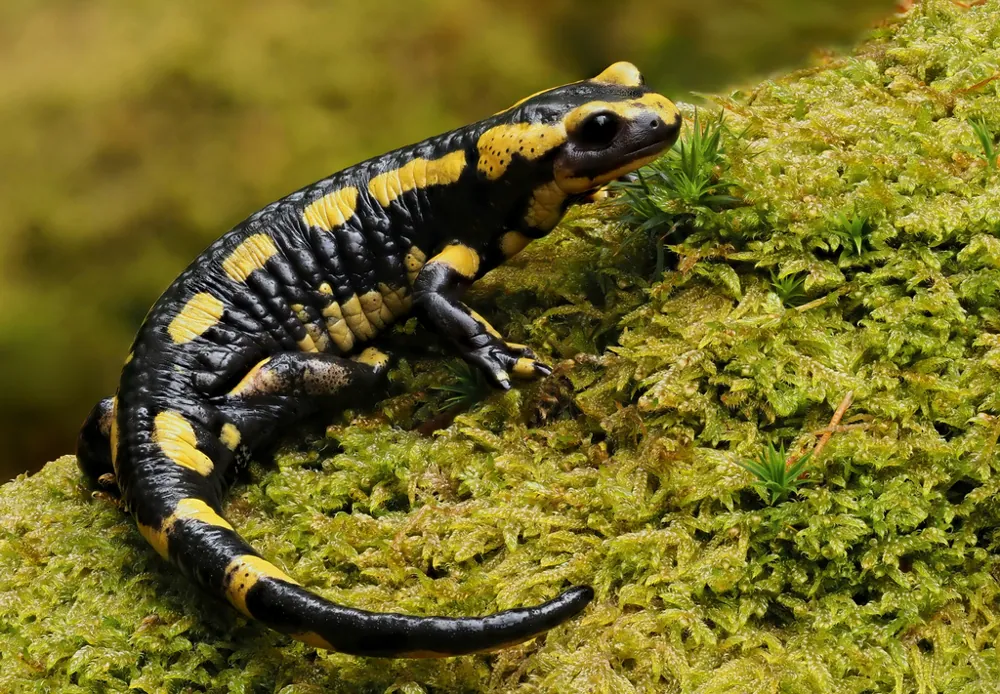
The fire salamander is a black amphibian with bright yellow, and sometimes red or orange, markings. It lives in forests across most of southern and central Europe. Its bright colours warn predators that its skin is poisonous.1
 Ho e tseba jwang
- Black with yellow spots or stripes; the amount of yellow varies, and some are almost completely black1
- Shades of red or orange may appear, replacing or mixing with the yellow, depending on the subspecies1
- Grows to 15 to 25 cm long, making it one of Europe's largest salamanders1
- Males and females look very similar, except in the breeding season, when the male has a swollen gland near his vent1
Matla a chefo
Letlalo la yona le a chefa. Ho kotsi ho e ama, ho e nyeka kapa ho e ja.
Chefo ya yona (e chefang ha o e ama kapa o e ja) e etsang?
The fire salamander is poisonous rather than venomous, so it does not inject venom with a bite. Its skin secretions contain alkaloid toxins, mainly samandarin, which cause strong muscle convulsions and high blood pressure, combined with fast breathing, in all vertebrates. Another alkaloid, samandarone, has also been found in its skin secretions. The poison comes from glands concentrated around the head and along the back.1
E kotsi hakae ho batho?
Kotsi ho batho: E bohlokoE ka utlwisa bohloko haholo, empa hoo e batlang e le kamehla ha e kotsi haholo.Some compounds in its skin secretions are potentially dangerous to human life. Touching the animal or handling its skin can expose people to the poison.1
E etsang ha e tshohile?
Its bright yellow, red or orange colours warn predators that it is poisonous, and it releases toxins from its skin glands.1
 Haeba motho a e amme kapa a e jele
- Haeba motho a amme e nngwe: hlatswa matsoho hantle mme o se ke wa ama mahlo kapa molomo. Haeba ngwana kapa phoofolo ya lapeng e e nyeditse kapa e e jele: letsetsa setsi sa chefo (poison centre) kapa nomoro ya tshohanyetso.
Kamehla letsetsa nomoro ya tshohanyetso pele (112, 000, 911). Ena ke tataiso e akaretsang ya thuso ya pele, hase keletso ya bongaka. Metheo ya thuso ya pele
 Dula o bolokehile
- O se ke wa ama, wa tshwara kapa wa tena phoofolo ya naheng, leha e le e nyenyane, le leha e shebahala e robetse kapa e shwele.
- E fe sebaka. Ha o kopana le yona, dula o kgutsitse, kgutlela morao butle mme o e tlohele e tsamaye ka tsela ya yona.
- Haeba o e amme kapa o e jele: o se ke wa hohla mahlo kapa molomo, hlatswa matsoho mme o fumane thuso ya bongaka.
Ha e o batle. Chefo ya yona e teng feela hore ho se be le letho le e jang. Ho eketsehileng ka ho dula o bolokehile
Hokae lefatsheng?
E kgolo hakae?
E telele hakae?
E boima hakae?

 e telele jwaloka diboloko tsa ho bapala tse 8 moleng
Fire salamander e kgolo hakae ha e bapiswa le WENA?
Ke dipalo feela ka hara sebatli sa hao. Ha ho letho le bolokwang kapa le romelwang kae kapa kae.
E potlaka hakae?


Dintlha
One fire salamander lived for more than 50 years in Museum Koenig, a natural history museum in Germany.1
Larvae do not make the poison. It develops as the salamander matures, in the ovaries, liver and testes.1
Its skin poison may also help protect it against bacterial and fungal infections of the skin.1
Its bright colours are a warning signal. Scientists call this aposematism, meaning the animal advertises that it is poisonous.1
Some subspecies give birth to live young, while others release larvae into water. Only two subspecies, fastuosa and bernadezi, give birth to fully formed young.1
In captivity, females can store sperm for a long time and use it to produce another clutch of eggs. This has not been seen in the wild.1
Bakeng sa ditsebi tsa chefo
- Lebitso la saense
- Salamandra salamandra
- Sehlopha
- Dihoho tse chefang, mampotsana le di-newt
- Lelapa
- Salamandridae2
- Tatelano
- Caudata
- Dikontinente
- Yuropa
- Masea
- Eggs develop inside the female, and she puts the larvae into water as they hatch. In some subspecies, the young develop inside the female until she gives birth to fully formed young.1
- Nako ya bophelo
- e ka bang dilemo tse 501
- Boemo ba yona naheng
- Vulnerable (IUCN Red List, 2023)1
- Kotsi ho batho
- 2 / 5: E bohloko3
Moo dintlha di tswang teng
- Fire salamander (Wikipedia (CC BY-SA 4.0))
- Salamandra salamandra (iNaturalist): mabitso le tlhophiso.
- Venom Wiki: boemo ba kotsi, boholo bo tlwaelehileng le kakanyo ya lebelo ke tsa rona. Bona kamoo re di balang ka teng: Kamoo re lekanyang kotsi ka teng.
Taba e nngwe le e nngwe leqepheng lena e na le nomoro e bontshang mohlodi wa yona. Haeba re entse phoso, re kopa tshwarelo, re barati ba diphoofolo, hase makasine wa saense. Re bolelle ho [email protected] mme re tla e lokisa.
 Phepheng e lapile! Venom Wiki ke projeke ya motho a le mong: ke mahala, ha e na dipapatso ebile ha e na di-tracker. Thuso e nyenyane ya tjhelete e e boloka e ntse e le inthaneteng.Fepa phepheng
Tse ding tsa sehlopha se le seng: Dihoho tse chefang, mampotsana le di-newt
 Common toadDihoho tse chefang, mampotsana le di-newtE utlwisa bohloko feelaO se ke wa ama
 European fire-bellied toadDihoho tse chefang, mampotsana le di-newtHa e na kotsi
 Iberian ribbed newtDihoho tse chefang, mampotsana le di-newtHa e na kotsi
 Natterjack toadDihoho tse chefang, mampotsana le di-newtHa e na kotsi
 Alpine salamanderDihoho tse chefang, mampotsana le di-newtHa e na kotsi
 European green toadDihoho tse chefang, mampotsana le di-newtHa e na kotsi
E boetse e phela: Yuropa
 Common European adderDi-viper le di-adderE hloka ngaka
 Spanish flyDiphoofolo tse ding tse chefangE hloka ngakaO se ke wa ama
 Common waspDinotshi, di-wasp le di-hornetE utlwisa bohloko feela
 European hornetDinotshi, di-wasp le di-hornetE utlwisa bohloko feela
 Western honey beeDinotshi, di-wasp le di-hornetE utlwisa bohloko feela
 Blunt-nosed viperDi-viper le di-adderE ka bolaya