
 Afrika
 Asia
Asia Yuropa
 Amerika Borwa
 Australia le Oceania
 Antarctica
 Lewatle la Pacific
 Lewatle la Atlantic
 Lewatle la India
 Lewatle la Arctic
 Lewatle la Mediterranean
 Lewatle le Lefubedu
 Lewatle la Caribbean
 Lewatle la Coral
 Lewatle la China Borwa
 Lewatle la Philippine
 Lewatle la Andaman
 Lewatle la Leboya
 Lewatle la Timor le Arafura
 Kgwohlo ya Bengal
 Kgwohlo ya California
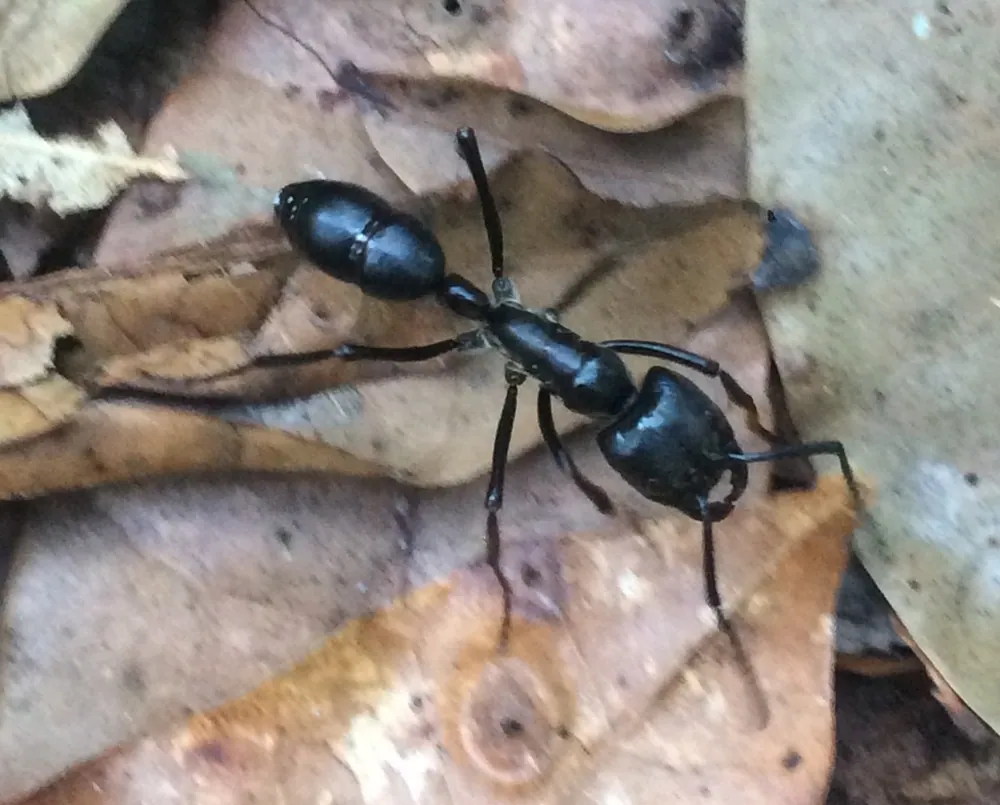
Dinosaur ant of Brazil
 Ho hlaba
The Dinosaur ant is a large ant from northeastern Brazil. It has a venomous sting that it uses to subdue big live prey and to defend its nest. Scientists are studying its venom because it may be useful for medicines.1

 Ho e tseba jwang
- Workers have a fine, textured surface that is dull rather than shiny.1
- Workers are covered in long, hair-like bristles.1
- Males are light brown and have long, fine hairs on the second segment of their antennae.1
- Colonies are large, with an average of 80 workers and a range of 26 to 238.1
Hangata e ferekanngwa le: It is most often confused with Dinoponera mutica. Dinoponera quadriceps has a dull, finely textured surface, no striped throat and a petiole (the narrow waist segment) that bulges at its upper front edge. Dinoponera mutica has a rougher surface, a striped throat and a petiole with even, non-bulging corners.1
Matla a chefo
Chefo e tswa ka lemao le hlabang.
Chefo ya yona (eo e e kenyang ka ho loma kapa ho hlaba) e etsang?
Its sting delivers venom that causes severe pain. The pain can last up to 48 hours. The venom contains many different compounds that can have wide effects on the body.1
E kotsi hakae ho batho?
Kotsi ho batho: E bohlokoE ka utlwisa bohloko haholo, empa hoo e batlang e le kamehla ha e kotsi haholo.The sting causes severe pain lasting up to 48 hours.1
E etsang ha e tshohile?
Workers use their sting to defend the nest.1
 Haeba e hlaba
- Hlatswa moo e hlabileng teng mme o pholise.
- Haeba motho a hema ka thata, sefahleho kapa qoqotho di ruruha, kapa a ikutlwa a tla idibala, ke tshohanyetso ya aletjhi (allergy): letsetsa nomoro ya tshohanyetso.
Kamehla letsetsa nomoro ya tshohanyetso pele (112, 000, 911). Ena ke tataiso e akaretsang ya thuso ya pele, hase keletso ya bongaka. Metheo ya thuso ya pele
 Dula o bolokehile
- O se ke wa ama, wa tshwara kapa wa tena phoofolo ya naheng, leha e le e nyenyane, le leha e shebahala e robetse kapa e shwele.
- E fe sebaka. Ha o kopana le yona, dula o kgutsitse, kgutlela morao butle mme o e tlohele e tsamaye ka tsela ya yona.
- Haeba e nngwe e o hlaba: dula o kgutsitse, o se ke wa sisinyeha, letsetsa nomoro ya tshohanyetso (112, 000, 911) kapa o ye sepetlele kapele. Hopola hore e ne e shebahala jwang, foto e a thusa.
Ha e o batle. E sebedisa chefo ya yona ho tshwara dijo kapa ho itshireletsa, mme e kgetha ho ipata. Ho eketsehileng ka ho dula o bolokehile
Hokae lefatsheng?
E kgolo hakae?
E telele hakae?
 e telele jwaloka klipi ya pampiri
Dinosaur ant of Brazil e kgolo hakae ha e bapiswa le WENA?
Ke dipalo feela ka hara sebatli sa hao. Ha ho letho le bolokwang kapa le romelwang kae kapa kae.
E potlaka hakae?


Dintlha
Moo dintlha di tswang teng
- Dinoponera quadriceps (Wikipedia (CC BY-SA 4.0))
- Dinoponera quadriceps (iNaturalist): mabitso le tlhophiso.
- Venom Wiki: boemo ba kotsi, boholo bo tlwaelehileng le kakanyo ya lebelo ke tsa rona. Bona kamoo re di balang ka teng: Kamoo re lekanyang kotsi ka teng.
Taba e nngwe le e nngwe leqepheng lena e na le nomoro e bontshang mohlodi wa yona. Haeba re entse phoso, re kopa tshwarelo, re barati ba diphoofolo, hase makasine wa saense. Re bolelle ho [email protected] mme re tla e lokisa.
 Phepheng e lapile! Venom Wiki ke projeke ya motho a le mong: ke mahala, ha e na dipapatso ebile ha e na di-tracker. Thuso e nyenyane ya tjhelete e e boloka e ntse e le inthaneteng.Fepa phepheng
 Bullet ant
 Red imported fire ant
 Army ant
 Giant Amazonian ant
 Trap-jaw ant
 Black imported fire ant
 Golden poison frog
 Terciopelo
 Brazilian wandering spider
 Eyelash viper
 Golden lancehead
 South American bushmaster