
 Afrika
 Asia
Asia Yuropa
 Amerika Borwa
 Australia le Oceania
 Antarctica
 Lewatle la Pacific
 Lewatle la Atlantic
 Lewatle la India
 Lewatle la Arctic
 Lewatle la Mediterranean
 Lewatle le Lefubedu
 Lewatle la Caribbean
 Lewatle la Coral
 Lewatle la China Borwa
 Lewatle la Philippine
 Lewatle la Andaman
 Lewatle la Leboya
 Lewatle la Timor le Arafura
 Kgwohlo ya Bengal
 Kgwohlo ya California
Eastern yellowjacket
 Ho hlaba
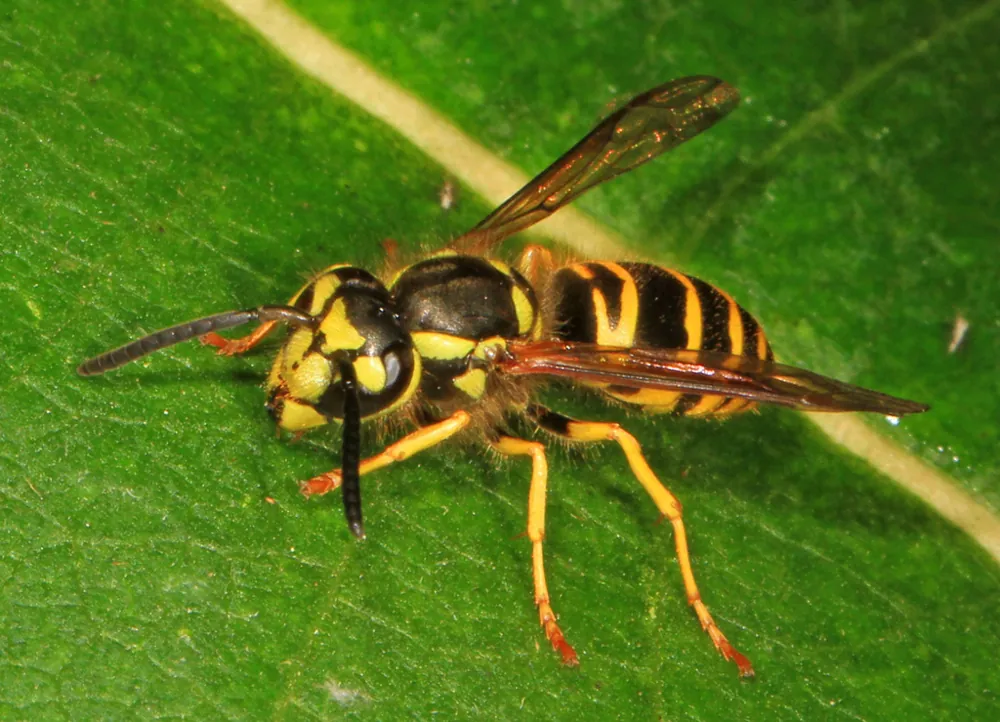
The eastern yellowjacket is a black and yellow wasp that lives in eastern North America. It builds paper nests, many of them underground, and lives in large family groups called colonies. People often meet it around recreational areas and buildings, and it can give a painful sting if its nest is threatened.1
 Ho e tseba jwang
- Black and yellow lines on the head, thorax and abdomen1
- Length of about 12.7 to 15.9 mm1
- Spots on the head, which give the species its scientific name1
- Queens have one flared black line nearest the thorax, followed by thinner black lines, with two black dots between each line1
Hangata e ferekanngwa le: It can be told apart from other wasp species by its smaller size and its abdominal pattern. Other yellowjacket species are also black and yellow, and in most areas where it lives, this is the most common yellowjacket species.1
Matla a chefo
Chefo e tswa ka lemao le hlabang.
Chefo ya yona (eo e e kenyang ka ho loma kapa ho hlaba) e etsang?
Its sting is painful. Wasps, bees, ants and sawflies (the order Hymenoptera) are the leading cause of anaphylaxis in humans, a severe allergic reaction. These reactions are usually triggered by proteins in the venom. Peptides called vespulakinins were first found in this species and are insecticidal, meaning they kill insects.1
E kotsi hakae ho batho?
Kotsi ho batho: E bohlokoE ka utlwisa bohloko haholo, empa hoo e batlang e le kamehla ha e kotsi haholo.It is known to inflict painful stings and defends its nest aggressively. Its nests are often treated as a pest because they are found so often in recreational and residential areas.1
E etsang ha e tshohile?
When threatened, workers release an alarm pheromone that calls others to attack. Wasps near the nest entrance circle in a zigzag pattern and fly straight at the target.1
 Haeba e hlaba
- Kgwaratla lemao la notshi o le ntshe mme o pholise sebaka seo.
- Haeba motho a hema ka thata, sefahleho kapa qoqotho di ruruha, kapa a ikutlwa a tla idibala, ke tshohanyetso ya aletjhi (allergy): letsetsa nomoro ya tshohanyetso mme o sebedise pene ya hae ya adrenaline (adrenaline auto-injector) haeba a na le yona.
Kamehla letsetsa nomoro ya tshohanyetso pele (112, 000, 911). Ena ke tataiso e akaretsang ya thuso ya pele, hase keletso ya bongaka. Metheo ya thuso ya pele
 Dula o bolokehile
- O se ke wa ama, wa tshwara kapa wa tena phoofolo ya naheng, leha e le e nyenyane, le leha e shebahala e robetse kapa e shwele.
- E fe sebaka. Ha o kopana le yona, dula o kgutsitse, kgutlela morao butle mme o e tlohele e tsamaye ka tsela ya yona.
- Haeba e nngwe e o hlaba: dula o kgutsitse, o se ke wa sisinyeha, letsetsa nomoro ya tshohanyetso (112, 000, 911) kapa o ye sepetlele kapele. Hopola hore e ne e shebahala jwang, foto e a thusa.
Ha e o batle. E sebedisa chefo ya yona ho tshwara dijo kapa ho itshireletsa, mme e kgetha ho ipata. Ho eketsehileng ka ho dula o bolokehile
Hokae lefatsheng?
E kgolo hakae?
E telele hakae?
E boima hakae?
 e kgutshwane ho feta monwana wa hao o monyenyane
 e bobebe hoo o neng o ke ke wa e utlwa letsohong la hao
 e ka fofa ho tshela lebala lohle la bolo ya maoto ka metsotswana e 16
Eastern yellowjacket e kgolo hakae ha e bapiswa le WENA?
Ke dipalo feela ka hara sebatli sa hao. Ha ho letho le bolokwang kapa le romelwang kae kapa kae.
E potlaka hakae?


Dintlha
A large nest can have 10,000 to 15,000 cells, and about a third of them are queen cells.1
The nest envelope is made from chewed, decaying wood mixed with saliva, which makes it fragile.1
The species is a host for a social parasite, Vespula squamosa, which can take over its nests.1
Males gather in groups around prominent trees and bushes, where they patrol and wait for queens.1
Queens can mate with several males, and both queens and males can mate more than once.1
Bakeng sa ditsebi tsa chefo
- Lebitso la saense
- Vespula maculifrons
- Sehlopha
- Dinotshi, di-wasp le di-hornet
- Lelapa
- Vespidae2
- Tatelano
- Hymenoptera
- Dikontinente
- Amerika Leboya
- Masea
- A queen founds a new colony in spring by laying eggs in the first cells. The eggs hatch into workers, which then build and enlarge the nest.1
- Kotsi ho batho
- 2 / 5: E bohloko3
Moo dintlha di tswang teng
- Eastern yellowjacket (Wikipedia (CC BY-SA 4.0))
- Vespula maculifrons (iNaturalist): mabitso le tlhophiso.
- Venom Wiki: boemo ba kotsi, boholo bo tlwaelehileng le kakanyo ya lebelo ke tsa rona. Bona kamoo re di balang ka teng: Kamoo re lekanyang kotsi ka teng.
Taba e nngwe le e nngwe leqepheng lena e na le nomoro e bontshang mohlodi wa yona. Haeba re entse phoso, re kopa tshwarelo, re barati ba diphoofolo, hase makasine wa saense. Re bolelle ho [email protected] mme re tla e lokisa.
 Phepheng e lapile! Venom Wiki ke projeke ya motho a le mong: ke mahala, ha e na dipapatso ebile ha e na di-tracker. Thuso e nyenyane ya tjhelete e e boloka e ntse e le inthaneteng.Fepa phepheng
Tse ding tsa sehlopha se le seng: Dinotshi, di-wasp le di-hornet
 Tarantula hawkDinotshi, di-wasp le di-hornetE utlwisa bohloko feela
 Executioner waspDinotshi, di-wasp le di-hornetE hloka ngaka
 Warrior waspDinotshi, di-wasp le di-hornetE hloka ngaka
 Bald-faced hornetDinotshi, di-wasp le di-hornetE utlwisa bohloko feela
 Cow killer velvet antDinotshi, di-wasp le di-hornetE utlwisa bohloko feela
 Eastern cicada killerDinotshi, di-wasp le di-hornetHa e na kotsi
 Terciopelo
 Eastern coral snake
 Eastern diamondback rattlesnake
 Eyelash viper
 Timber rattlesnake
 Western diamondback rattlesnake